




EDTA is hexadentate ligand and is used to remove hardness in water.
A.True
B.False
Answer
 Verified
623.1k+ views
Hint: EDTA is Hexadentate ligand. It forms by the complex with central metal and ligands. Hexadentate ligand combines with the central atom with six bonds. It forms very stable complexes with most of the transition metals. EDTA forms by the nitrogen and oxygen atoms, where oxygen contains negatively charged..
Complete step by step answer:
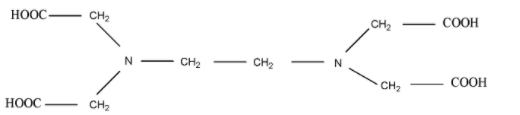
EDTA is a hexadentate ligand which is able to donate electrons from six sites. It is formed by two nitrogens and four oxygen. Here ligand has a number of lone pair electrons to donate the central atom. Many ligands are capable of binding metal by different sites because ligands have lone pair electrons on more than one atom.
The full form of EDTA is ethylene diamine tetra acetic acid. As we know the hardness of water is due to the presence of $M{g^{ + 2}}$ and $C{a^{ + 2}}$ in it. They are in sulphate or carbonate forms in water. EDTA is able to form stable complexes with these ions and estimate by simple titration.
The structure of EDTA is given below, which showed that EDTA is hexadentate ligand,
EDTA is also used to remove hardness of water because it forms stable complexes with ions which present in water.
Hence, This statement is true.
Therefore, option (A) is the correct answer.
Note:
EDTA is polyprotic acid which contains four carboxylic groups and two amines with lone pair electrons. It is able to form stable complexes with water to remove its hardness because $M{g^{ + 2}}$ and $C{a^{ + 2}}$ react with this ligand to form complexes.
Complete step by step answer:
EDTA is a hexadentate ligand which is able to donate electrons from six sites. It is formed by two nitrogens and four oxygen. Here ligand has a number of lone pair electrons to donate the central atom. Many ligands are capable of binding metal by different sites because ligands have lone pair electrons on more than one atom.
The full form of EDTA is ethylene diamine tetra acetic acid. As we know the hardness of water is due to the presence of $M{g^{ + 2}}$ and $C{a^{ + 2}}$ in it. They are in sulphate or carbonate forms in water. EDTA is able to form stable complexes with these ions and estimate by simple titration.
The structure of EDTA is given below, which showed that EDTA is hexadentate ligand,
EDTA is also used to remove hardness of water because it forms stable complexes with ions which present in water.
Hence, This statement is true.
Therefore, option (A) is the correct answer.
Note:
EDTA is polyprotic acid which contains four carboxylic groups and two amines with lone pair electrons. It is able to form stable complexes with water to remove its hardness because $M{g^{ + 2}}$ and $C{a^{ + 2}}$ react with this ligand to form complexes.
Recently Updated Pages
Master Class 12 Business Studies: Engaging Questions & Answers for Success

Master Class 12 Chemistry: Engaging Questions & Answers for Success
Master Class 12 Biology: Engaging Questions & Answers for Success
Class 12 Question and Answer - Your Ultimate Solutions Guide
Master Class 11 English: Engaging Questions & Answers for Success
Master Class 11 Social Science: Engaging Questions & Answers for Success
Trending doubts
Which are the Top 10 Largest Countries of the World?
Draw a labelled sketch of the human eye class 12 physics CBSE
Differentiate between homogeneous and heterogeneous class 12 chemistry CBSE
Why is the cell called the structural and functional class 12 biology CBSE
When was the first election held in India a 194748 class 12 sst CBSE
Draw ray diagrams each showing i myopic eye and ii class 12 physics CBSE