




Each wheel of a car is of diameter 40cm. Find the time taken by the wheel of the car to rotate by 200 radians if the car moves at the speed of 70km/hr.
[a] 17s
[b] 15.26s
[c] 2.06s
[d] 3.09s
Answer
 Verified
585.3k+ views
Hint: Calculate the total number of revolutions equivalent to $200$ radians (say a). Calculate the distance covered in one revolution of the wheel. Hence calculate the total distance equivalent to a revolution. This will give the total distance covered. Convert the speed of the car in metre/sec. Using the fact that time (T) is given by $T=\dfrac{S}{v}$, where S is the distance covered and v is the speed. Hence determine the total time taken. Alternatively, calculate the angular velocity of the wheel and hence the time taken to cover $200$ radians
Complete step-by-step answer:
The wheel covers a distance equal to the length of the circumference of the wheel in one revolution.
Given the diameter of the wheel = 40 cm =0.4 m
Hence the radius of the wheel = 0.2m.
We know that the circumference of the circle of radius r is given by $c=2\pi r$
Hence distance covered in one revolution $=2\pi \left( 0.2 \right)=0.4\pi $.
Also, we have $2\pi $ radians is equal to 1 complete revolution.
Hence, we have
$1$ radian is equal to $\dfrac{1}{2\pi }$ revolutions
Hence, we have $200$ radians is equal to $\dfrac{200}{2\pi }=\dfrac{100}{\pi }$ revolutions.
We have distance covered in 1 revolutions $=0.4\pi $
Hence the distance covered in $\dfrac{100}{\pi }$ revolutions $=0.4\pi \times \dfrac{100}{\pi }=40m$
(Conversion shortcut: When converting Km/hr to m/s multiply by $\dfrac{5}{18}$)
Here $v=70km/hr=\dfrac{5}{18}\times 70m{{s}^{-1}}=\dfrac{175}{9}m{{s}^{-1}}$
We know that time (T) is given by $T=\dfrac{S}{v}$, where S is the distance covered and v is the speed.
Hence, we have
$T=\dfrac{40}{175}\times 9=2.06s$
Hence the total time taken to rotate 200 radians is 2.06s.
Hence option [c] is correct.
Note: The speed at the circumference of the wheel = 70km/h $=\dfrac{175}{9}\text{m/sec}$
We know that angular velocity $=\dfrac{\text{Velocity at point P}}{\text{Distance of point P from centre}}$, where P is any point on the wheel. Taking P at the circumference of the wheel as shown, we have
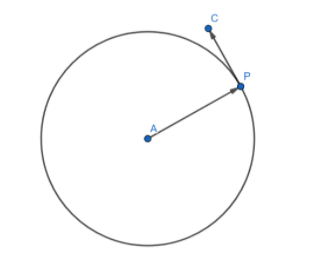
Angular velocity $=\dfrac{\dfrac{175}{9}}{0.2}=\dfrac{875}{9}$ rad/sec
We know that $\theta =\omega t$, where $\theta $ is the amount of angular rotation, $\omega $ is the angular velocity and $t$ is the time taken.
Hence, we have
$t=\dfrac{\theta }{\omega }=\dfrac{200}{\dfrac{875}{9}}=2.06$s.
Hence the total time taken is 2.06s, which is the same as obtained above.
Hence option [c] is correct.
Complete step-by-step answer:
The wheel covers a distance equal to the length of the circumference of the wheel in one revolution.
Given the diameter of the wheel = 40 cm =0.4 m
Hence the radius of the wheel = 0.2m.
We know that the circumference of the circle of radius r is given by $c=2\pi r$
Hence distance covered in one revolution $=2\pi \left( 0.2 \right)=0.4\pi $.
Also, we have $2\pi $ radians is equal to 1 complete revolution.
Hence, we have
$1$ radian is equal to $\dfrac{1}{2\pi }$ revolutions
Hence, we have $200$ radians is equal to $\dfrac{200}{2\pi }=\dfrac{100}{\pi }$ revolutions.
We have distance covered in 1 revolutions $=0.4\pi $
Hence the distance covered in $\dfrac{100}{\pi }$ revolutions $=0.4\pi \times \dfrac{100}{\pi }=40m$
(Conversion shortcut: When converting Km/hr to m/s multiply by $\dfrac{5}{18}$)
Here $v=70km/hr=\dfrac{5}{18}\times 70m{{s}^{-1}}=\dfrac{175}{9}m{{s}^{-1}}$
We know that time (T) is given by $T=\dfrac{S}{v}$, where S is the distance covered and v is the speed.
Hence, we have
$T=\dfrac{40}{175}\times 9=2.06s$
Hence the total time taken to rotate 200 radians is 2.06s.
Hence option [c] is correct.
Note: The speed at the circumference of the wheel = 70km/h $=\dfrac{175}{9}\text{m/sec}$
We know that angular velocity $=\dfrac{\text{Velocity at point P}}{\text{Distance of point P from centre}}$, where P is any point on the wheel. Taking P at the circumference of the wheel as shown, we have
Angular velocity $=\dfrac{\dfrac{175}{9}}{0.2}=\dfrac{875}{9}$ rad/sec
We know that $\theta =\omega t$, where $\theta $ is the amount of angular rotation, $\omega $ is the angular velocity and $t$ is the time taken.
Hence, we have
$t=\dfrac{\theta }{\omega }=\dfrac{200}{\dfrac{875}{9}}=2.06$s.
Hence the total time taken is 2.06s, which is the same as obtained above.
Hence option [c] is correct.
Recently Updated Pages
Master Class 10 Computer Science: Engaging Questions & Answers for Success

Master Class 10 General Knowledge: Engaging Questions & Answers for Success
Master Class 10 English: Engaging Questions & Answers for Success
Master Class 10 Social Science: Engaging Questions & Answers for Success
Master Class 10 Maths: Engaging Questions & Answers for Success
Master Class 10 Science: Engaging Questions & Answers for Success
Trending doubts
What is the median of the first 10 natural numbers class 10 maths CBSE
Which women's tennis player has 24 Grand Slam singles titles?
Who is the Brand Ambassador of Incredible India?
Why is there a time difference of about 5 hours between class 10 social science CBSE
Write a letter to the principal requesting him to grant class 10 english CBSE
A moving boat is observed from the top of a 150 m high class 10 maths CBSE