




Each side of a rhombus is \[\text{14}\] in. long. Two of the sides form a \[\text{6}0{}^\circ \] degree angle, how do you find the area of the rhombus?
Answer
 Verified
546.6k+ views
Hint: To get area of a rhombus, we will use the following formula:
\[\Rightarrow \text{Area of Rhombus }\left( \text{A} \right)\text{ }={{s}^{2}}\sin \alpha \]
Where, $s$ is a side of rhombus and $\alpha $ is measure of any interior angle. Since, each side of the rhombus is equal, $s=\text{14}$ and the given angle will be $\alpha =\text{6}0{}^\circ $ . After applying this value in the above formula, we will get the area of rhombus.
Complete step-by-step answer:
Given that side of rhombus $=14$ in. and an angle formed by two sides $=60{}^\circ $
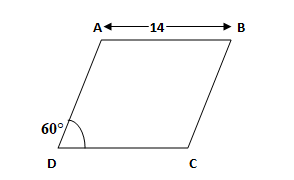
Since, each side of rhombus is equal to each other, so:
$\Rightarrow AB=BC=CD=DA=14=s$
An angle formed by two consecutive sides of rhombus $=60{}^\circ =\alpha $
Now, we have the formula for finding the area of the given rhombus as:
\[\Rightarrow \text{Area of Rhombus }\left( \text{A} \right)\text{ }={{s}^{2}}\sin \alpha \]
Since, we already have the value of $s$ and $\alpha $ , we will use this values in the above equation to get the area of rhombus as:
\[\text{Area of Rhombus }\left( \text{A} \right)\text{ }={{\left( 14 \right)}^{2}}\sin \left( 60{}^\circ \right)\]
Now, we will expand the equation as:
\[\text{Area of Rhombus }\left( \text{A} \right)\text{ }=14\times 14\times \sin \left( 60{}^\circ \right)\]
Since, we know that the value of \[\sin \left( 60{}^\circ \right)\] is $\dfrac{\sqrt{3}}{2}$ . We will put this value in the above equation, then the equation will be as;
\[\text{Area of Rhombus }\left( \text{A} \right)\text{ }=14\times 14\times \dfrac{\sqrt{3}}{2}\]
After doing necessary calculation like multiplication of $14$ and $14$ is $196$ , the above equation will be as:
\[\text{Area of Rhombus }\left( \text{A} \right)\text{ }=196\times \dfrac{\sqrt{3}}{2}\]
Now, the multiplication makes the above equation as:
\[\text{Area of Rhombus }\left( \text{A} \right)\text{ }=98\sqrt{3}\]
Hence, applying the required calculation in the formula, we had the area of rhombus is \[98\sqrt{3}\text{ in}{{\text{.}}^{2}}\] .
Note: Here, we will verify that if our solution is correct or not in the following way by using formula of area of rhombus as:
\[\Rightarrow \text{Area of Rhombus }\left( \text{A} \right)\text{ }={{s}^{2}}\sin \alpha \]
Here, we will try to find the side of rhombus by putting the value of area of Rhombus and angle formed by two sides as:
\[\Rightarrow \text{98}\sqrt{3}\text{ }={{s}^{2}}\sin 60{}^\circ \]
Since, we have the value $\dfrac{\sqrt{3}}{2}$ for\[\sin 60{}^\circ \]. We will use it in the above equation as:
\[\Rightarrow \text{98}\sqrt{3}\text{ }={{s}^{2}}\times \dfrac{\sqrt{3}}{2}\]
Here, we will divide by $\sqrt{3}$ in the above equation:
\[\Rightarrow \dfrac{\text{98}\sqrt{3}}{\sqrt{3}}\text{ }=\dfrac{{{s}^{2}}\times \dfrac{\sqrt{3}}{2}}{\sqrt{3}}\]
Now, the above equation will be as:
\[\Rightarrow \text{98 }={{s}^{2}}\times \dfrac{1}{2}\]
After doing required calculation, the above equation will be as:
\[\Rightarrow {{s}^{2}}=\text{98 }\times 2\]
\[\Rightarrow {{s}^{2}}=196\]
Taking square root both sides in the above equation, we will have:
\[\Rightarrow s=14\] in.
Since, we got the given side of the rhombus by putting the area of rhombus. Hence, the calculation is correct.
\[\Rightarrow \text{Area of Rhombus }\left( \text{A} \right)\text{ }={{s}^{2}}\sin \alpha \]
Where, $s$ is a side of rhombus and $\alpha $ is measure of any interior angle. Since, each side of the rhombus is equal, $s=\text{14}$ and the given angle will be $\alpha =\text{6}0{}^\circ $ . After applying this value in the above formula, we will get the area of rhombus.
Complete step-by-step answer:
Given that side of rhombus $=14$ in. and an angle formed by two sides $=60{}^\circ $
Since, each side of rhombus is equal to each other, so:
$\Rightarrow AB=BC=CD=DA=14=s$
An angle formed by two consecutive sides of rhombus $=60{}^\circ =\alpha $
Now, we have the formula for finding the area of the given rhombus as:
\[\Rightarrow \text{Area of Rhombus }\left( \text{A} \right)\text{ }={{s}^{2}}\sin \alpha \]
Since, we already have the value of $s$ and $\alpha $ , we will use this values in the above equation to get the area of rhombus as:
\[\text{Area of Rhombus }\left( \text{A} \right)\text{ }={{\left( 14 \right)}^{2}}\sin \left( 60{}^\circ \right)\]
Now, we will expand the equation as:
\[\text{Area of Rhombus }\left( \text{A} \right)\text{ }=14\times 14\times \sin \left( 60{}^\circ \right)\]
Since, we know that the value of \[\sin \left( 60{}^\circ \right)\] is $\dfrac{\sqrt{3}}{2}$ . We will put this value in the above equation, then the equation will be as;
\[\text{Area of Rhombus }\left( \text{A} \right)\text{ }=14\times 14\times \dfrac{\sqrt{3}}{2}\]
After doing necessary calculation like multiplication of $14$ and $14$ is $196$ , the above equation will be as:
\[\text{Area of Rhombus }\left( \text{A} \right)\text{ }=196\times \dfrac{\sqrt{3}}{2}\]
Now, the multiplication makes the above equation as:
\[\text{Area of Rhombus }\left( \text{A} \right)\text{ }=98\sqrt{3}\]
Hence, applying the required calculation in the formula, we had the area of rhombus is \[98\sqrt{3}\text{ in}{{\text{.}}^{2}}\] .
Note: Here, we will verify that if our solution is correct or not in the following way by using formula of area of rhombus as:
\[\Rightarrow \text{Area of Rhombus }\left( \text{A} \right)\text{ }={{s}^{2}}\sin \alpha \]
Here, we will try to find the side of rhombus by putting the value of area of Rhombus and angle formed by two sides as:
\[\Rightarrow \text{98}\sqrt{3}\text{ }={{s}^{2}}\sin 60{}^\circ \]
Since, we have the value $\dfrac{\sqrt{3}}{2}$ for\[\sin 60{}^\circ \]. We will use it in the above equation as:
\[\Rightarrow \text{98}\sqrt{3}\text{ }={{s}^{2}}\times \dfrac{\sqrt{3}}{2}\]
Here, we will divide by $\sqrt{3}$ in the above equation:
\[\Rightarrow \dfrac{\text{98}\sqrt{3}}{\sqrt{3}}\text{ }=\dfrac{{{s}^{2}}\times \dfrac{\sqrt{3}}{2}}{\sqrt{3}}\]
Now, the above equation will be as:
\[\Rightarrow \text{98 }={{s}^{2}}\times \dfrac{1}{2}\]
After doing required calculation, the above equation will be as:
\[\Rightarrow {{s}^{2}}=\text{98 }\times 2\]
\[\Rightarrow {{s}^{2}}=196\]
Taking square root both sides in the above equation, we will have:
\[\Rightarrow s=14\] in.
Since, we got the given side of the rhombus by putting the area of rhombus. Hence, the calculation is correct.
Recently Updated Pages
Master Class 11 English: Engaging Questions & Answers for Success

Master Class 11 Maths: Engaging Questions & Answers for Success
Master Class 11 Biology: Engaging Questions & Answers for Success
Master Class 11 Physics: Engaging Questions & Answers for Success
Master Class 11 Accountancy: Engaging Questions & Answers for Success
Class 11 Question and Answer - Your Ultimate Solutions Guide
Trending doubts
Why is there a time difference of about 5 hours between class 10 social science CBSE
What is the median of the first 10 natural numbers class 10 maths CBSE
The draft of the Preamble of the Indian Constitution class 10 social science CBSE
Who gave "Inqilab Zindabad" slogan?
Write a letter to the principal requesting him to grant class 10 english CBSE
Who was Subhash Chandra Bose Why was he called Net class 10 english CBSE