




Each beehive consists of thousands of hexagonal thin-walled fragile cells. Name the material which is used to make these cells and mention the significance of the hexagonal shape of the cell.
Answer
 Verified
522.9k+ views
Hint: A Beehive is a structure where several honey bees live and raise their young ones. It can be seen in the cavities of the trees, cracks, caves etc. The cells of the beehive are used to store food and also to house the egg, pupa and larva.
Complete answer:
The bees which make hives belong to the genus Apis. They feed on the nectar from the flowers. A beehive is the nest of the bee colony.
The beehive is made up of several units which are parallel to each other and have a single entrance. The volume of the bee nest can range from around 45- 100 litres. The hives contain hexagonal cells or units. This is made up of beeswax and is known as the honeycomb. This bee wax is secreted by the worker bees. The main function of the honeycomb is to store food and raise the young ones. The bees occupy the nest/hive for more than several years. The honey is stored in the upper part of the hive and under it there are pollen storage cells, worker- larva, egg, pupa cells and drone cells. The queen occupies the peanut-shaped cell which is present at the lower edge.
The figure below shows the hexagonal units of a beehive.
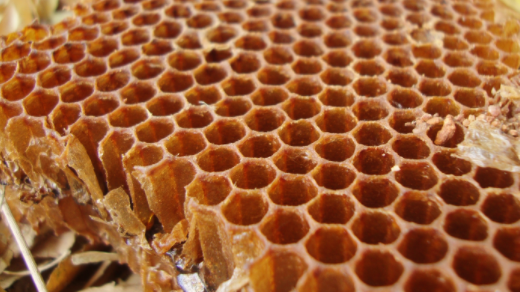
The shape of the units is hexagonal because the six-sided cells would fit perfectly without leaving any space in between. These units can perfectly store queen’s eggs and also store pollen and honey which is brought to the hive by the worker bees.
Note: The honey is the sugary food for the bee colony which is made from the nectar and pollen from the flowers. Honey is the source of energy for the bees so that they can reproduce and build their homes. The worker bees make wax for the colony by consuming honey.
Complete answer:
The bees which make hives belong to the genus Apis. They feed on the nectar from the flowers. A beehive is the nest of the bee colony.
The beehive is made up of several units which are parallel to each other and have a single entrance. The volume of the bee nest can range from around 45- 100 litres. The hives contain hexagonal cells or units. This is made up of beeswax and is known as the honeycomb. This bee wax is secreted by the worker bees. The main function of the honeycomb is to store food and raise the young ones. The bees occupy the nest/hive for more than several years. The honey is stored in the upper part of the hive and under it there are pollen storage cells, worker- larva, egg, pupa cells and drone cells. The queen occupies the peanut-shaped cell which is present at the lower edge.
The figure below shows the hexagonal units of a beehive.
The shape of the units is hexagonal because the six-sided cells would fit perfectly without leaving any space in between. These units can perfectly store queen’s eggs and also store pollen and honey which is brought to the hive by the worker bees.
Note: The honey is the sugary food for the bee colony which is made from the nectar and pollen from the flowers. Honey is the source of energy for the bees so that they can reproduce and build their homes. The worker bees make wax for the colony by consuming honey.
Recently Updated Pages
Master Class 11 Social Science: Engaging Questions & Answers for Success

Master Class 11 Physics: Engaging Questions & Answers for Success
Master Class 11 Maths: Engaging Questions & Answers for Success
Master Class 11 Economics: Engaging Questions & Answers for Success
Master Class 11 Computer Science: Engaging Questions & Answers for Success
Master Class 11 Chemistry: Engaging Questions & Answers for Success
Trending doubts
One Metric ton is equal to kg A 10000 B 1000 C 100 class 11 physics CBSE
There are 720 permutations of the digits 1 2 3 4 5 class 11 maths CBSE
1 Quintal is equal to a 110 kg b 10 kg c 100kg d 1000 class 11 physics CBSE
State and prove Bernoullis theorem class 11 physics CBSE
Difference Between Prokaryotic Cells and Eukaryotic Cells
Which among the following are examples of coming together class 11 social science CBSE