




Each angle of an equilateral triangle is\[60^\circ \]. If true then enter 1 else 0.
Answer
 Verified
621.9k+ views
Hint: The equality of angles in an equilateral triangle can be checked with the help of congruence of triangles .We can construct relevant constructions inside a triangle to get the proofs for our result. Through relevant constructions we can prove that angles opposite to equal sides of a triangle are also equal by using rules of congruence of triangles.
Complete step-by-step answer:
Step1 we prove that angles opposite to that of equal sides of a triangle are also equal.
Consider an isosceles triangle \[\Delta ABC\]in which sides\[AB = AC\]. Angles opposite to equal sides of the triangle are\[\angle C\,and\,\angle B\], so we need to prove that\[\angle C = \angle B\].
Draw a line segment bisecting angle A and intersecting the line segment BC on point D.
Now we have,
\[AB = AC\](By given)
\[\angle BAD = \angle CAD\](By construction)
\[AD = AD\](Common side)
So by SAS rule of congruence \[\Delta BAD \cong \Delta CAD\]
Therefore we have \[\angle B = \angle C\](By CPCT)
So we arrive at a result that angles opposite to the equal sides of a triangle are also equal, now we use this result in our main proof.
Step2. We will prove that all angles in an equilateral triangle are of\[60^\circ \].
Consider a triangle \[\Delta ABC\]which has all sides equal i.e. \[AB = BC = AC\]
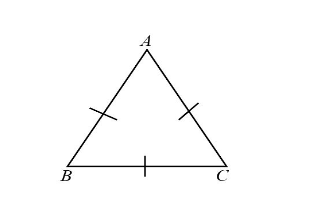
Now we have AB=AC then as we proved in step 1\[\angle B = \angle C\].
Similarly, AC=BC then\[\angle A = \angle B\].
Therefore, we have\[\angle A = \angle B = \angle C\]i.e. all the angles in an equilateral triangle are equal.
Also, we know that the sum of interior angles of a triangle is\[180^\circ \] i.e.
\[
\Rightarrow \angle A + \angle B + \angle C = 180^\circ \\
\Rightarrow \angle A + \angle A + \angle A = 180^\circ \\
\Rightarrow 3\angle A = 180^\circ \\
\Rightarrow \angle A = 60^\circ
\]
Therefore, each angle of an equilateral triangle is equal i.e.\[\angle A = \angle B = \angle C = 60^\circ \].
So, the given statement is true therefore we enter ‘1’.
Note: In these types of questions in which students have to prove results in case of triangles they can make a good use of construction of angle bisectors, perpendiculars, side bisectors etc. so as to apply different rules of congruence of triangles. There are 5 rules of congruence namely SSS( side, side, side) ,SAS(side ,angle, side), ASA(angle, side angle), AAS( angle, angle, side), HL(hypotenuse, leg).
\[
\Rightarrow \angle A + \angle B + \angle C = 180^\circ \\
\Rightarrow \angle A + \angle A + \angle A = 180^\circ \\
\Rightarrow 3\angle A = 180^\circ \\
\Rightarrow \angle A = 60^\circ
\]
Therefore, each angle of an equilateral triangle is equal i.e.\[\angle A = \angle B = \angle C = 60^\circ \].
So, the given statement is true therefore we enter ‘1’.
Note: In these types of questions in which students have to prove results in case of triangles they can make a good use of construction of angle bisectors, perpendiculars, side bisectors etc. so as to apply different rules of congruence of triangles. There are 5 rules of congruence namely SSS( side, side, side) ,SAS(side ,angle, side), ASA(angle, side angle), AAS( angle, angle, side), HL(hypotenuse, leg).
Complete step-by-step answer:
Step1 we prove that angles opposite to that of equal sides of a triangle are also equal.
Consider an isosceles triangle \[\Delta ABC\]in which sides\[AB = AC\]. Angles opposite to equal sides of the triangle are\[\angle C\,and\,\angle B\], so we need to prove that\[\angle C = \angle B\].
Draw a line segment bisecting angle A and intersecting the line segment BC on point D.
Now we have,
\[AB = AC\](By given)
\[\angle BAD = \angle CAD\](By construction)
\[AD = AD\](Common side)
So by SAS rule of congruence \[\Delta BAD \cong \Delta CAD\]
Therefore we have \[\angle B = \angle C\](By CPCT)
So we arrive at a result that angles opposite to the equal sides of a triangle are also equal, now we use this result in our main proof.
Step2. We will prove that all angles in an equilateral triangle are of\[60^\circ \].
Consider a triangle \[\Delta ABC\]which has all sides equal i.e. \[AB = BC = AC\]
Now we have AB=AC then as we proved in step 1\[\angle B = \angle C\].
Similarly, AC=BC then\[\angle A = \angle B\].
Therefore, we have\[\angle A = \angle B = \angle C\]i.e. all the angles in an equilateral triangle are equal.
Also, we know that the sum of interior angles of a triangle is\[180^\circ \] i.e.
\[
\Rightarrow \angle A + \angle B + \angle C = 180^\circ \\
\Rightarrow \angle A + \angle A + \angle A = 180^\circ \\
\Rightarrow 3\angle A = 180^\circ \\
\Rightarrow \angle A = 60^\circ
\]
Therefore, each angle of an equilateral triangle is equal i.e.\[\angle A = \angle B = \angle C = 60^\circ \].
So, the given statement is true therefore we enter ‘1’.
Note: In these types of questions in which students have to prove results in case of triangles they can make a good use of construction of angle bisectors, perpendiculars, side bisectors etc. so as to apply different rules of congruence of triangles. There are 5 rules of congruence namely SSS( side, side, side) ,SAS(side ,angle, side), ASA(angle, side angle), AAS( angle, angle, side), HL(hypotenuse, leg).
\[
\Rightarrow \angle A + \angle B + \angle C = 180^\circ \\
\Rightarrow \angle A + \angle A + \angle A = 180^\circ \\
\Rightarrow 3\angle A = 180^\circ \\
\Rightarrow \angle A = 60^\circ
\]
Therefore, each angle of an equilateral triangle is equal i.e.\[\angle A = \angle B = \angle C = 60^\circ \].
So, the given statement is true therefore we enter ‘1’.
Note: In these types of questions in which students have to prove results in case of triangles they can make a good use of construction of angle bisectors, perpendiculars, side bisectors etc. so as to apply different rules of congruence of triangles. There are 5 rules of congruence namely SSS( side, side, side) ,SAS(side ,angle, side), ASA(angle, side angle), AAS( angle, angle, side), HL(hypotenuse, leg).

Recently Updated Pages
Master Class 11 English: Engaging Questions & Answers for Success

Master Class 11 Social Science: Engaging Questions & Answers for Success
Master Class 11 Maths: Engaging Questions & Answers for Success
Master Class 11 Biology: Engaging Questions & Answers for Success
Master Class 11 Physics: Engaging Questions & Answers for Success
Master Class 11 Chemistry: Engaging Questions & Answers for Success
Trending doubts
What is BLO What is the full form of BLO class 8 social science CBSE
Citizens of India can vote at the age of A 18 years class 8 social science CBSE
Full form of STD, ISD and PCO
Advantages and disadvantages of science
What is the difference between rai and mustard see class 8 biology CBSE
What is the collective noun for soldiers class 8 english CBSE