




During what stages of plant development is the coleoptile present?
Answer
 Verified
519.6k+ views
Hint: Coleoptile is a pointed protective sheath, which covers the emerging shoot in monocots like grass. Few leaf primordia and shoot apex of embryo remain enclosed inside the coleoptile. It protects the first leaf and growing stem in seedlings and eventually permits the first leaf to emerge. When the coleoptile reaches the surface, it ceases to grow.
Complete answer:
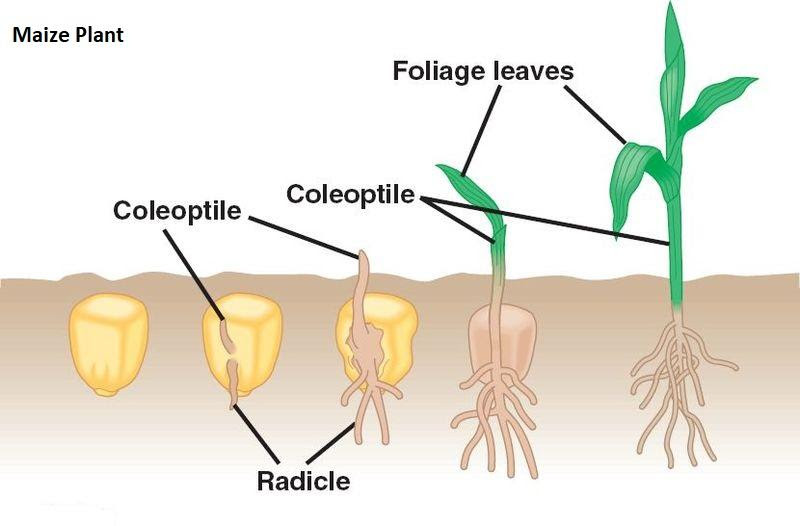
Fig: Presence of Coleoptile in Maize Plant
Coleoptile is a sheath, covering the plumule (embryonic shoot) in monocot seeds. It is present only in embryonic stages.
The growth of the coleoptile is limited due to the lack of apical meristem and the occurrence of growth is due to cell elongation only.
At the time of germination of seed, the growing embryonic seed is covered by coleoptile, which protects the apical meristem from the shoot from any injury, which can be caused by frictional forces of the soil particles.
The growing shoot comes out of the coleoptile by rupturing it after coming out of the soil because, in the absence of meristematic tissue, the coleoptile is not able to grow anymore. In the absence of frictional forces of soil particles when the growing shoot comes out of the soil, it does not need any protection.
Note:
Coleoptiles grow by cell division and cell enlargement until they reach $5$ mm in length. They possess some similarly specialized cells, which promote stretch growth. When they increase in size, they accumulate more water. They have water vessels along the axis, providing the water supply to the plant. In the wheat plant, the coleoptile attains full growth on the third day of germination.
Complete answer:
Fig: Presence of Coleoptile in Maize Plant
Coleoptile is a sheath, covering the plumule (embryonic shoot) in monocot seeds. It is present only in embryonic stages.
The growth of the coleoptile is limited due to the lack of apical meristem and the occurrence of growth is due to cell elongation only.
At the time of germination of seed, the growing embryonic seed is covered by coleoptile, which protects the apical meristem from the shoot from any injury, which can be caused by frictional forces of the soil particles.
The growing shoot comes out of the coleoptile by rupturing it after coming out of the soil because, in the absence of meristematic tissue, the coleoptile is not able to grow anymore. In the absence of frictional forces of soil particles when the growing shoot comes out of the soil, it does not need any protection.
Note:
Coleoptiles grow by cell division and cell enlargement until they reach $5$ mm in length. They possess some similarly specialized cells, which promote stretch growth. When they increase in size, they accumulate more water. They have water vessels along the axis, providing the water supply to the plant. In the wheat plant, the coleoptile attains full growth on the third day of germination.
Recently Updated Pages
Master Class 11 English: Engaging Questions & Answers for Success

Master Class 11 Social Science: Engaging Questions & Answers for Success
Master Class 11 Maths: Engaging Questions & Answers for Success
Master Class 11 Biology: Engaging Questions & Answers for Success
Master Class 11 Physics: Engaging Questions & Answers for Success
Master Class 11 Chemistry: Engaging Questions & Answers for Success
Trending doubts
One Metric ton is equal to kg A 10000 B 1000 C 100 class 11 physics CBSE
Difference Between Prokaryotic Cells and Eukaryotic Cells
Difference between physical and chemical change class 11 chemistry CBSE
Find the value of the expression given below sin 30circ class 11 maths CBSE
Two of the body parts which do not appear in MRI are class 11 biology CBSE
Draw a diagram of a plant cell and label at least eight class 11 biology CBSE