




During the festival of Holi, Ram throws a small water balloon from the ground so as to hit Shyam. Shyam is standing on top of a building of height $10m$. If the building is at a distance $20m$ away from Ram and he throws the balloon at angle ${{45}^{\circ }}$with horizontal, then the speed of projection required will be? (Given $g=10m{{s}^{-2}}$)
A. $10m{{s}^{-1}}$
B. $20m{{s}^{-1}}$
C. $30m{{s}^{-1}}$
D. $40m{{s}^{-1}}$
Answer
 Verified
558.3k+ views
Hint:The balloon thrown by Ram follows a semi-parabolic path to reach Shyam at a height of $10m$from the ground. The balloon will acquire two components of its initial velocity, one in the x-direction and the other in the y-direction. Thus, we shall solve this problem by using the equations of a projectile.
Complete step-by-step solution:
The situation described in the given question is illustrated in the diagram given below:
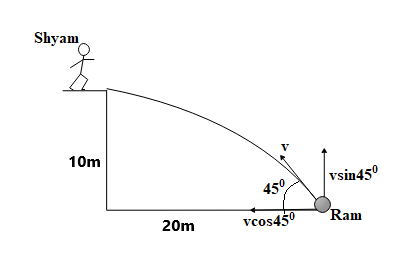
Let $v$ be the initial velocity of projection of the water- filled balloon thrown by Ram. Since the balloon is thrown at an angle of ${{45}^{\circ }}$ with the horizontal, therefore it will have the following components of its velocity:
In the x-direction: ${{v}_{x}}=-v\cos {{45}^{\circ }}$ (negative sign implies that velocity is in the negative x-direction along the horizontal.)
In the y-direction: ${{v}_{y}}=v\sin {{45}^{\circ }}$
We know that $\sin {{45}^{\circ }}=\dfrac{1}{\sqrt{2}}$ as well as $\cos {{45}^{\circ }}=\dfrac{1}{\sqrt{2}}$ .
Hence, ${{v}_{x}}=-\dfrac{v}{\sqrt{2}}$ and ${{v}_{y}}=\dfrac{v}{\sqrt{2}}$ . …………….. equation (1)
The maximum height of a projectile motion is given by:
$H=\dfrac{{{\left( {{v}_{y}} \right)}^{2}}}{2g}$
Where,
$H=$ maximum height of the projectile motion
${{v}_{y}}=$ velocity of the projectile along the vertical (in y-direction)
$g=$ acceleration due to gravity
The only unknown quantity is the initial velocity of projection, $v$ of the balloon.
Here, we are given that
$y=H=10m,\text{ }x=20m,\text{ }{{v}_{x}}=-\dfrac{v}{\sqrt{2}},\text{ }\theta ={{45}^{\circ }},\text{ }g=10m{{s}^{-2}}$
From equation (1):
$\Rightarrow H=\dfrac{{{\left( \dfrac{v}{\sqrt{2}} \right)}^{2}}}{2g}$
$\begin{align}
& \Rightarrow H=\dfrac{{{v}^{2}}}{\left( 2 \right)2g} \\
& \Rightarrow 10=\dfrac{{{v}^{2}}}{4\left( 10 \right)} \\
& \Rightarrow {{v}^{2}}=\left( 400 \right) \\
\end{align}$
$\begin{align}
& \Rightarrow v=\sqrt{400} \\
& \Rightarrow v=\pm 20 \\
\end{align}$
Ignoring the negative value, we get that the initial velocity of projection of the balloon is $20m{{s}^{-1}}$.
Therefore, the correct option is (B) $20m{{s}^{-1}}$.
Note:
Another way of solving the problem was by substituting all the given values in the equation of range of the projectile. Range of a projectile is the horizontal distance travelled by the body during its projectile motion. As the balloon hits Shyam, it is stopped in the middle of its projectile motion. If the balloon would have missed Shyam, it would have travelled another $20m$ to the left to complete its path.
Complete step-by-step solution:
The situation described in the given question is illustrated in the diagram given below:
Let $v$ be the initial velocity of projection of the water- filled balloon thrown by Ram. Since the balloon is thrown at an angle of ${{45}^{\circ }}$ with the horizontal, therefore it will have the following components of its velocity:
In the x-direction: ${{v}_{x}}=-v\cos {{45}^{\circ }}$ (negative sign implies that velocity is in the negative x-direction along the horizontal.)
In the y-direction: ${{v}_{y}}=v\sin {{45}^{\circ }}$
We know that $\sin {{45}^{\circ }}=\dfrac{1}{\sqrt{2}}$ as well as $\cos {{45}^{\circ }}=\dfrac{1}{\sqrt{2}}$ .
Hence, ${{v}_{x}}=-\dfrac{v}{\sqrt{2}}$ and ${{v}_{y}}=\dfrac{v}{\sqrt{2}}$ . …………….. equation (1)
The maximum height of a projectile motion is given by:
$H=\dfrac{{{\left( {{v}_{y}} \right)}^{2}}}{2g}$
Where,
$H=$ maximum height of the projectile motion
${{v}_{y}}=$ velocity of the projectile along the vertical (in y-direction)
$g=$ acceleration due to gravity
The only unknown quantity is the initial velocity of projection, $v$ of the balloon.
Here, we are given that
$y=H=10m,\text{ }x=20m,\text{ }{{v}_{x}}=-\dfrac{v}{\sqrt{2}},\text{ }\theta ={{45}^{\circ }},\text{ }g=10m{{s}^{-2}}$
From equation (1):
$\Rightarrow H=\dfrac{{{\left( \dfrac{v}{\sqrt{2}} \right)}^{2}}}{2g}$
$\begin{align}
& \Rightarrow H=\dfrac{{{v}^{2}}}{\left( 2 \right)2g} \\
& \Rightarrow 10=\dfrac{{{v}^{2}}}{4\left( 10 \right)} \\
& \Rightarrow {{v}^{2}}=\left( 400 \right) \\
\end{align}$
$\begin{align}
& \Rightarrow v=\sqrt{400} \\
& \Rightarrow v=\pm 20 \\
\end{align}$
Ignoring the negative value, we get that the initial velocity of projection of the balloon is $20m{{s}^{-1}}$.
Therefore, the correct option is (B) $20m{{s}^{-1}}$.
Note:
Another way of solving the problem was by substituting all the given values in the equation of range of the projectile. Range of a projectile is the horizontal distance travelled by the body during its projectile motion. As the balloon hits Shyam, it is stopped in the middle of its projectile motion. If the balloon would have missed Shyam, it would have travelled another $20m$ to the left to complete its path.
Recently Updated Pages
Master Class 12 Economics: Engaging Questions & Answers for Success

Master Class 12 Physics: Engaging Questions & Answers for Success
Master Class 12 English: Engaging Questions & Answers for Success
Master Class 12 Social Science: Engaging Questions & Answers for Success
Master Class 12 Maths: Engaging Questions & Answers for Success
Master Class 12 Business Studies: Engaging Questions & Answers for Success
Trending doubts
Which are the Top 10 Largest Countries of the World?
What are the major means of transport Explain each class 12 social science CBSE
Draw a labelled sketch of the human eye class 12 physics CBSE
Differentiate between insitu conservation and exsitu class 12 biology CBSE
Draw a neat and well labeled diagram of TS of ovary class 12 biology CBSE
Give 10 examples of unisexual and bisexual flowers