




During SHM, a particle has displacement $ x $ from mean position. If acceleration, kinetic energy and excess potential energy are represented by $ a $ , $ k $ and $ U $ respectively, then choose the appropriate graph
(A)
(B)
(C)
(D)
Answer
 Verified
601.2k+ views
Hint
We write down the equations of kinetic energy and potential energy in a simple harmonic motion. Acceleration is then substituted into the formulas of kinetic and potential energy. These equations are compared to the graph to find which one of them is correct.
Formula used: kinetic energy $ k = \dfrac{1}{2}{\omega ^2}({A^2} - {x^2}) $
Potential energy $ U = \dfrac{1}{2}m{\omega ^2}{x^2} $
Acceleration of particle $ a = {\omega ^2}x $
Here,Mass of particle is represented by $ m $
Amplitude of particle is represented by $ A $
Displacement is represented by $ x $
Angular frequency is represented by $ \omega $
Kinetic energy is represented by $ k $
Potential energy is represented by $ U $ .
Complete step by step answer
kinetic energy of a particle in a simple harmonic motion is given by
$\Rightarrow k = \dfrac{1}{2}{\omega ^2}({A^2} - {x^2}) $
$\Rightarrow k = \dfrac{1}{2}({\omega ^2}{A^2} - ax) $
Potential energy is given by
$\Rightarrow U = \dfrac{1}{2}m{\omega ^2}{x^2} $
$\Rightarrow U = \dfrac{1}{2}m \times a \times x $
Acceleration is given by $ a = {\omega ^2}x $
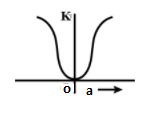
Taking graph (A) we can see that acceleration is zero at $ x $ equal to zero but from kinetic energy formula $ k = \dfrac{1}{2}({\omega ^2}{A^2} - ax) $ . kinetic energy is not equal to zero at acceleration zero hence (A) is incorrect
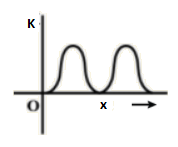
The graph of kinetic energy vs displacement should be parabolic. which is not the case in option (B), so it is incorrect.
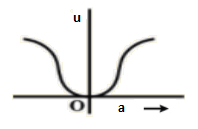
Potential energy is zero when acceleration is zero and maximum when acceleration is maximum which is satisfied by the equation of potential energy $ U = \dfrac{1}{2}m \times a \times x $ hence option (c) is correct.
The sum of kinetic and potential energy is always equal to
$ \begin{array}{*{20}{l}}
{\;U + K = \dfrac{1}{2}m{\omega ^2}{A^2}} \\
{ \Rightarrow U = - K + \dfrac{1}{2}m{\omega ^2}{A^2}}
\end{array} $
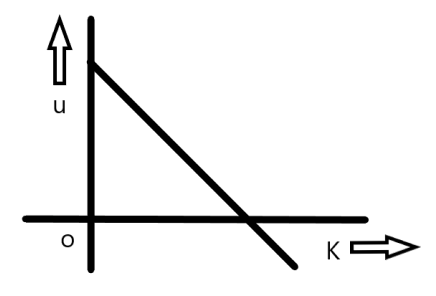
So it is a straight line with a negative slope and an intercept on the y-axis
Hence option (D) is correct.
Option (C) and (D) are correct.
Note
Simple harmonic motion is a special type of periodic motion where the restoring force on the moving object is directly proportional to the object's displacement magnitude and acts towards the object's equilibrium position.
We write down the equations of kinetic energy and potential energy in a simple harmonic motion. Acceleration is then substituted into the formulas of kinetic and potential energy. These equations are compared to the graph to find which one of them is correct.
Formula used: kinetic energy $ k = \dfrac{1}{2}{\omega ^2}({A^2} - {x^2}) $
Potential energy $ U = \dfrac{1}{2}m{\omega ^2}{x^2} $
Acceleration of particle $ a = {\omega ^2}x $
Here,Mass of particle is represented by $ m $
Amplitude of particle is represented by $ A $
Displacement is represented by $ x $
Angular frequency is represented by $ \omega $
Kinetic energy is represented by $ k $
Potential energy is represented by $ U $ .
Complete step by step answer
kinetic energy of a particle in a simple harmonic motion is given by
$\Rightarrow k = \dfrac{1}{2}{\omega ^2}({A^2} - {x^2}) $
$\Rightarrow k = \dfrac{1}{2}({\omega ^2}{A^2} - ax) $
Potential energy is given by
$\Rightarrow U = \dfrac{1}{2}m{\omega ^2}{x^2} $
$\Rightarrow U = \dfrac{1}{2}m \times a \times x $
Acceleration is given by $ a = {\omega ^2}x $
Taking graph (A) we can see that acceleration is zero at $ x $ equal to zero but from kinetic energy formula $ k = \dfrac{1}{2}({\omega ^2}{A^2} - ax) $ . kinetic energy is not equal to zero at acceleration zero hence (A) is incorrect
The graph of kinetic energy vs displacement should be parabolic. which is not the case in option (B), so it is incorrect.
Potential energy is zero when acceleration is zero and maximum when acceleration is maximum which is satisfied by the equation of potential energy $ U = \dfrac{1}{2}m \times a \times x $ hence option (c) is correct.
The sum of kinetic and potential energy is always equal to
$ \begin{array}{*{20}{l}}
{\;U + K = \dfrac{1}{2}m{\omega ^2}{A^2}} \\
{ \Rightarrow U = - K + \dfrac{1}{2}m{\omega ^2}{A^2}}
\end{array} $
So it is a straight line with a negative slope and an intercept on the y-axis
Hence option (D) is correct.
Option (C) and (D) are correct.
Note
Simple harmonic motion is a special type of periodic motion where the restoring force on the moving object is directly proportional to the object's displacement magnitude and acts towards the object's equilibrium position.
Recently Updated Pages
Master Class 12 Economics: Engaging Questions & Answers for Success

Master Class 12 English: Engaging Questions & Answers for Success
Master Class 12 Social Science: Engaging Questions & Answers for Success
Master Class 12 Maths: Engaging Questions & Answers for Success
Master Class 12 Physics: Engaging Questions & Answers for Success
Master Class 11 Social Science: Engaging Questions & Answers for Success
Trending doubts
One Metric ton is equal to kg A 10000 B 1000 C 100 class 11 physics CBSE
Difference Between Prokaryotic Cells and Eukaryotic Cells
Find the value of the expression given below sin 30circ class 11 maths CBSE
Two of the body parts which do not appear in MRI are class 11 biology CBSE
Draw a diagram of nephron and explain its structur class 11 biology CBSE
10 examples of friction in our daily life