




During a rainy day, rain is falling vertically with a velocity $2m{s^{ - 1}}.$ A boy at rest starts his motion with a constant acceleration of $2m{s^{ - 2}}$ along a straight road. Find the rate at which the angle of the axis of umbrella with vertical should be changed so that the rain always falls parallel to the axis of the umbrella.
Answer
 Verified
568.8k+ views
Hint: Follow the given word statements step by step and convert them in the mathematical expressions. Use formula for velocity as the product of the acceleration and time, ${v_b} = a \times t$ and use derivatives to find the rate of change of angle with respect to time for the required solution.
Complete step by step answer:
Let the velocity of rain falling be ${v_r} = 2m/s$
Acceleration, $a = 2m/{s^2}$
Velocity of boy be ${v_b} = a \times t$
Place the values in the above equation –
${v_b} = 2t$
Velocity of rain with respect to boy is $\overrightarrow {{v_{rb}}} = \overrightarrow {{v_r}} - \overrightarrow {{v_b}} $
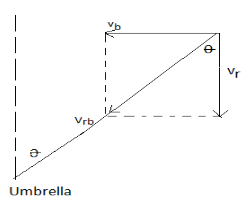
From the above figure, we can find $\tan \theta = \dfrac{{{v_b}}}{{{v_r}}}$
Place the known values in the above equation –
$\tan \theta = \dfrac{{2t}}{2}$
By simplification- we get,
$\tan \theta = t{\text{ }}.....{\text{(a)}}$
We have to find out – the rate, at which an angle changes vertically with respect to time, $\dfrac{{d\theta }}{{dt}} = ?$
Now, take derivative of the equation (a) with respect to “t” -
\[
\dfrac{{d\tan \theta }}{{dt}} = \dfrac{{dt}}{{dt}}{\text{ }} \\
{\text{ }}\dfrac{{d\tan \theta }}{{dt}} = 1{\text{ }} \\
\]
The above equation can be re-written as –
$\dfrac{{d\tan \theta }}{{d\theta }} \times \dfrac{{d\theta }}{{dt}} = 1$
Now, we know that derivative of $\tan \theta = {\sec ^2}\theta $
${\sec ^2}\theta \times \dfrac{{d\theta }}{{dt}} = 1$
Now make the required unknown angle the subject –
$\dfrac{{d\theta }}{{dt}} = \dfrac{1}{{{{\sec }^2}\theta }}$
By property - ${\sec ^2}\theta = 1 + {\tan ^2}\theta $
$ \Rightarrow \dfrac{{d\theta }}{{dt}} = \dfrac{1}{{1 + {{\tan }^2}\theta }}$
Place the value of $\tan \theta $ in the above equation
$ \Rightarrow \dfrac{{d\theta }}{{dt}} = \dfrac{1}{{1 + {t^2}}}$
Hence, the required answer - the rate at which the angle of the axis of umbrella with vertical should be changed so that the rain always falls parallel to the axis of the umbrella is $\dfrac{{d\theta }}{{dt}} = \dfrac{1}{{1 + {t^2}}}$.
Note:
Correct application of formula and its substitution is the most important factor in this question. Also, the correct application of the derivative gives the right answer. Remember the basic derivative of the trigonometric functions.
Complete step by step answer:
Let the velocity of rain falling be ${v_r} = 2m/s$
Acceleration, $a = 2m/{s^2}$
Velocity of boy be ${v_b} = a \times t$
Place the values in the above equation –
${v_b} = 2t$
Velocity of rain with respect to boy is $\overrightarrow {{v_{rb}}} = \overrightarrow {{v_r}} - \overrightarrow {{v_b}} $
From the above figure, we can find $\tan \theta = \dfrac{{{v_b}}}{{{v_r}}}$
Place the known values in the above equation –
$\tan \theta = \dfrac{{2t}}{2}$
By simplification- we get,
$\tan \theta = t{\text{ }}.....{\text{(a)}}$
We have to find out – the rate, at which an angle changes vertically with respect to time, $\dfrac{{d\theta }}{{dt}} = ?$
Now, take derivative of the equation (a) with respect to “t” -
\[
\dfrac{{d\tan \theta }}{{dt}} = \dfrac{{dt}}{{dt}}{\text{ }} \\
{\text{ }}\dfrac{{d\tan \theta }}{{dt}} = 1{\text{ }} \\
\]
The above equation can be re-written as –
$\dfrac{{d\tan \theta }}{{d\theta }} \times \dfrac{{d\theta }}{{dt}} = 1$
Now, we know that derivative of $\tan \theta = {\sec ^2}\theta $
${\sec ^2}\theta \times \dfrac{{d\theta }}{{dt}} = 1$
Now make the required unknown angle the subject –
$\dfrac{{d\theta }}{{dt}} = \dfrac{1}{{{{\sec }^2}\theta }}$
By property - ${\sec ^2}\theta = 1 + {\tan ^2}\theta $
$ \Rightarrow \dfrac{{d\theta }}{{dt}} = \dfrac{1}{{1 + {{\tan }^2}\theta }}$
Place the value of $\tan \theta $ in the above equation
$ \Rightarrow \dfrac{{d\theta }}{{dt}} = \dfrac{1}{{1 + {t^2}}}$
Hence, the required answer - the rate at which the angle of the axis of umbrella with vertical should be changed so that the rain always falls parallel to the axis of the umbrella is $\dfrac{{d\theta }}{{dt}} = \dfrac{1}{{1 + {t^2}}}$.
Note:
Correct application of formula and its substitution is the most important factor in this question. Also, the correct application of the derivative gives the right answer. Remember the basic derivative of the trigonometric functions.
Recently Updated Pages
Master Class 11 Computer Science: Engaging Questions & Answers for Success

Master Class 11 Business Studies: Engaging Questions & Answers for Success
Master Class 11 Economics: Engaging Questions & Answers for Success
Master Class 11 English: Engaging Questions & Answers for Success
Master Class 11 Maths: Engaging Questions & Answers for Success
Master Class 11 Biology: Engaging Questions & Answers for Success
Trending doubts
One Metric ton is equal to kg A 10000 B 1000 C 100 class 11 physics CBSE
There are 720 permutations of the digits 1 2 3 4 5 class 11 maths CBSE
Discuss the various forms of bacteria class 11 biology CBSE
Draw a diagram of a plant cell and label at least eight class 11 biology CBSE
State the laws of reflection of light
Explain zero factorial class 11 maths CBSE