




Dumb-bell shaped guard cells are found in
a. Gymnosperms
b. Most dicots
c. Cereals
d. Xerophytes
Answer
 Verified
559.2k+ views
Hint: Guard cells are specialized cells found in the epidermis of the leaves, stem, and some other parts of the plants, and they are involved in different mechanisms which include the transpiration and Exchange of gases.
Complete answer:
Guard cells usually surround the stroma, and the major function of the guard cell is transpiration, where the action of opening and closing of the stomata is mainly by the trigger, which comes from the light.
The guard cell outside is surrounded by the thin layer and the inside is by the thick layer, whenever there is water conduction, the outer layer is seemed or bulged and it draws the inner thick layer with it and forms the crescent shaped, which results in the opening of the pore.
Shape of the guard cells varies in some plants, where dicots possess the stomatal complex with the pair of kidney shaped cells, while monocots, typically consists of dumbbell shaped guard cells, along with surrounding subsidiary cells, where subsidiary cells acts as ion reservoir cells, for the storage of ions and helps to regulate the opening and closing of the guard cells.
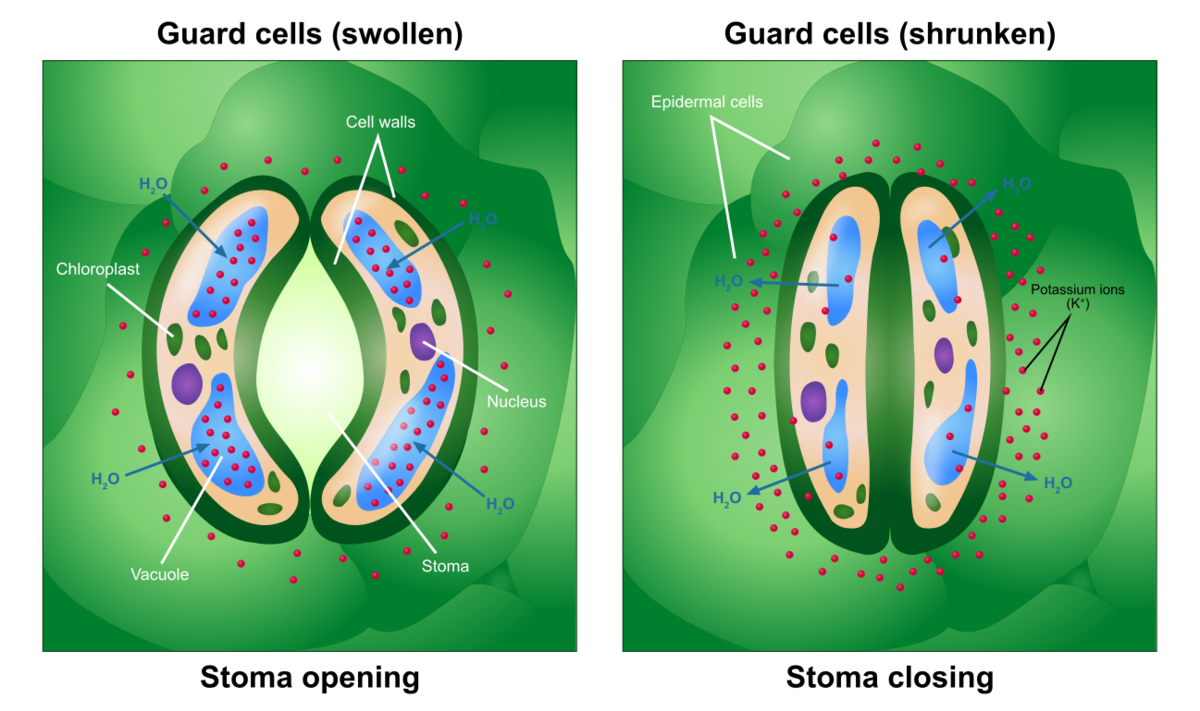
The examples of the plants which contain the dumbbell shaped guard cells are the members of some families like Poaceae, Cyperaceae and some palm plants and in some types of grasses and sugarcanes dumbbell shaped guard cells are present.
Hence, the correct answer is option (C).
Note: Generally stomata are open in the day time, and closed in the night time, and an immediate opening and closing of stomata are occur mainly because of increase in turgidity in the guard cells, and guard cells also possess chloroplast, which responsible for opening and closing by light activity.
Complete answer:
Guard cells usually surround the stroma, and the major function of the guard cell is transpiration, where the action of opening and closing of the stomata is mainly by the trigger, which comes from the light.
The guard cell outside is surrounded by the thin layer and the inside is by the thick layer, whenever there is water conduction, the outer layer is seemed or bulged and it draws the inner thick layer with it and forms the crescent shaped, which results in the opening of the pore.
Shape of the guard cells varies in some plants, where dicots possess the stomatal complex with the pair of kidney shaped cells, while monocots, typically consists of dumbbell shaped guard cells, along with surrounding subsidiary cells, where subsidiary cells acts as ion reservoir cells, for the storage of ions and helps to regulate the opening and closing of the guard cells.
The examples of the plants which contain the dumbbell shaped guard cells are the members of some families like Poaceae, Cyperaceae and some palm plants and in some types of grasses and sugarcanes dumbbell shaped guard cells are present.
Hence, the correct answer is option (C).
Note: Generally stomata are open in the day time, and closed in the night time, and an immediate opening and closing of stomata are occur mainly because of increase in turgidity in the guard cells, and guard cells also possess chloroplast, which responsible for opening and closing by light activity.
Recently Updated Pages
Master Class 11 English: Engaging Questions & Answers for Success

Master Class 11 Social Science: Engaging Questions & Answers for Success
Master Class 11 Maths: Engaging Questions & Answers for Success
Master Class 11 Biology: Engaging Questions & Answers for Success
Master Class 11 Physics: Engaging Questions & Answers for Success
Master Class 11 Chemistry: Engaging Questions & Answers for Success
Trending doubts
One Metric ton is equal to kg A 10000 B 1000 C 100 class 11 physics CBSE
Difference Between Prokaryotic Cells and Eukaryotic Cells
1 ton equals to A 100 kg B 1000 kg C 10 kg D 10000 class 11 physics CBSE
Find the value of the expression given below sin 30circ class 11 maths CBSE
Two of the body parts which do not appear in MRI are class 11 biology CBSE
Draw a diagram of a plant cell and label at least eight class 11 biology CBSE