




Due to its sextet (having six electrons) the carbonium ions are:
(A) Unstable
(B) Very stable
(C) Negatively charged
(D) All of these
Answer
 Verified
593.1k+ views
Hint: Carbocation which is also called carbonium or carbenium ion is a positively charged molecule having a planar geometry. It is a short-lived intermediate formed during the chemical reactions. It has a vacant p- orbital.
Complete step by step answer:
Carbocation has two types of ions based on their valence shell electrons.
Carbenium:
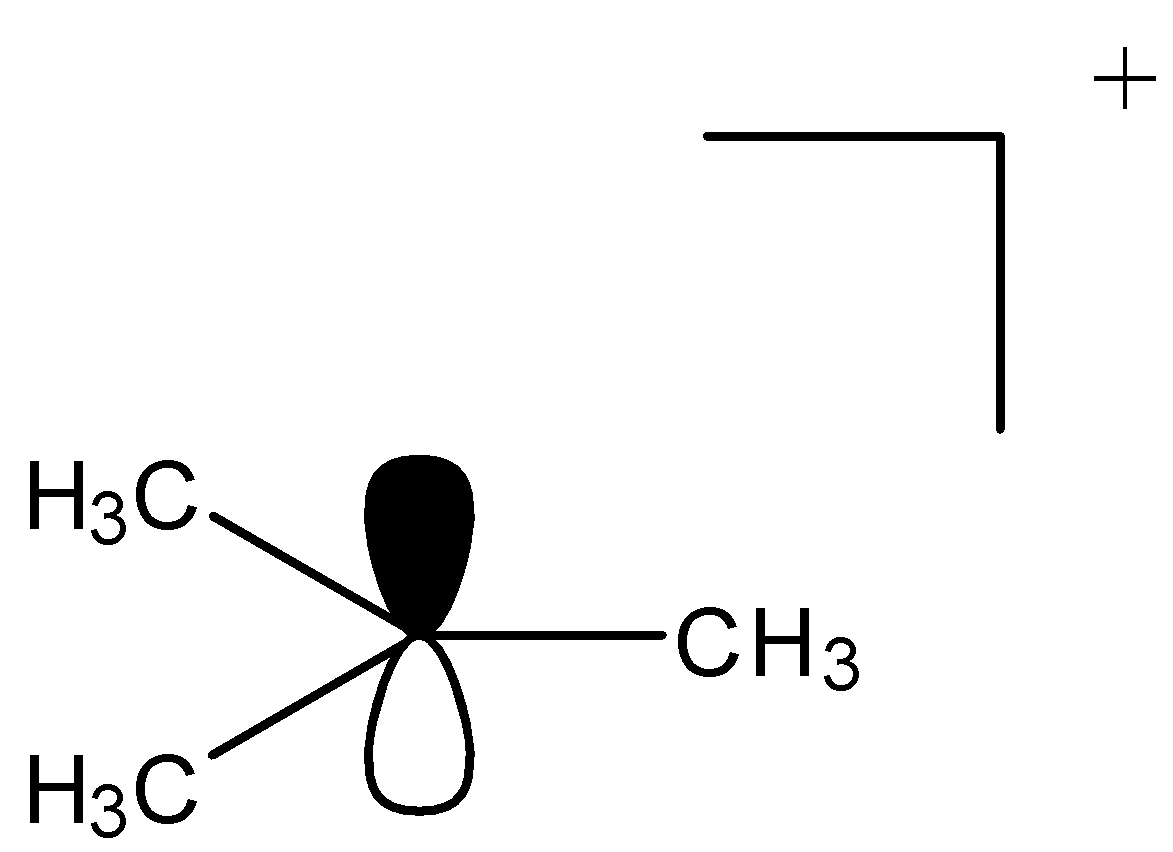
1.It contains ${\text{6}}$ electrons i.e sextet moiety.
2.Carbenium is a positively charged species.
3.It contains a ${\text{s}}{{\text{p}}^{\text{2}}}$ hybridized central carbon.
4.It contains vacant p-orbital on the central atom.
5.Carbenium ions have trivalent central carbon.
6.This is unstable structure and stability depends on substituent groups attached.
7.It has ${\text{2c - 2}}{{\text{e}}^{\text{ - }}}$ bonds for every carbon.
Carbonium:
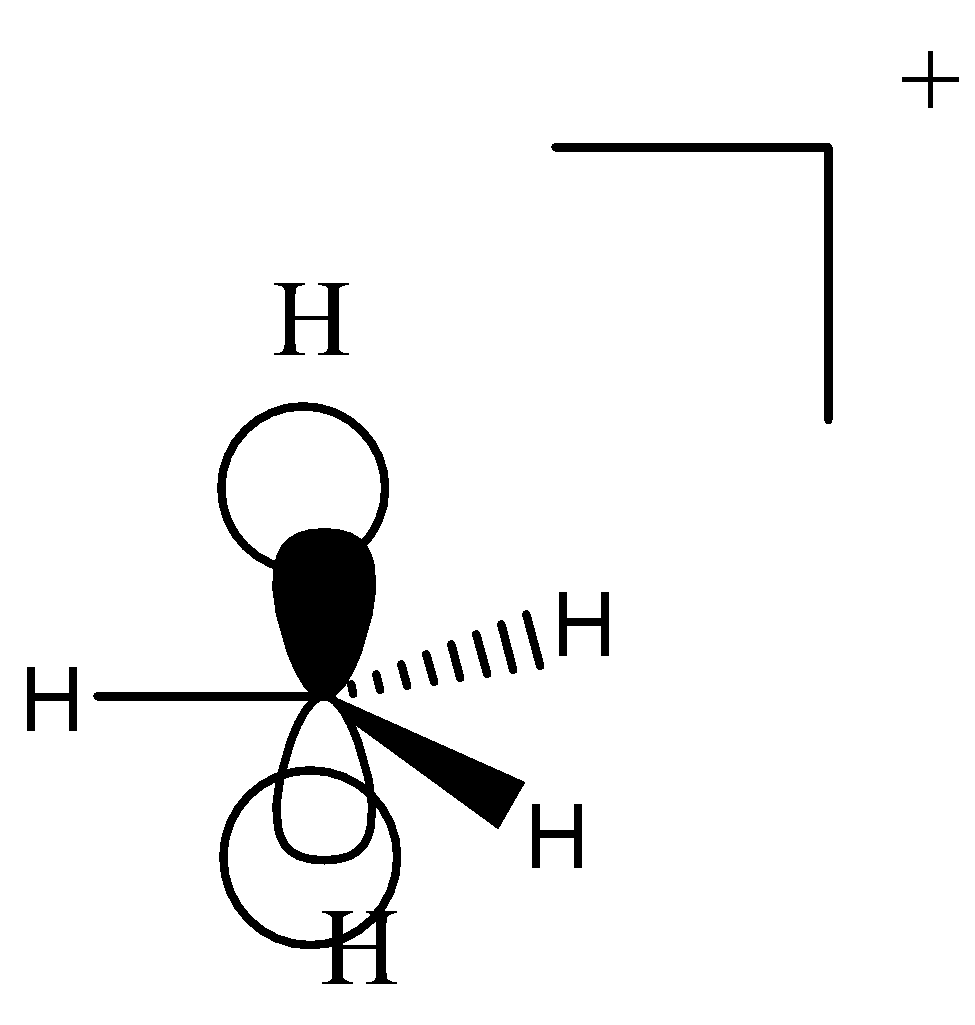
1.It contains ${\text{8}}$ electrons in this chemical moiety.
2.It is also a positively charged species.
3.It does not contain a vacant p-orbital as it is occupied by two hydrogen atoms.
4.Carbonium ions have a pentavalent central carbon.
5.It has ${\text{1 3c - 2}}{{\text{e}}^{\text{ - }}}$ bond in it.
6.It is also an unstable moiety.
Carbocations in themselves are very unstable that’s why they are the reaction intermediate for most the reaction mechanism because they will react fast and try to become stable.
Still we can increase the stability of carbocation by changing the adjacent groups to which it is attached. A tertiary carbocation having three alkyl groups around are comparably stabler than primary or secondary carbocation.
If carbonium ions have a sextet of electrons it will be very unstable.
So, the correct answer is Option A.
Additional information:
Carbocations due to being unstable are intermediate for many reactions like ${\text{S}}{{\text{N}}^{\text{1}}}$ reactions take place only when carbocation is formed. The migration of carbocation happens very frequently to attain stability like primary carbocation migrates its charge to form secondary stable carbocation.
Note: Phenyl carbocation having three phenyl rings attached to it is the most stable of carbocation present. The stability of carbocation can be altered this way by changing the nature of substituent. Electron releasing groups will increase the stability of the carbocation while electron withdrawing groups will decrease the stability of carbocation.
Complete step by step answer:
Carbocation has two types of ions based on their valence shell electrons.
Carbenium:
1.It contains ${\text{6}}$ electrons i.e sextet moiety.
2.Carbenium is a positively charged species.
3.It contains a ${\text{s}}{{\text{p}}^{\text{2}}}$ hybridized central carbon.
4.It contains vacant p-orbital on the central atom.
5.Carbenium ions have trivalent central carbon.
6.This is unstable structure and stability depends on substituent groups attached.
7.It has ${\text{2c - 2}}{{\text{e}}^{\text{ - }}}$ bonds for every carbon.
Carbonium:
1.It contains ${\text{8}}$ electrons in this chemical moiety.
2.It is also a positively charged species.
3.It does not contain a vacant p-orbital as it is occupied by two hydrogen atoms.
4.Carbonium ions have a pentavalent central carbon.
5.It has ${\text{1 3c - 2}}{{\text{e}}^{\text{ - }}}$ bond in it.
6.It is also an unstable moiety.
Carbocations in themselves are very unstable that’s why they are the reaction intermediate for most the reaction mechanism because they will react fast and try to become stable.
Still we can increase the stability of carbocation by changing the adjacent groups to which it is attached. A tertiary carbocation having three alkyl groups around are comparably stabler than primary or secondary carbocation.
If carbonium ions have a sextet of electrons it will be very unstable.
So, the correct answer is Option A.
Additional information:
Carbocations due to being unstable are intermediate for many reactions like ${\text{S}}{{\text{N}}^{\text{1}}}$ reactions take place only when carbocation is formed. The migration of carbocation happens very frequently to attain stability like primary carbocation migrates its charge to form secondary stable carbocation.
Note: Phenyl carbocation having three phenyl rings attached to it is the most stable of carbocation present. The stability of carbocation can be altered this way by changing the nature of substituent. Electron releasing groups will increase the stability of the carbocation while electron withdrawing groups will decrease the stability of carbocation.
Recently Updated Pages
Master Class 9 General Knowledge: Engaging Questions & Answers for Success

Master Class 9 Maths: Engaging Questions & Answers for Success
Master Class 9 Science: Engaging Questions & Answers for Success
Master Class 9 English: Engaging Questions & Answers for Success
Master Class 9 Social Science: Engaging Questions & Answers for Success
Class 9 Question and Answer - Your Ultimate Solutions Guide
Trending doubts
One Metric ton is equal to kg A 10000 B 1000 C 100 class 11 physics CBSE
Difference Between Prokaryotic Cells and Eukaryotic Cells
Two of the body parts which do not appear in MRI are class 11 biology CBSE
1 ton equals to A 100 kg B 1000 kg C 10 kg D 10000 class 11 physics CBSE
10 examples of friction in our daily life
Name the Largest and the Smallest Cell in the Human Body ?