




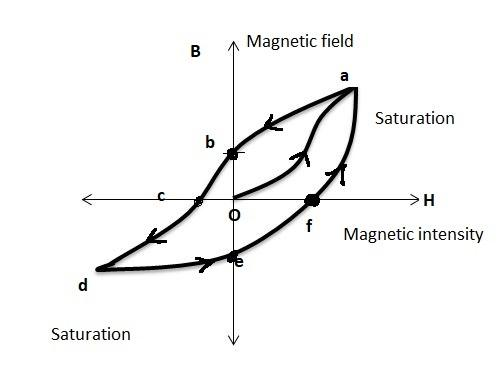
Draw the variation of magnetic field (B) with magnetic intensity (H) when a ferromagnetic material is subjected to a cycle of magnetisation?
Answer
 Verified
661.2k+ views
Hint: Hysteresis curve represents the graphical relationship between the intensity of magnetization and the magnetic field. To draw the variation of magnetic field (B) with magnetic intensity (H) when a ferromagnetic material is subjected to a cycle of magnetization, we will use the hysteresis curve.
Complete step by step solution:
When a ferromagnetic material is subjected to a cycle of magnetization in a unidirectional manner then it will not move back to the initial position of zero magnetization when the magnetization field is removed. The lack of ability to move back to the zero magnetization of the magnetic material is called the hysteresis of the magnetic material and it is due to the existence of the magnetic domain of the magnetic material.
When magnetization is applied then due to alignment of magnetic domains the ferromagnetic material gets magnetized and when the magnetization field is removed then the saturation moves towards the opposite direction. The hysteresis loop shows the time dependent magnetization of the ferromagnetic material. When the magnetization field is removed then the material can retain its magnetization history.
To demagnetize the ferromagnetic material it requires application of heat or the magnetization field in the opposite direction.
The relationship between magnetic intensity (H) and the magnetic field (B) is not linear for the ferromagnetic material.
The relation between magnetic field (B) and magnetic intensity (H) is as,
$\text{B}=\text{H}+4\pi \text{M}$
Where,
M is magnetization induced
H is applied field intensity
And B is a magnetic field.
Note: 1. Magnetization of ferromagnetic material is temperature dependent.
2. No internal field is present above the Curie temperature.
Complete step by step solution:
When a ferromagnetic material is subjected to a cycle of magnetization in a unidirectional manner then it will not move back to the initial position of zero magnetization when the magnetization field is removed. The lack of ability to move back to the zero magnetization of the magnetic material is called the hysteresis of the magnetic material and it is due to the existence of the magnetic domain of the magnetic material.
When magnetization is applied then due to alignment of magnetic domains the ferromagnetic material gets magnetized and when the magnetization field is removed then the saturation moves towards the opposite direction. The hysteresis loop shows the time dependent magnetization of the ferromagnetic material. When the magnetization field is removed then the material can retain its magnetization history.
To demagnetize the ferromagnetic material it requires application of heat or the magnetization field in the opposite direction.
The relationship between magnetic intensity (H) and the magnetic field (B) is not linear for the ferromagnetic material.
The relation between magnetic field (B) and magnetic intensity (H) is as,
$\text{B}=\text{H}+4\pi \text{M}$
Where,
M is magnetization induced
H is applied field intensity
And B is a magnetic field.
Note: 1. Magnetization of ferromagnetic material is temperature dependent.
2. No internal field is present above the Curie temperature.
Recently Updated Pages
If x a + bt + ct2 where x is in meters and t is in class 11 physics CBSE

A car covers the first half distance between two places class 11 physics CBSE
The resultant of two vectors overrightarrow P and overrightarrow class 11 physics CBSE
Find the value of cos 135 class 11 maths CBSE
A mass M is held in place by an applied force F and class 11 physics CBSE
A solution of glucose in water is labelled as 10 dfracwv class 11 chemistry CBSE
Trending doubts
One Metric ton is equal to kg A 10000 B 1000 C 100 class 11 physics CBSE
Find the value of the expression given below sin 30circ class 11 maths CBSE
What do you mean by retardation What is its SI uni class 11 physics CBSE
Draw a diagram of nephron and explain its structur class 11 biology CBSE
10 examples of friction in our daily life
Difference between physical and chemical change class 11 chemistry CBSE