




Draw the structures of the following molecules:
A.${{H}_{3}}P{{O}_{2}}$
B.$Cl{{F}_{3}}$
Answer
 Verified
582.6k+ views
Hint: In this question, we have to draw the structures of ${{H}_{3}}P{{O}_{2}}$and $Cl{{F}_{3}}$. ${{H}_{3}}P{{O}_{2}}$ which is known as Hypophosphorous acid. It is a phosphorus oxyacid which is a strong reducing agent. It is also called phosphinic acid. $Cl{{F}_{3}}$is chlorine trifluoride which is formed by fluorination of chlorine.
Complete answer:
${{H}_{3}}P{{O}_{2}}$- It is a colorless compound that is water-soluble. It’s a low-melting compound. It is also soluble in dioxane and alcohol. The more descriptive representation of it is $HOP(O){{H}_{2}}$. It has a monoprotic character. Hypophosphites are the name of the salts that are derived from this acid.
$HOP(O){{H}_{2}}$ occurs in the equilibrium with slight tautomer $HP{{(OH)}_{2}}$, It is called hypophosphorous acid whereas the major tautomer is phosphonic acid.
Preparation-
The white phosphorus reacts with a hot aqueous solution of a hydroxide results in the formation of hypophosphite salts.
${{P}_{4}}+O{{H}^{-}}+4{{H}_{2}}O\to 4{{H}_{2}}P{{O}_{2}}^{-}+2{{H}_{2}}$
A strong non-oxidizing acid is reacted with the salt to give hypophosphorous acid.
${{H}_{2}}P{{O}_{2}}^{-}+{{H}^{+}}\to {{H}_{3}}P{{O}_{2}}$
${{H}_{3}}P{{O}_{2}}$is used as a 50% aqueous solution. The evaporation of water cannot form anhydrous acid because the acid disproportionates to phosphorus and phosphine, it gets oxidized to phosphorous acid and phosphoric acid. The continuous extraction of aqueous solution with diethyl ether forms pure anhydrous hypophosphorous acid.
Structure of ${{H}_{3}}P{{O}_{2}}$ is :
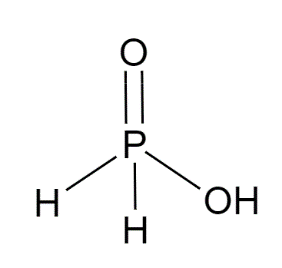
The molecular shape of ${{H}_{3}}P{{O}_{2}}$is pseudo-tetrahedral.
$Cl{{F}_{3}}$- In 1930, Ruff and Krug prepared it by fluorination of chlorine, It also gave ClF, and Distillation was used to separate the mixture.
Preparation-
$3{{F}_{2}}+C{{l}_{2}}\to 2Cl{{F}_{3}}$
Structure of $Cl{{F}_{3}}$ is :
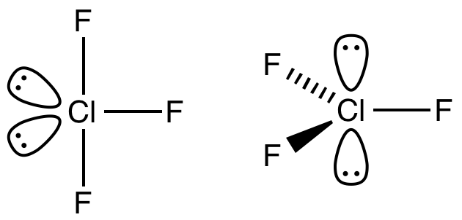
The molecular geometry of $Cl{{F}_{3}}$ is T-shaped.
The structure was predicted by VSEPR theory.
Note:
Uses of ${{H}_{3}}P{{O}_{2}}$ are- It is utilized as a salt (Sodium hypophosphite). It is also used in the electroless plating of Nickel.
Uses of $Cl{{F}_{3}}$are- It helps in cleaning of the chemical vapor deposition chambers in the semiconductor industry. It can be used as a storable oxidizer in rocket propellant systems.
Complete answer:
${{H}_{3}}P{{O}_{2}}$- It is a colorless compound that is water-soluble. It’s a low-melting compound. It is also soluble in dioxane and alcohol. The more descriptive representation of it is $HOP(O){{H}_{2}}$. It has a monoprotic character. Hypophosphites are the name of the salts that are derived from this acid.
$HOP(O){{H}_{2}}$ occurs in the equilibrium with slight tautomer $HP{{(OH)}_{2}}$, It is called hypophosphorous acid whereas the major tautomer is phosphonic acid.
Preparation-
The white phosphorus reacts with a hot aqueous solution of a hydroxide results in the formation of hypophosphite salts.
${{P}_{4}}+O{{H}^{-}}+4{{H}_{2}}O\to 4{{H}_{2}}P{{O}_{2}}^{-}+2{{H}_{2}}$
A strong non-oxidizing acid is reacted with the salt to give hypophosphorous acid.
${{H}_{2}}P{{O}_{2}}^{-}+{{H}^{+}}\to {{H}_{3}}P{{O}_{2}}$
${{H}_{3}}P{{O}_{2}}$is used as a 50% aqueous solution. The evaporation of water cannot form anhydrous acid because the acid disproportionates to phosphorus and phosphine, it gets oxidized to phosphorous acid and phosphoric acid. The continuous extraction of aqueous solution with diethyl ether forms pure anhydrous hypophosphorous acid.
Structure of ${{H}_{3}}P{{O}_{2}}$ is :
The molecular shape of ${{H}_{3}}P{{O}_{2}}$is pseudo-tetrahedral.
$Cl{{F}_{3}}$- In 1930, Ruff and Krug prepared it by fluorination of chlorine, It also gave ClF, and Distillation was used to separate the mixture.
Preparation-
$3{{F}_{2}}+C{{l}_{2}}\to 2Cl{{F}_{3}}$
Structure of $Cl{{F}_{3}}$ is :
The molecular geometry of $Cl{{F}_{3}}$ is T-shaped.
The structure was predicted by VSEPR theory.
Note:
Uses of ${{H}_{3}}P{{O}_{2}}$ are- It is utilized as a salt (Sodium hypophosphite). It is also used in the electroless plating of Nickel.
Uses of $Cl{{F}_{3}}$are- It helps in cleaning of the chemical vapor deposition chambers in the semiconductor industry. It can be used as a storable oxidizer in rocket propellant systems.
Recently Updated Pages
Master Class 11 English: Engaging Questions & Answers for Success

Master Class 11 Physics: Engaging Questions & Answers for Success
Master Class 11 Computer Science: Engaging Questions & Answers for Success
Master Class 11 Chemistry: Engaging Questions & Answers for Success
Master Class 11 Social Science: Engaging Questions & Answers for Success
Master Class 11 Accountancy: Engaging Questions & Answers for Success
Trending doubts
Difference Between Prokaryotic Cells and Eukaryotic Cells
Two of the body parts which do not appear in MRI are class 11 biology CBSE
One Metric ton is equal to kg A 10000 B 1000 C 100 class 11 physics CBSE
10 examples of friction in our daily life
Draw a diagram of nephron and explain its structur class 11 biology CBSE
Draw a diagram of a plant cell and label at least eight class 11 biology CBSE