




Draw the structures of the following:
(1) $HCl{{O}_{4}}$
(2) ${{H}_{3}}P{{O}_{3}}$
Answer
 Verified
663k+ views
Hint: Perchloric acid is monobasic so there will be one $Cl-OH$ bond and Phosphorous acid is dibasic so there will be two $P-OH$ bonds. It has tetrahedral geometry just like methane with bond angle 109.8.
Complete Step by step Answer:
Perchloric acid
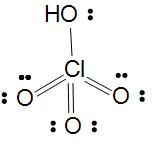
Basicity of oxoacids of Cl is equal to the number of $Cl-OH$ bonds in the molecule.
In Perchloric acid its basicity is 1 as there is one $Cl-OH$ bond in the molecule and three $Cl-O$ bonds due to which it is oxidizing power is less. Here Perchloric acid is monobasic and the halogen(chlorine) is $s{{p}_{3}}$ hybridized.
Halogens forms several oxyacids such as $HOX$, $HOXO$, $HOX{{O}_{2}}$, $HOX{{O}_{3}}$.
Order of acidic strength of oxoacids of the same halogen is
$HCl{{O}_{4}}$>$HCl{{O}_{3}}$>$HCl{{O}_{2}}$>$HCl{{O}_{{}}}$ it’s like this because acidic strength of oxoacids of same halogen increases when there oxidation state increases.
This following trend can also be seen from the stability of anion produced more stable is the conjugate base more is the acidic character.
Oxidizing power of the oxoacids of chlorine is
$HCl{{O}_{4}}$<$HCl{{O}_{3}}$<$HCl{{O}_{2}}$<$HCl{{O}_{{}}}$.
Phosphorous acid
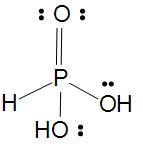
Basicity of oxoacids of P is equal to the number of $P-OH$ bonds in the molecule.
In Phosphorous acid its basicity is 2 as there is two $P-OH$ bond in the molecule which we can also say as dibasic and one $P=O$ bond and one $P-H$ bond which help to be as a strong reducing agents but Phosphorous acid is a weak reducing agent as we can see there is only one $P-H$ bond.
Oxidation state of phosphorus is tetrahedrally surrounded by other atoms.
Phosphorous acid is Dibasic due to the presence of two replaceable hydrogen.
On heating, ${{H}_{3}}P{{O}_{3}}$ undergoes disproportionation reaction to form ${{H}_{3}}P{{O}_{3}}$ and $P{{H}_{3}}$
$4{{H}_{3}}P{{O}_{3}}\xrightarrow{\Delta }3{{H}_{3}}P{{O}_{4}}+P{{H}_{3}}$
Note:
- Phosphorous acid is triprotic as we can judge by the given formula ${{H}_{3}}P{{O}_{3}}$.
- Perchloric acid solids made up of perchlorate anion.
Complete Step by step Answer:
Perchloric acid
Basicity of oxoacids of Cl is equal to the number of $Cl-OH$ bonds in the molecule.
In Perchloric acid its basicity is 1 as there is one $Cl-OH$ bond in the molecule and three $Cl-O$ bonds due to which it is oxidizing power is less. Here Perchloric acid is monobasic and the halogen(chlorine) is $s{{p}_{3}}$ hybridized.
Halogens forms several oxyacids such as $HOX$, $HOXO$, $HOX{{O}_{2}}$, $HOX{{O}_{3}}$.
Order of acidic strength of oxoacids of the same halogen is
$HCl{{O}_{4}}$>$HCl{{O}_{3}}$>$HCl{{O}_{2}}$>$HCl{{O}_{{}}}$ it’s like this because acidic strength of oxoacids of same halogen increases when there oxidation state increases.
This following trend can also be seen from the stability of anion produced more stable is the conjugate base more is the acidic character.
Oxidizing power of the oxoacids of chlorine is
$HCl{{O}_{4}}$<$HCl{{O}_{3}}$<$HCl{{O}_{2}}$<$HCl{{O}_{{}}}$.
Phosphorous acid
Basicity of oxoacids of P is equal to the number of $P-OH$ bonds in the molecule.
In Phosphorous acid its basicity is 2 as there is two $P-OH$ bond in the molecule which we can also say as dibasic and one $P=O$ bond and one $P-H$ bond which help to be as a strong reducing agents but Phosphorous acid is a weak reducing agent as we can see there is only one $P-H$ bond.
Oxidation state of phosphorus is tetrahedrally surrounded by other atoms.
Phosphorous acid is Dibasic due to the presence of two replaceable hydrogen.
On heating, ${{H}_{3}}P{{O}_{3}}$ undergoes disproportionation reaction to form ${{H}_{3}}P{{O}_{3}}$ and $P{{H}_{3}}$
$4{{H}_{3}}P{{O}_{3}}\xrightarrow{\Delta }3{{H}_{3}}P{{O}_{4}}+P{{H}_{3}}$
Note:
- Phosphorous acid is triprotic as we can judge by the given formula ${{H}_{3}}P{{O}_{3}}$.
- Perchloric acid solids made up of perchlorate anion.
Recently Updated Pages
If x a + bt + ct2 where x is in meters and t is in class 11 physics CBSE

A car covers the first half distance between two places class 11 physics CBSE
The resultant of two vectors overrightarrow P and overrightarrow class 11 physics CBSE
Find the value of cos 135 class 11 maths CBSE
A mass M is held in place by an applied force F and class 11 physics CBSE
A solution of glucose in water is labelled as 10 dfracwv class 11 chemistry CBSE
Trending doubts
One Metric ton is equal to kg A 10000 B 1000 C 100 class 11 physics CBSE
Find the value of the expression given below sin 30circ class 11 maths CBSE
What do you mean by retardation What is its SI uni class 11 physics CBSE
Draw a diagram of nephron and explain its structur class 11 biology CBSE
10 examples of friction in our daily life
Difference between physical and chemical change class 11 chemistry CBSE