




Draw the structure of the chromosome and label the parts.
Answer
 Verified
616.5k+ views
Hint: Chromosomes are the long molecules having some or all the genetic material of an organism. It is the package of DNA found in the nucleus of a cell.
Complete answer:
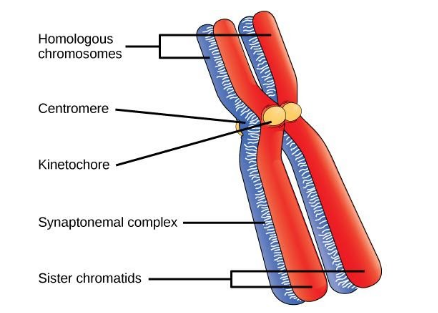
Homologous chromosomes – Homologous chromosomes are a set or pair or chromosome which offspring received from its parent one from the maternal parents and one from the paternal parent. Bothe these chromosomes of maternal and paternal parents combine with each other during the process of fertilization.
Centromere – Centromere is a specialized DNA sequence of a chromosome which links a pair of sister chromatids. During mitosis or meiosis the spindle fibres get attached to the centromere via kinetochore. The function of the centrosome is to act as the site of assembly of the kinetochore.
Kinetochore – Kinetochore is a disc shaped protein structure. Kinetochore is a site where the spindle fibres get attached during the cell division in order to pull sister chromatids apart.
Synaptonemal complex – Synaptonemal complex is a protein structure which is present between the homologous chromosomes during meiosis. This complex mediate synapsis and recombination process during meiosis 1 in eukaryotic organisms.
Sister chromatids – Sister chromatids are the identical copies of a chromosome that are formed by the DNA replication. Both the sister chromatids are joined together at the centromere. A pair of sister chromatids is called dyad.
Note: Without chromosomes, crossing over is not possible. If crossing over does not occur, then there will be no variation in the species. Chromosomes contain genes in the beaded form. And genes are the unit of inheritance which are responsible for the passage of characters from one generation to the next generation.
Complete answer:
Homologous chromosomes – Homologous chromosomes are a set or pair or chromosome which offspring received from its parent one from the maternal parents and one from the paternal parent. Bothe these chromosomes of maternal and paternal parents combine with each other during the process of fertilization.
Centromere – Centromere is a specialized DNA sequence of a chromosome which links a pair of sister chromatids. During mitosis or meiosis the spindle fibres get attached to the centromere via kinetochore. The function of the centrosome is to act as the site of assembly of the kinetochore.
Kinetochore – Kinetochore is a disc shaped protein structure. Kinetochore is a site where the spindle fibres get attached during the cell division in order to pull sister chromatids apart.
Synaptonemal complex – Synaptonemal complex is a protein structure which is present between the homologous chromosomes during meiosis. This complex mediate synapsis and recombination process during meiosis 1 in eukaryotic organisms.
Sister chromatids – Sister chromatids are the identical copies of a chromosome that are formed by the DNA replication. Both the sister chromatids are joined together at the centromere. A pair of sister chromatids is called dyad.
Note: Without chromosomes, crossing over is not possible. If crossing over does not occur, then there will be no variation in the species. Chromosomes contain genes in the beaded form. And genes are the unit of inheritance which are responsible for the passage of characters from one generation to the next generation.
Recently Updated Pages
Master Class 11 English: Engaging Questions & Answers for Success

Master Class 11 Social Science: Engaging Questions & Answers for Success
Master Class 11 Maths: Engaging Questions & Answers for Success
Master Class 11 Biology: Engaging Questions & Answers for Success
Master Class 11 Physics: Engaging Questions & Answers for Success
Master Class 11 Chemistry: Engaging Questions & Answers for Success
Trending doubts
One Metric ton is equal to kg A 10000 B 1000 C 100 class 11 physics CBSE
Difference Between Prokaryotic Cells and Eukaryotic Cells
Find the value of the expression given below sin 30circ class 11 maths CBSE
Difference between physical and chemical change class 11 chemistry CBSE
Two of the body parts which do not appear in MRI are class 11 biology CBSE
Draw a diagram of a plant cell and label at least eight class 11 biology CBSE