




Draw the structure of parenchyma, label and mention its functions.
Answer
 Verified
606.6k+ views
Hint: Parenchyma is one of the easy permanent tissues that help in creating a main portion of indispensable or ground tissues in plants. There are mainly three kinds of simple permanent tissues observed in plants Parenchyma, Collenchyma, and Sclerenchyma.
Complete answer:
Parenchyma cells are termed as living cells. A vital part for respective organisms, its basic structural characteristics are noted below.
i) This ground cell consists of distinguished protoplasts and nuclei. Mostly, parenchymas are polyhedral or isodiametric in shape. However, these cells can be observed as round, oval, elongated, or polygonal as well.
ii) The intercellular space of parenchyma is small, and the cells may additionally be tightly packed.
They have skinny cellophane walls which are composed of hemicelluloses and cellulose.
iii) In a parenchyma tissue, plasmodesmata joins all the cells. These cells have more than one small vacuole. In older parenchyma, these small vacuoles fuse and structure a large central vacuole. This large vacuole accumulates tannins or anthocyanin.
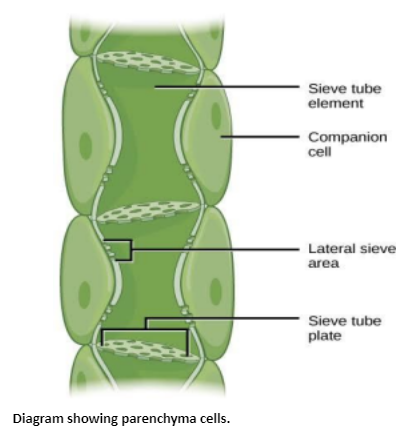
iv) Vacuoles in parenchyma have plentiful water, and they work as water reservoirs of plants.
v) Storage parenchyma can have thick mobile walls of xyloglucan like the endosperm of a date palm. During the germination of seeds, the sugar is utilised and the partitions are decreased to thin layers.
vi) Chromoplast is existing in the parenchyma of fruits and flowers.
vii) Sometimes, parenchyma also has a thick lignified mobile phone wall comparable to sclerenchyma.
viii) The mechanical power of parenchyma is derived from the cell's hydraulic property. Parenchyma contains chloroplast that in particular performs photosynthesis
Note: Parenchyma cells made up of thin-walled, living, simple, and structure-wise unspecialised cells. Thus, these cells are adaptable for quite a few functions. Notably, these floor tissues are neither embedded nor vascular. Moreover, parenchyma tissue is alive, and hence it can be worried in secretion, food storage, photosynthesis, and more than a few different existence procedures of plants.
Complete answer:
Parenchyma cells are termed as living cells. A vital part for respective organisms, its basic structural characteristics are noted below.
i) This ground cell consists of distinguished protoplasts and nuclei. Mostly, parenchymas are polyhedral or isodiametric in shape. However, these cells can be observed as round, oval, elongated, or polygonal as well.
ii) The intercellular space of parenchyma is small, and the cells may additionally be tightly packed.
They have skinny cellophane walls which are composed of hemicelluloses and cellulose.
iii) In a parenchyma tissue, plasmodesmata joins all the cells. These cells have more than one small vacuole. In older parenchyma, these small vacuoles fuse and structure a large central vacuole. This large vacuole accumulates tannins or anthocyanin.
iv) Vacuoles in parenchyma have plentiful water, and they work as water reservoirs of plants.
v) Storage parenchyma can have thick mobile walls of xyloglucan like the endosperm of a date palm. During the germination of seeds, the sugar is utilised and the partitions are decreased to thin layers.
vi) Chromoplast is existing in the parenchyma of fruits and flowers.
vii) Sometimes, parenchyma also has a thick lignified mobile phone wall comparable to sclerenchyma.
viii) The mechanical power of parenchyma is derived from the cell's hydraulic property. Parenchyma contains chloroplast that in particular performs photosynthesis
Note: Parenchyma cells made up of thin-walled, living, simple, and structure-wise unspecialised cells. Thus, these cells are adaptable for quite a few functions. Notably, these floor tissues are neither embedded nor vascular. Moreover, parenchyma tissue is alive, and hence it can be worried in secretion, food storage, photosynthesis, and more than a few different existence procedures of plants.
Recently Updated Pages
Write structures of the following compounds i 2 Chloro3methylpentane class 11 chemistry CBSE

If x a + bt + ct2 where x is in meters and t is in class 11 physics CBSE
A car covers the first half distance between two places class 11 physics CBSE
The resultant of two vectors overrightarrow P and overrightarrow class 11 physics CBSE
Find the value of cos 135 class 11 maths CBSE
A mass M is held in place by an applied force F and class 11 physics CBSE
Trending doubts
Find the value of the expression given below sin 30circ class 11 maths CBSE
One Metric ton is equal to kg A 10000 B 1000 C 100 class 11 physics CBSE
Draw a diagram of nephron and explain its structur class 11 biology CBSE
10 examples of friction in our daily life
Draw a diagram of a plant cell and label at least eight class 11 biology CBSE
Difference Between Prokaryotic Cells and Eukaryotic Cells