




Draw the shape of the $ CI{{F}_{}}^{+} $ ions, including any lone pairs, and name the shape made by the atoms? Predict the bond angle in the ion?
Answer
 Verified
507.6k+ views
Hint: $ CI{{F}_{}}^{+} $ is referred to as difluorochloranium. It is formed when $ CI{{F}_{3}} $ loses one fluorine atom. It gains a positive charge from the removal of one cation from the $ CI{{F}_{3}} $ structure. The shape of $ CI{{F}_{}}^{+} $ will differ from that of $ CI{{F}_{3}} $ the compound. Also, the bond angle will reduce in the unipositive molecule.
Complete answer:
$ CI{{F}_{}}^{+} $ has two fluorine atoms and a central chlorine atom. Firstly, we will draw the Lewis structure $ CI{{F}_{}}^{+} $ . The positive charge will be positioned on Chlorine. Chlorine will be in the centre with the two fluorine atoms on either side.
Let’s take into account all the electrons in the structure. Chlorine has 7 atoms in the valence shell and so do fluorine atoms. So, the total electrons from one chlorine and two fluorine result in 21 electrons. But as it has a positive charge so an electron will be deducted from the total valence electrons.
$ \therefore \text{ Total No}\text{. of }{{\text{e}}^{-}}\text{ = No}\text{. of }{{\text{e}}^{-}}\text{ on Cl + 2 }\times \text{ No}\text{. of }{{\text{e}}^{-}}\text{ on }{{\text{F}}^{-}} $
$ =\text{ 7 + 2 }\times \text{ 7 - 1} $
$ =\text{ 20 }{{\text{e}}^{-}} $
Total electrons are 20, so the lone pairs will be 10 in $ CI{{F}_{}}^{+} $ . Two electrons are shared between each atom to form a bond. Thus, each atom will complete its octet of electrons.
The Lewis structure of $ CI{{F}_{}}^{+} $ is as follows:
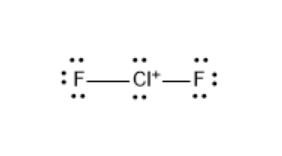
$ CI{{F}_{}}^{+} $ has three lone pairs each on fluoride atoms and two lone pairs on chlorine atoms. Also, 2 bonding pairs are used to make two F-Cl bonds.
The shape of the ion is determined by the VSEPR theory. The central atom possesses 2 lone pairs and 2 bonding pairs i.e. 4 electrons in each domain. Thus according to the VSEPR theory, the electron geometry is tetrahedral.
However, the molecular geometry only includes the bonding pairs so the molecular shape is ‘bent’ with a theoretical bond angle of $109.5^\circ$.
Note:
The actual bond angle comes out to be 104.5o. But due to the repulsion caused by the lone pair of electrons on the central atom the F-Cl-F bond angle changes to 109.5o. The electron cloud is placed at an angle above the chlorine atom to cause minimum repulsion.
Complete answer:
$ CI{{F}_{}}^{+} $ has two fluorine atoms and a central chlorine atom. Firstly, we will draw the Lewis structure $ CI{{F}_{}}^{+} $ . The positive charge will be positioned on Chlorine. Chlorine will be in the centre with the two fluorine atoms on either side.
Let’s take into account all the electrons in the structure. Chlorine has 7 atoms in the valence shell and so do fluorine atoms. So, the total electrons from one chlorine and two fluorine result in 21 electrons. But as it has a positive charge so an electron will be deducted from the total valence electrons.
$ \therefore \text{ Total No}\text{. of }{{\text{e}}^{-}}\text{ = No}\text{. of }{{\text{e}}^{-}}\text{ on Cl + 2 }\times \text{ No}\text{. of }{{\text{e}}^{-}}\text{ on }{{\text{F}}^{-}} $
$ =\text{ 7 + 2 }\times \text{ 7 - 1} $
$ =\text{ 20 }{{\text{e}}^{-}} $
Total electrons are 20, so the lone pairs will be 10 in $ CI{{F}_{}}^{+} $ . Two electrons are shared between each atom to form a bond. Thus, each atom will complete its octet of electrons.
The Lewis structure of $ CI{{F}_{}}^{+} $ is as follows:
$ CI{{F}_{}}^{+} $ has three lone pairs each on fluoride atoms and two lone pairs on chlorine atoms. Also, 2 bonding pairs are used to make two F-Cl bonds.
The shape of the ion is determined by the VSEPR theory. The central atom possesses 2 lone pairs and 2 bonding pairs i.e. 4 electrons in each domain. Thus according to the VSEPR theory, the electron geometry is tetrahedral.
However, the molecular geometry only includes the bonding pairs so the molecular shape is ‘bent’ with a theoretical bond angle of $109.5^\circ$.
Note:
The actual bond angle comes out to be 104.5o. But due to the repulsion caused by the lone pair of electrons on the central atom the F-Cl-F bond angle changes to 109.5o. The electron cloud is placed at an angle above the chlorine atom to cause minimum repulsion.
Recently Updated Pages
Master Class 11 Social Science: Engaging Questions & Answers for Success

Master Class 11 Physics: Engaging Questions & Answers for Success
Master Class 11 Maths: Engaging Questions & Answers for Success
Master Class 11 Economics: Engaging Questions & Answers for Success
Master Class 11 Computer Science: Engaging Questions & Answers for Success
Master Class 11 Chemistry: Engaging Questions & Answers for Success
Trending doubts
One Metric ton is equal to kg A 10000 B 1000 C 100 class 11 physics CBSE
There are 720 permutations of the digits 1 2 3 4 5 class 11 maths CBSE
1 Quintal is equal to a 110 kg b 10 kg c 100kg d 1000 class 11 physics CBSE
State and prove Bernoullis theorem class 11 physics CBSE
Difference Between Prokaryotic Cells and Eukaryotic Cells
Which among the following are examples of coming together class 11 social science CBSE