




Draw the pyranose structure of glucose.
Answer
 Verified
619.2k+ views
Hint: The pyranose structure of glucose is similar to the organic compound pyran, which is a six membered ring with one oxygen and five carbon atoms in the ring.
Complete answer:
In order to answer the question, we need to learn about the structure and properties of glucose.
Cyclic structure of glucose: The limitations shown by the open chain structure of glucose can be explained by its cyclic structure. It was proposed that glucose can form a six-membered ring in which $-OH$ at C-5 can add to the $-CHO$ group and can form a cyclic hemiacetal structure. This explains the absence of $-CHO$ group and also the existence of glucose in $\alpha ,\beta $ forms.
The two cyclic hemiacetal forms of glucose differ only in the configuration of the hydroxyl group at C-1, called anomeric carbon (the aldehyde carbon before cyclisation) and the corresponding $\alpha $ and $\beta $ forms are called anomers. It should be noted that a and B-forms of glucose are not mirror images of each other, hence are not enantiomers. The six membered cyclic structure of glucose is called pyranose structure ($\alpha $ or $\beta $), in analogy with pyran.
Pyran is a six membered ring with one oxygen and five carbon atoms in the ring. The cyclic structure of glucose can be more accurately shown by Haworth structure as given below:
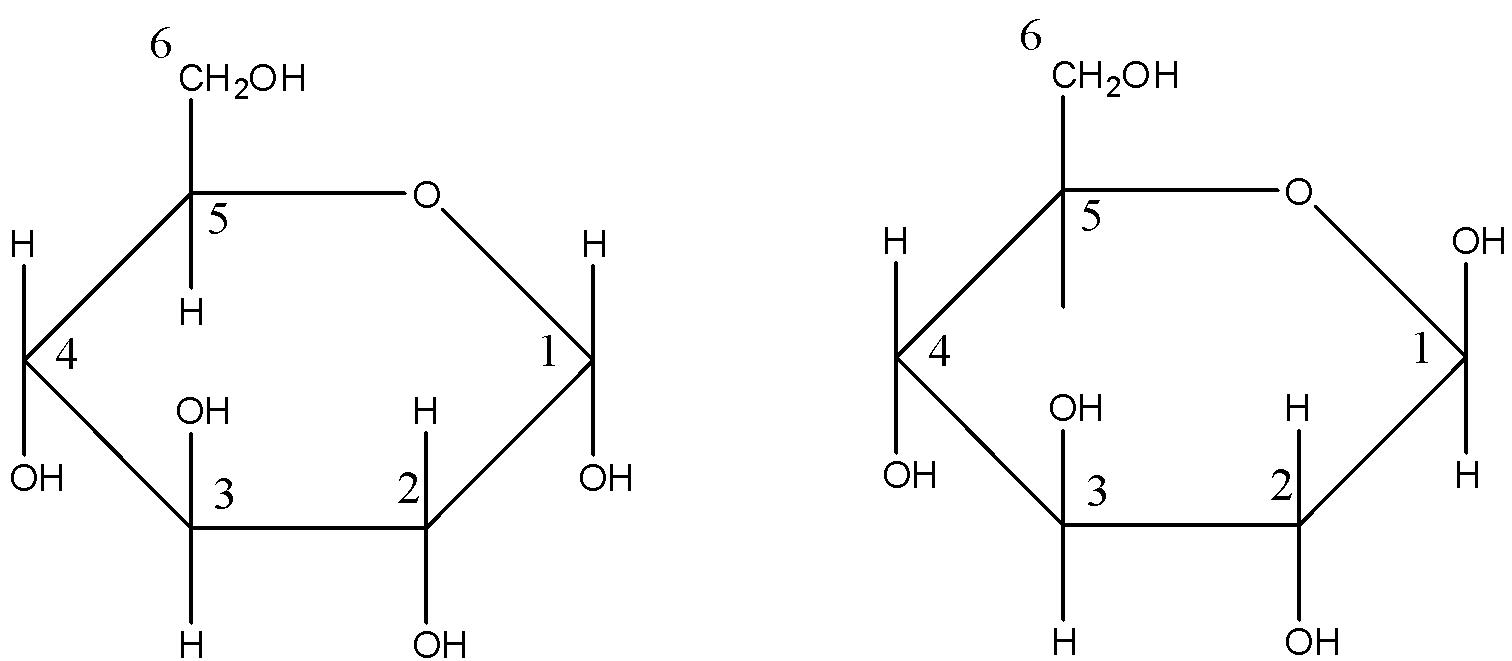
The left diagram shows the structure of $\alpha $-D-( + ) Glucopyranose and the right diagram shows the structure of $\beta $-D-( + ) Glucopyranose.
Note:
It is to be noted that the cyclic structure of glucose was so given because the existence of glucose in $\alpha ,\beta $ forms could not be explained by it’s open chain structure.
Complete answer:
In order to answer the question, we need to learn about the structure and properties of glucose.
Cyclic structure of glucose: The limitations shown by the open chain structure of glucose can be explained by its cyclic structure. It was proposed that glucose can form a six-membered ring in which $-OH$ at C-5 can add to the $-CHO$ group and can form a cyclic hemiacetal structure. This explains the absence of $-CHO$ group and also the existence of glucose in $\alpha ,\beta $ forms.
The two cyclic hemiacetal forms of glucose differ only in the configuration of the hydroxyl group at C-1, called anomeric carbon (the aldehyde carbon before cyclisation) and the corresponding $\alpha $ and $\beta $ forms are called anomers. It should be noted that a and B-forms of glucose are not mirror images of each other, hence are not enantiomers. The six membered cyclic structure of glucose is called pyranose structure ($\alpha $ or $\beta $), in analogy with pyran.
Pyran is a six membered ring with one oxygen and five carbon atoms in the ring. The cyclic structure of glucose can be more accurately shown by Haworth structure as given below:
The left diagram shows the structure of $\alpha $-D-( + ) Glucopyranose and the right diagram shows the structure of $\beta $-D-( + ) Glucopyranose.
Note:
It is to be noted that the cyclic structure of glucose was so given because the existence of glucose in $\alpha ,\beta $ forms could not be explained by it’s open chain structure.
Recently Updated Pages
Which will be the least stable resonating structure class 11 chemistry CBSE

How many 5 digit telephone numbers can be construc-class-11-maths-CBSE
How do you find the angle of the resultant vector class 11 physics CBSE
Draw labelled diagram of the following i Gram seed class 11 biology CBSE
1 Quintal is equal to a 110 kg b 10 kg c 100kg d 1000 class 11 physics CBSE
What is the need and importance of classification class 11 biology CBSE
Trending doubts
Find the value of the expression given below sin 30circ class 11 maths CBSE
One Metric ton is equal to kg A 10000 B 1000 C 100 class 11 physics CBSE
10 examples of friction in our daily life
Draw a diagram of a plant cell and label at least eight class 11 biology CBSE
Difference between physical and chemical change class 11 chemistry CBSE
Proton was discovered by A Thomson B Rutherford C Chadwick class 11 chemistry CBSE