




How do you draw the product of the hydrogenation of ethyne?
Answer
 Verified
610.8k+ views
Hint: We know that the hydrogenation reaction involves the direct reaction of a substrate containing $ \pi - $ bonds or $ \pi - $ bond like nature with $ {{H}_{2}} $ molecule using a metal like Palladium $ \left( Pd \right) $ , Platinum $ \left( Pt \right) $ , Rhodium $ \left( Rh \right) $ or Nickel $ \left( Ni \right) $ as a base of support for the reaction giving rise to products which may be partially hydrogenated or completely hydrogenated.
Complete step by step answer:
When we treat ethyne which is a chemical species represented by $ HC\equiv CH $ and contains $ 2\pi -bonds $ with a hydrogenating reagent, the product we would obtain is a cis-hydrogenation product always. The one difference however that we may obtain in the product is the number of $ \pi -bonds $ left in them, depending on the reagent used we may obtain an ethene $ \left( C{{H}_{2}}=C{{H}_{2}} \right) $ or an ethane $ \left( C{{H}_{3}}-C{{H}_{3}} \right) $ as the final product. An illustration to show this is provided below:-
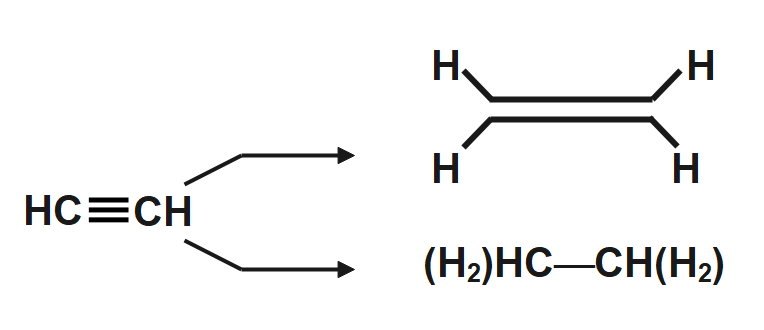
The Hydrogens shown in orange are the hydrogens that are obtained from $ {{H}_{2}} $ as you can clearly see the hydrogenation occurs in a cis-manner as seen clear in the product $ \left[ A \right] $ .
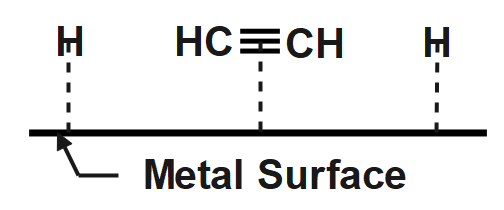
Depending on what reagent has been used the partial hydrogenation product $ \left[ A \right] $ or the complete hydrogenation product $ \left[ B \right] $ is obtained. So we must be clearly wary about the reaction conditions and draw the products required accordingly. To help understand the process of hydrogenation in an even more clear manner let us look at the illustration below:
Note: Note that generally for partial hydrogenation a catalyst is poisoned using some chemical species which reduces its reactivity so take note on every species present also when forming ethane you don’t need to show cis-attack as in case of ethane due to presence of only a single bond it can easily rotate and thus no purely cis or trans species can be obtained for ethane.
Complete step by step answer:
When we treat ethyne which is a chemical species represented by $ HC\equiv CH $ and contains $ 2\pi -bonds $ with a hydrogenating reagent, the product we would obtain is a cis-hydrogenation product always. The one difference however that we may obtain in the product is the number of $ \pi -bonds $ left in them, depending on the reagent used we may obtain an ethene $ \left( C{{H}_{2}}=C{{H}_{2}} \right) $ or an ethane $ \left( C{{H}_{3}}-C{{H}_{3}} \right) $ as the final product. An illustration to show this is provided below:-
The Hydrogens shown in orange are the hydrogens that are obtained from $ {{H}_{2}} $ as you can clearly see the hydrogenation occurs in a cis-manner as seen clear in the product $ \left[ A \right] $ .
Depending on what reagent has been used the partial hydrogenation product $ \left[ A \right] $ or the complete hydrogenation product $ \left[ B \right] $ is obtained. So we must be clearly wary about the reaction conditions and draw the products required accordingly. To help understand the process of hydrogenation in an even more clear manner let us look at the illustration below:
Note: Note that generally for partial hydrogenation a catalyst is poisoned using some chemical species which reduces its reactivity so take note on every species present also when forming ethane you don’t need to show cis-attack as in case of ethane due to presence of only a single bond it can easily rotate and thus no purely cis or trans species can be obtained for ethane.
Recently Updated Pages
Which will be the least stable resonating structure class 11 chemistry CBSE

How many 5 digit telephone numbers can be construc-class-11-maths-CBSE
How do you find the angle of the resultant vector class 11 physics CBSE
Draw labelled diagram of the following i Gram seed class 11 biology CBSE
1 Quintal is equal to a 110 kg b 10 kg c 100kg d 1000 class 11 physics CBSE
What is the need and importance of classification class 11 biology CBSE
Trending doubts
Find the value of the expression given below sin 30circ class 11 maths CBSE
One Metric ton is equal to kg A 10000 B 1000 C 100 class 11 physics CBSE
10 examples of friction in our daily life
Draw a diagram of a plant cell and label at least eight class 11 biology CBSE
Difference between physical and chemical change class 11 chemistry CBSE
Proton was discovered by A Thomson B Rutherford C Chadwick class 11 chemistry CBSE