




Draw the labeled diagram of the ear. Write a note on the mechanism of hearing.
Answer
 Verified
630.6k+ views
Hint: This is the main organ of hearing and balance in the human body. The main function of this organ is to transmit and transduce sound to the brain through its parts.
Complete step by step answer:
Mechanism of hearing:
- The external ear receives and collects the sound waves and then directs them to the eardrum
- The sound waves travel through the external auditory canal
- The eardrum vibrates and these vibrations are passed to the three ear ossicles (malleus, incus, and stapes) in the middle ear.
- the ear ossicles increase the intensity of the sound vibrations and transmit them to the oval window.
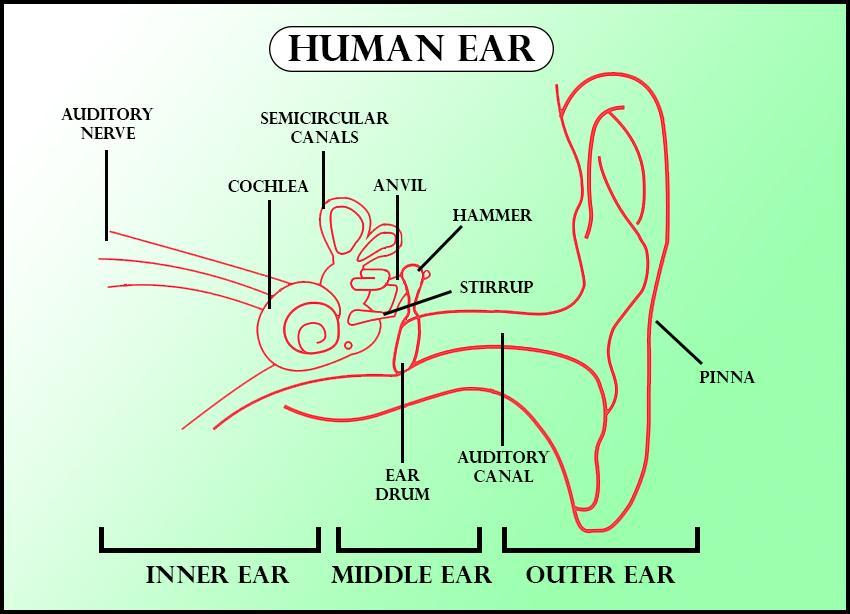
The vibrations pass through the oval window till the cochlea where they generate the waves in the lymph present in the cochlea
- Firstly the waves are generated in the perilymph present in the scala vestibuli and then in the endolymph present in the scala media.
- The waves in the endolymph induce a ripple in the basilar membrane
- The basilar movements bend the hair cells present in the organ of Corti pressing them against the tectorial membrane.
- This generates the nerve impulse in the associated afferent neurons
- The impulse gets transmitted to the auditory region of the brain via the auditory nerve.
- The impulse gets analyzed and thus the sound is recognized
Note:
- Three main parts of the ear i.e. outer ear, middle ear, and inner ear have different functions. They have different features that facilitate hearing and balance.
- They are delicate organs that can have problems due to damage, bacteria, or even changes in the environment.
Complete step by step answer:
Mechanism of hearing:
- The external ear receives and collects the sound waves and then directs them to the eardrum
- The sound waves travel through the external auditory canal
- The eardrum vibrates and these vibrations are passed to the three ear ossicles (malleus, incus, and stapes) in the middle ear.
- the ear ossicles increase the intensity of the sound vibrations and transmit them to the oval window.
The vibrations pass through the oval window till the cochlea where they generate the waves in the lymph present in the cochlea
- Firstly the waves are generated in the perilymph present in the scala vestibuli and then in the endolymph present in the scala media.
- The waves in the endolymph induce a ripple in the basilar membrane
- The basilar movements bend the hair cells present in the organ of Corti pressing them against the tectorial membrane.
- This generates the nerve impulse in the associated afferent neurons
- The impulse gets transmitted to the auditory region of the brain via the auditory nerve.
- The impulse gets analyzed and thus the sound is recognized
Note:
- Three main parts of the ear i.e. outer ear, middle ear, and inner ear have different functions. They have different features that facilitate hearing and balance.
- They are delicate organs that can have problems due to damage, bacteria, or even changes in the environment.
Recently Updated Pages
Master Class 11 English: Engaging Questions & Answers for Success

Master Class 11 Physics: Engaging Questions & Answers for Success
Master Class 11 Computer Science: Engaging Questions & Answers for Success
Master Class 11 Chemistry: Engaging Questions & Answers for Success
Master Class 11 Social Science: Engaging Questions & Answers for Success
Master Class 11 Accountancy: Engaging Questions & Answers for Success
Trending doubts
Difference Between Prokaryotic Cells and Eukaryotic Cells
Two of the body parts which do not appear in MRI are class 11 biology CBSE
One Metric ton is equal to kg A 10000 B 1000 C 100 class 11 physics CBSE
10 examples of friction in our daily life
Draw a diagram of nephron and explain its structur class 11 biology CBSE
Draw a diagram of a plant cell and label at least eight class 11 biology CBSE