




Draw the graphs of the quadratic polynomial, \[f(x)=3-2x-{{x}^{2}}\].
Answer
 Verified
650.4k+ views
Hint: Put \[f(x)=y\]. Thus give x various values and get the coordinates (x, y) to plot the graph. After plotting the points, join the points with a smooth free hand curve and identify the curve that we have obtained.
Complete step by step answer:
Given us is the quadratic polynomial \[f(x)=3-2x-{{x}^{2}}\].
Let us put \[f(x)=y\].
\[\therefore y=3-2x-{{x}^{2}}\]
Now let us list a few values of \[y=3-2x-{{x}^{2}}\] corresponding to the values of x as,
Thus the following points lie on the graph of the polynomial \[y=3-2x-{{x}^{2}}\].
Thus the 11 points are (-5, -12), (-4, -5), (-3, 0), (-2, 3) (-1, 4), (0, 3), (1, 0), (2, -5), (3, -12), (4, -21), (5, -29).
Now let us plot these points on a graph paper and draw a smooth free hand arriving passing through three points to obtain the graphs of \[y=3-2x-{{x}^{2}}\].
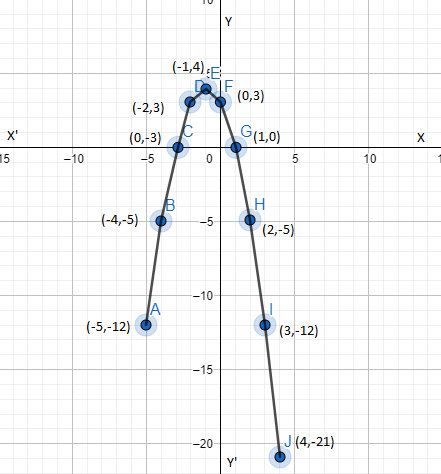
The curve thus obtained represents a parabola. The highest point P (1,-4) is called a maximum point, is the vertex of the parabola. Vertical line through P is the axis of the parabola.
Thus the parabola is symmetric about the axis.
If we factorize the polynomial \[f(x)=3-2x-{{x}^{2}}\], we get, i.e. , the product of 2 terms should be 3.
Sum of the 2 terms should be -2.
Thus we get factorized f(x) as (1-x) (x+3) which is two distinct linear factors.
So the parabola cuts x-axis at two distinct points (1,0) and (-3,0). The coordinates of three points are zeroes of f(x).
Thus we got the required parabola which is symmetric about the x-axis.
Note: The coefficient of \[{{x}^{2}}\] in \[f(x)=3-2x-{{x}^{2}}\] is 1. It is a negative real number and so the parabola opens downwards. Be careful while plotting the point, if marking the point wrong, we may get the curve it won’t be parabola.
Complete step by step answer:
Given us is the quadratic polynomial \[f(x)=3-2x-{{x}^{2}}\].
Let us put \[f(x)=y\].
\[\therefore y=3-2x-{{x}^{2}}\]
Now let us list a few values of \[y=3-2x-{{x}^{2}}\] corresponding to the values of x as,
| x | -5 | -4 | -3 | -2 | -1 | 0 | 1 | 2 | 3 | 4 | 5 |
| \[y=3-2x-{{x}^{2}}\] | -12 | -5 | 0 | 3 | 4 | 3 | 0 | -5 | -12 | -21 | -29 |
Thus the following points lie on the graph of the polynomial \[y=3-2x-{{x}^{2}}\].
Thus the 11 points are (-5, -12), (-4, -5), (-3, 0), (-2, 3) (-1, 4), (0, 3), (1, 0), (2, -5), (3, -12), (4, -21), (5, -29).
Now let us plot these points on a graph paper and draw a smooth free hand arriving passing through three points to obtain the graphs of \[y=3-2x-{{x}^{2}}\].
The curve thus obtained represents a parabola. The highest point P (1,-4) is called a maximum point, is the vertex of the parabola. Vertical line through P is the axis of the parabola.
Thus the parabola is symmetric about the axis.
If we factorize the polynomial \[f(x)=3-2x-{{x}^{2}}\], we get, i.e. , the product of 2 terms should be 3.
Sum of the 2 terms should be -2.
Thus we get factorized f(x) as (1-x) (x+3) which is two distinct linear factors.
So the parabola cuts x-axis at two distinct points (1,0) and (-3,0). The coordinates of three points are zeroes of f(x).
Thus we got the required parabola which is symmetric about the x-axis.
Note: The coefficient of \[{{x}^{2}}\] in \[f(x)=3-2x-{{x}^{2}}\] is 1. It is a negative real number and so the parabola opens downwards. Be careful while plotting the point, if marking the point wrong, we may get the curve it won’t be parabola.
Recently Updated Pages
Master Class 11 English: Engaging Questions & Answers for Success

Master Class 11 Social Science: Engaging Questions & Answers for Success
Master Class 11 Maths: Engaging Questions & Answers for Success
Master Class 11 Chemistry: Engaging Questions & Answers for Success
Master Class 11 Biology: Engaging Questions & Answers for Success
Master Class 11 Physics: Engaging Questions & Answers for Success
Trending doubts
Explain the Treaty of Vienna of 1815 class 10 social science CBSE
Why is it 530 pm in india when it is 1200 afternoon class 10 social science CBSE
What is the full form of CNG A Complete Natural Gas class 10 social science CBSE
In cricket, what is a "Yorker" designed to do?
What is the full form of POSCO class 10 social science CBSE
Define Potential, Developed, Stock and Reserved resources