




Draw the graph of $y=2{{x}^{2}}$ and hence solve $2{{x}^{2}}+x-6=0$ .
Answer
 Verified
548.1k+ views
Hint: Any year which has 366 days is called a leap year. Non-leap year contains 365 days. We have to find 80% of 365 days. We will write this mathematically as $80%\times 365$ . Then, we have to convert 80% into its number form by dividing 80 by 100 and simplify.
Complete step by step answer:
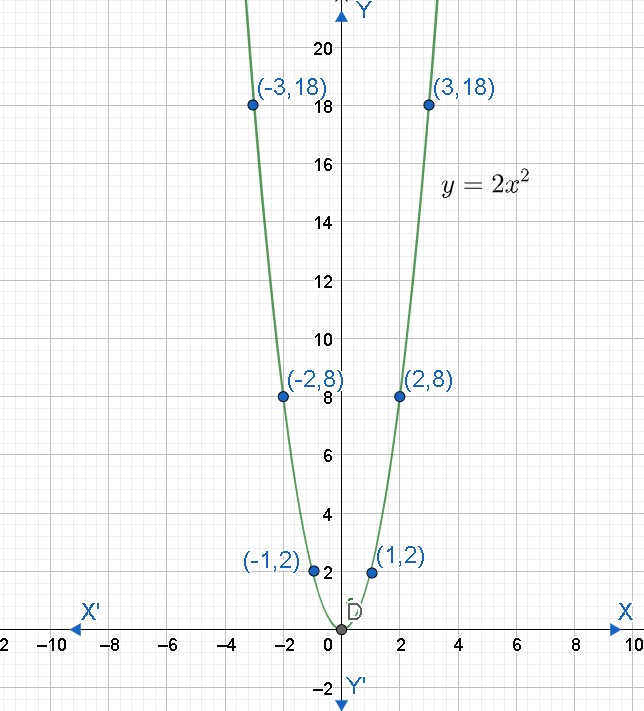
We have to draw the graph of $y=2{{x}^{2}}$ and hence solve $2{{x}^{2}}+x-6=0$ . Let us first draw the graph of $y=2{{x}^{2}}$ by substituting different values of x and find the corresponding values of y.
Let us consider when $x=-3,-2,1,0,1,2,3$ .
When $x=-3$ , we can find y as
$y=2\times {{\left( -3 \right)}^{2}}=2\times 9=18$
When $x=-2$ , we can find y as
$y=2\times {{\left( -2 \right)}^{2}}=2\times 4=8$
When $x=-1$ ,
$y=2\times {{\left( -1 \right)}^{2}}=2\times 1=2$
When $x=0$ ,
$y=2\times {{\left( 0 \right)}^{2}}=0$
Similarly, we have to find the for $x=1,2,3$ .
We can tabulate the corresponding y values as follows.
Now, let us plot the points $\left( -3,18 \right),\left( -2,8 \right),\left( -1,2 \right),\left( 0,0 \right),\left( 1,2 \right),\left( 2,8 \right),\left( 3,18 \right)$ .
Now, let us consider the equation $2{{x}^{2}}+x-6=0...\left( i \right)$ .
We are given that $y=2{{x}^{2}}$ . Let us substitute this value in the equation (i).
$\Rightarrow y+x-6=0$
We have to take all the terms other than y to the RHS.
$\Rightarrow y=6-x$
We have to substitute different values of x and find the corresponding values of y.
Let us consider $x=-3$ .
$\Rightarrow y=6-\left( -3 \right)=6+3=9$
When $x=-2$ ,
$\Rightarrow y=6-\left( -2 \right)=6+2=8$
When $x=-1$ ,
$\Rightarrow y=6-\left( -1 \right)=6+1=7$
When $x=0$ ,
$\Rightarrow y=6-\left( 0 \right)=6-0=6$
Similarly, we have to find the for $x=1,2,3$ .
We can tabulate the corresponding y values as follows.
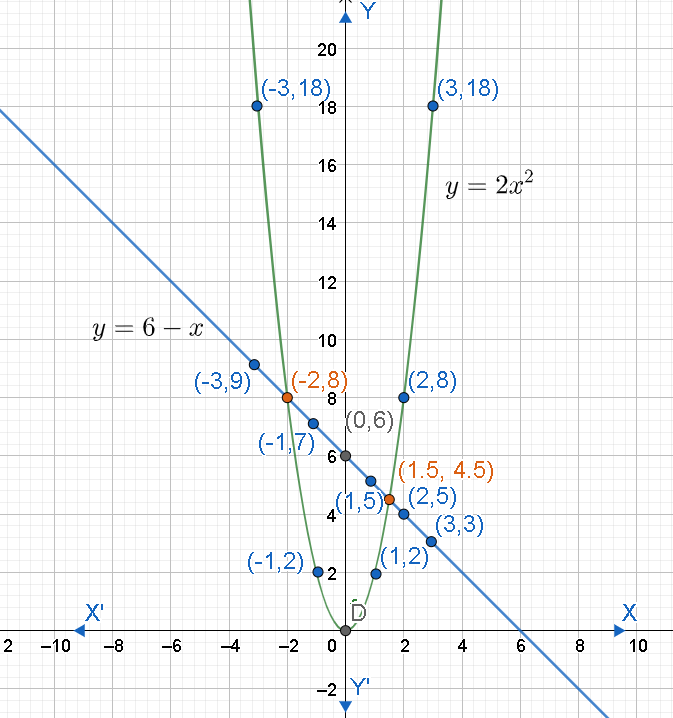
Now, let us plot the points $\left( -3,9 \right),\left( -2,8 \right),\left( -1,7 \right),\left( 0,6 \right),\left( 1,5 \right),\left( 2,4 \right),\left( 3,3 \right)$ .
From the graph, we have to look for the points of the intersection of equations $y=2{{x}^{2}}$ and $y=6-x$ .
We can see that both the equations intersect at $\left( -2,8 \right)$ and $\left( 1.5,4.5 \right)$ (shown as red colour in the graph). The solution of $y=6-x$ will be the set of x coordinates of the points of intersection.
Hence, the solution of $2{{x}^{2}}+x-6=0$ is $\left\{ -2,1.5 \right\}$ .
Note: Students must draw the graph of $2{{x}^{2}}+x-6=0$ in the graph of $y=2{{x}^{2}}$ . They must note that the solution set will be the set of x coordinates of the points of intersection not the y-coordinates. They must know to simplify an equation. Students must make the second equation in terms of y.
Complete step by step answer:
We have to draw the graph of $y=2{{x}^{2}}$ and hence solve $2{{x}^{2}}+x-6=0$ . Let us first draw the graph of $y=2{{x}^{2}}$ by substituting different values of x and find the corresponding values of y.
Let us consider when $x=-3,-2,1,0,1,2,3$ .
When $x=-3$ , we can find y as
$y=2\times {{\left( -3 \right)}^{2}}=2\times 9=18$
When $x=-2$ , we can find y as
$y=2\times {{\left( -2 \right)}^{2}}=2\times 4=8$
When $x=-1$ ,
$y=2\times {{\left( -1 \right)}^{2}}=2\times 1=2$
When $x=0$ ,
$y=2\times {{\left( 0 \right)}^{2}}=0$
Similarly, we have to find the for $x=1,2,3$ .
We can tabulate the corresponding y values as follows.
| x | -3 | -2 | -1 | 0 | 1 | 2 | 3 |
| $y=2{{x}^{2}}$ | 18 | 8 | 2 | 0 | 2 | 4 | 18 |
Now, let us plot the points $\left( -3,18 \right),\left( -2,8 \right),\left( -1,2 \right),\left( 0,0 \right),\left( 1,2 \right),\left( 2,8 \right),\left( 3,18 \right)$ .
Now, let us consider the equation $2{{x}^{2}}+x-6=0...\left( i \right)$ .
We are given that $y=2{{x}^{2}}$ . Let us substitute this value in the equation (i).
$\Rightarrow y+x-6=0$
We have to take all the terms other than y to the RHS.
$\Rightarrow y=6-x$
We have to substitute different values of x and find the corresponding values of y.
Let us consider $x=-3$ .
$\Rightarrow y=6-\left( -3 \right)=6+3=9$
When $x=-2$ ,
$\Rightarrow y=6-\left( -2 \right)=6+2=8$
When $x=-1$ ,
$\Rightarrow y=6-\left( -1 \right)=6+1=7$
When $x=0$ ,
$\Rightarrow y=6-\left( 0 \right)=6-0=6$
Similarly, we have to find the for $x=1,2,3$ .
We can tabulate the corresponding y values as follows.
| x | -3 | -2 | -1 | 0 | 1 | 2 | 3 |
| $y=6-x$ | 9 | 8 | 7 | 6 | 5 | 4 | 3 |
Now, let us plot the points $\left( -3,9 \right),\left( -2,8 \right),\left( -1,7 \right),\left( 0,6 \right),\left( 1,5 \right),\left( 2,4 \right),\left( 3,3 \right)$ .
From the graph, we have to look for the points of the intersection of equations $y=2{{x}^{2}}$ and $y=6-x$ .
We can see that both the equations intersect at $\left( -2,8 \right)$ and $\left( 1.5,4.5 \right)$ (shown as red colour in the graph). The solution of $y=6-x$ will be the set of x coordinates of the points of intersection.
Hence, the solution of $2{{x}^{2}}+x-6=0$ is $\left\{ -2,1.5 \right\}$ .
Note: Students must draw the graph of $2{{x}^{2}}+x-6=0$ in the graph of $y=2{{x}^{2}}$ . They must note that the solution set will be the set of x coordinates of the points of intersection not the y-coordinates. They must know to simplify an equation. Students must make the second equation in terms of y.
Recently Updated Pages
Master Class 12 Business Studies: Engaging Questions & Answers for Success

Master Class 12 Biology: Engaging Questions & Answers for Success
Master Class 12 Chemistry: Engaging Questions & Answers for Success
Class 12 Question and Answer - Your Ultimate Solutions Guide
Master Class 11 Social Science: Engaging Questions & Answers for Success
Master Class 11 English: Engaging Questions & Answers for Success
Trending doubts
Explain the Treaty of Vienna of 1815 class 10 social science CBSE
Which Indian city is known as the "City of Victory"?
Which instrument is used to measure the Blood Pressure?
Who Won 36 Oscar Awards? Record Holder Revealed
What is the median of the first 10 natural numbers class 10 maths CBSE
Why is it 530 pm in india when it is 1200 afternoon class 10 social science CBSE