




Draw the graph of the following pair of linear equations.
$x+3y=6$, $2x-3y=12$, hence find the area of the region bounded by lines $x=0,y=0$ and $2x-3y=12$ .
Answer
 Verified
601.8k+ views
Hint: In order to plot the graphs, we need to find the two points where the line cuts both the axis. If the point lies on the x-axis that means the coordinate is zero and if the point lies on the y-axis that means the x coordinate is zero. To find the area of the triangle we need to know the formula for that. The area of the triangle is given by $\text{area = }\dfrac{\text{1}}{\text{2}}\text{ }\!\!\times\!\!\text{ base }\!\!\times\!\!\text{ height}$ .
Complete step-by-step answer:
The aim is to draw the two equations.
\[x+3y=6\] and $2x-3y=12$ .
Let’s start by plotting the first equation.
It is easier to plot the graph if we have two points where the line cuts.
So, for $x+3y=6$ ,
Let’s get the point it cuts the y-axis.
The point lies on the y-axis that means the x coordinate is zero.
Hence, substituting x = 0, we get,
$\begin{align}
& x+3y=6 \\
& 0+3y=6 \\
\end{align}$
Solving for y we get,
$y=\dfrac{6}{3}=2$
Therefore, let this point be A where $A\left( 0,2 \right)$ .
Let’s get the point: it cuts the x-axis.
The point lies on the x-axis that means the y coordinate is zero.
Hence, substituting y = 0, we get,
$\begin{align}
& x+3y=6 \\
& x+3\left( 0 \right)=6 \\
\end{align}$
Solving for x we get,
$x=6$
Therefore, let this point be B where $B\left( 6,0 \right)$ .
Now following the same procedure for the second equation.
So, for $2x-3y=12$ ,
Let’s get the point it cuts the y-axis.
The point lies on the y-axis that means the x coordinate is zero.
Hence, substituting x = 0, we get,
$\begin{align}
& 2x-3y=12 \\
& 2\left( 0 \right)-3y=12 \\
\end{align}$
Solving for y we get,
$y=\dfrac{12}{-3}=-4$
Therefore, let this point be C where $C\left( 0,-3 \right)$ .
Let’s get the point: it cuts the x-axis.
The point lies on the x-axis that means the y coordinate is zero.
Hence, substituting y = 0, we get,
$\begin{align}
& 2x-3y=12 \\
& 2x-3\left( 0 \right)=12 \\
\end{align}$
Solving for x we get,
$\begin{align}
& 2x=12 \\
& x=\dfrac{12}{2}=6 \\
\end{align}$
The coordinates are the same as that of B.
Therefore, at this point $B\left( 6,0 \right)$ , both the lines intersect.
Now drawing these lines, we get,
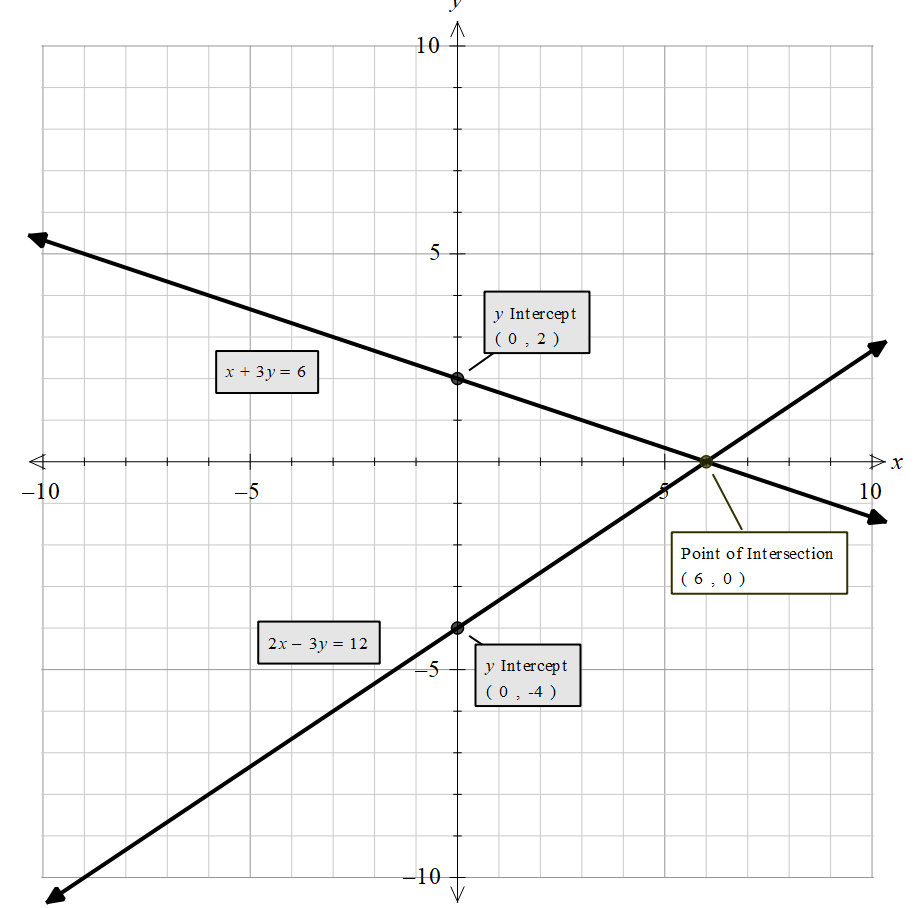
Now, we need to find the area of the region bounded by the lines $x=0,y=0$ and $2x-3y=12$ .
Let’s draw the lines of $x=0,y=0$ . we get,
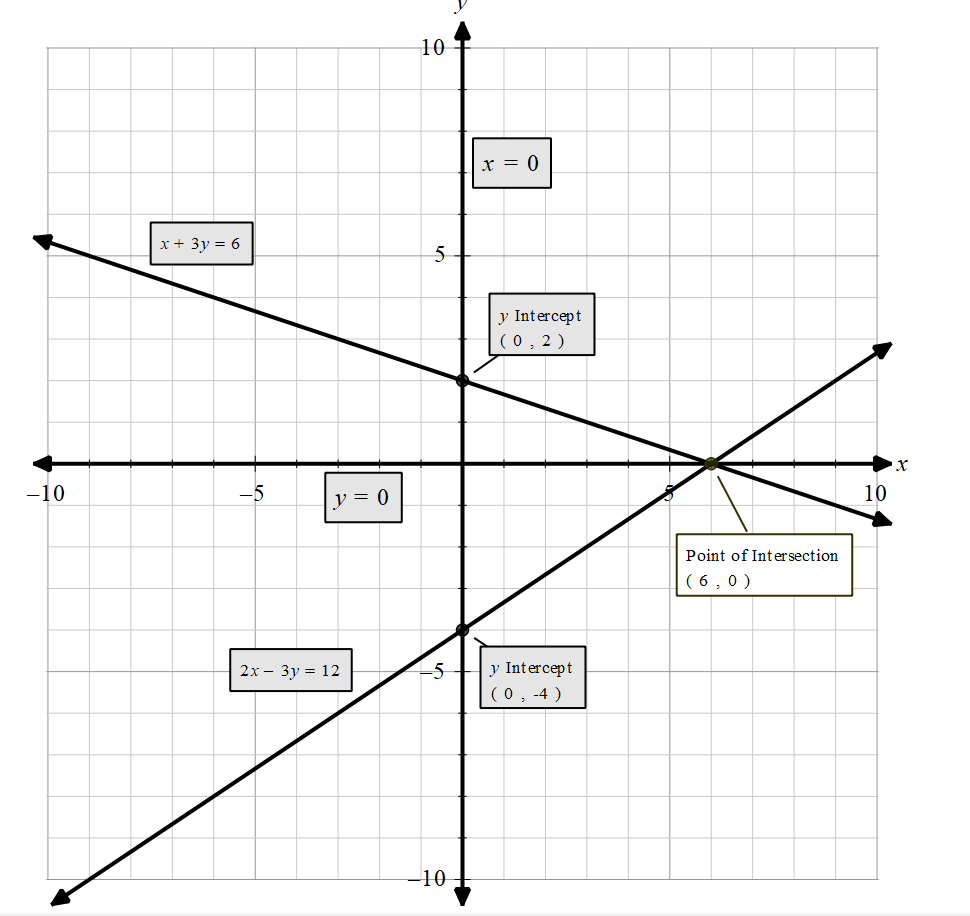
Now, we can mark the shaded region as follows,
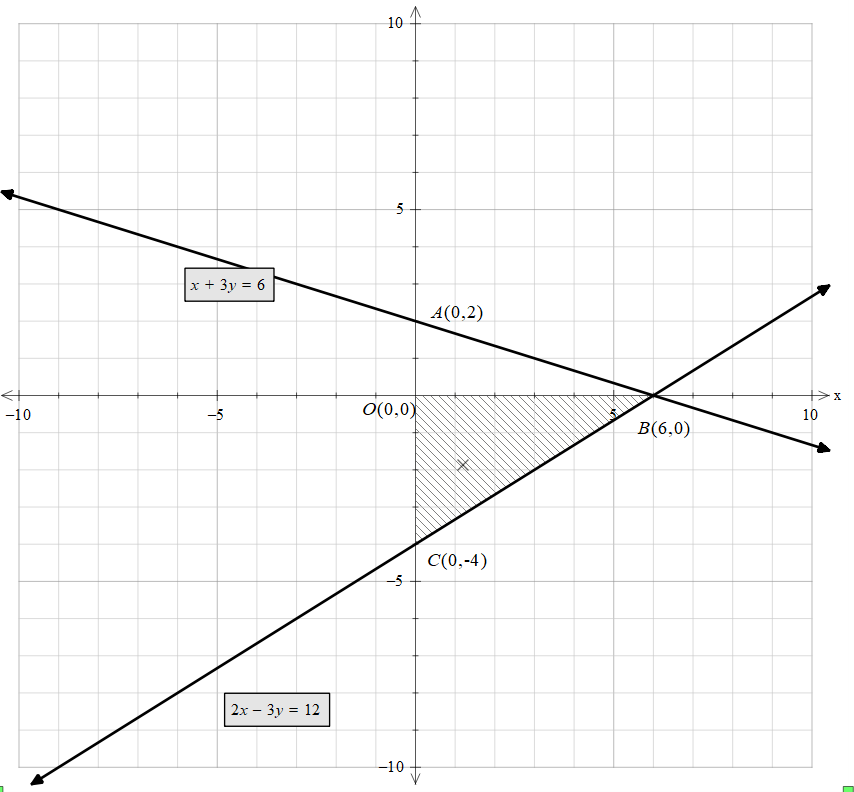
In this diagram, we can see that the shape formed is a triangle.
The area of the triangle is given by $\text{Area = }\dfrac{\text{1}}{\text{2}}\text{ }\!\!\times\!\!\text{ base }\!\!\times\!\!\text{ height}$
Here, the base is OB and the height is OC.
To find the distance of OB, we can see that as the y coordinate is the same, we can get by just taking the difference between x coordinates.
Therefore, OB = 6 - 0 = 6 units.
To find the distance of OC, we can see that as the x coordinate is the same, we can get by just taking the difference between y coordinates.
Therefore, OC = 0 – (-4) = 4 units.
Substituting the value in the formula we get,
$\begin{align}
& \text{Area = }\dfrac{\text{1}}{\text{2}}\text{ }\!\!\times\!\!\text{ 6 }\!\!\times\!\!\text{ 4} \\
& \text{=3}\times 4=12
\end{align}$
Hence, the area of the triangle is 12 sq. units.
Note: In this problem, we can directly subtract the coordinates because the line was either parallel to the x-axis or parallel to the y-axis. Also, we should not worry about the sign because the sign is always taken as positive as the distance can never be negative.
Complete step-by-step answer:
The aim is to draw the two equations.
\[x+3y=6\] and $2x-3y=12$ .
Let’s start by plotting the first equation.
It is easier to plot the graph if we have two points where the line cuts.
So, for $x+3y=6$ ,
Let’s get the point it cuts the y-axis.
The point lies on the y-axis that means the x coordinate is zero.
Hence, substituting x = 0, we get,
$\begin{align}
& x+3y=6 \\
& 0+3y=6 \\
\end{align}$
Solving for y we get,
$y=\dfrac{6}{3}=2$
Therefore, let this point be A where $A\left( 0,2 \right)$ .
Let’s get the point: it cuts the x-axis.
The point lies on the x-axis that means the y coordinate is zero.
Hence, substituting y = 0, we get,
$\begin{align}
& x+3y=6 \\
& x+3\left( 0 \right)=6 \\
\end{align}$
Solving for x we get,
$x=6$
Therefore, let this point be B where $B\left( 6,0 \right)$ .
Now following the same procedure for the second equation.
So, for $2x-3y=12$ ,
Let’s get the point it cuts the y-axis.
The point lies on the y-axis that means the x coordinate is zero.
Hence, substituting x = 0, we get,
$\begin{align}
& 2x-3y=12 \\
& 2\left( 0 \right)-3y=12 \\
\end{align}$
Solving for y we get,
$y=\dfrac{12}{-3}=-4$
Therefore, let this point be C where $C\left( 0,-3 \right)$ .
Let’s get the point: it cuts the x-axis.
The point lies on the x-axis that means the y coordinate is zero.
Hence, substituting y = 0, we get,
$\begin{align}
& 2x-3y=12 \\
& 2x-3\left( 0 \right)=12 \\
\end{align}$
Solving for x we get,
$\begin{align}
& 2x=12 \\
& x=\dfrac{12}{2}=6 \\
\end{align}$
The coordinates are the same as that of B.
Therefore, at this point $B\left( 6,0 \right)$ , both the lines intersect.
Now drawing these lines, we get,
Now, we need to find the area of the region bounded by the lines $x=0,y=0$ and $2x-3y=12$ .
Let’s draw the lines of $x=0,y=0$ . we get,
Now, we can mark the shaded region as follows,
In this diagram, we can see that the shape formed is a triangle.
The area of the triangle is given by $\text{Area = }\dfrac{\text{1}}{\text{2}}\text{ }\!\!\times\!\!\text{ base }\!\!\times\!\!\text{ height}$
Here, the base is OB and the height is OC.
To find the distance of OB, we can see that as the y coordinate is the same, we can get by just taking the difference between x coordinates.
Therefore, OB = 6 - 0 = 6 units.
To find the distance of OC, we can see that as the x coordinate is the same, we can get by just taking the difference between y coordinates.
Therefore, OC = 0 – (-4) = 4 units.
Substituting the value in the formula we get,
$\begin{align}
& \text{Area = }\dfrac{\text{1}}{\text{2}}\text{ }\!\!\times\!\!\text{ 6 }\!\!\times\!\!\text{ 4} \\
& \text{=3}\times 4=12
\end{align}$
Hence, the area of the triangle is 12 sq. units.
Note: In this problem, we can directly subtract the coordinates because the line was either parallel to the x-axis or parallel to the y-axis. Also, we should not worry about the sign because the sign is always taken as positive as the distance can never be negative.
Recently Updated Pages
Master Class 11 Social Science: Engaging Questions & Answers for Success

Master Class 11 Physics: Engaging Questions & Answers for Success
Master Class 11 Maths: Engaging Questions & Answers for Success
Master Class 11 Economics: Engaging Questions & Answers for Success
Master Class 11 Computer Science: Engaging Questions & Answers for Success
Master Class 11 Chemistry: Engaging Questions & Answers for Success
Trending doubts
One Metric ton is equal to kg A 10000 B 1000 C 100 class 11 physics CBSE
There are 720 permutations of the digits 1 2 3 4 5 class 11 maths CBSE
1 Quintal is equal to a 110 kg b 10 kg c 100kg d 1000 class 11 physics CBSE
State and prove Bernoullis theorem class 11 physics CBSE
Difference Between Prokaryotic Cells and Eukaryotic Cells
Which among the following are examples of coming together class 11 social science CBSE