




Draw the graph of the equation $ 2x + y = 6 $ . Shade the region bounded by the graph and the coordinate axis, also find the area.
Answer
 Verified
606k+ views
Hint: To obtain a graph of a linear equation, we first assume some points of either variable(x or y) and then calculate the value of another variable using a given linear equation and then plot these points in x y plane on joining them we will get a graph of a linear equation. Then, find the coordinate of vertices of the triangle formed by a graph of a line and coordinate axis and hence it’s required area.
Complete step-by-step answer:
Given, linear equation is: $ 2x + y = 6 $
To plot a graph of a linear equation. We first assume some points of either of the variables and then calculate the value of another variable using the given linear equation.
Let $ x = 1, $ substituting it in a given linear equation. We have,
$
2(1) + y = 6 \\
\Rightarrow 2 + y = 6 \\
\Rightarrow y = 6 - 2 \\
\Rightarrow y = 4 \;
$
Therefore for $ x = 1, $ we have y = $ 4 $ .
Let $ x = 2, $ substituting it in a given linear equation. We have,
$
2(2) + y = 6 \\
\Rightarrow 4 + y = 6 \\
\Rightarrow y = 6 - 4 \\
\Rightarrow y = 2 \;
$
Therefore for $ x = 2, $ we have y = $ 2 $ .
Let $ x = 3, $ substituting it in a given linear equation. We have,
$
2(3) + y = 6 \\
\Rightarrow 6 + y = 6 \\
\Rightarrow y = 6 - 6 \\
\Rightarrow y = 0 \;
$
Therefore for $ x = 3, $ we have y = $ 0 $ .
Hence, from above we have a table:
Now, we will plot these points in the xy plane to find a graph of an equation $ 2x + y = 6 $ .
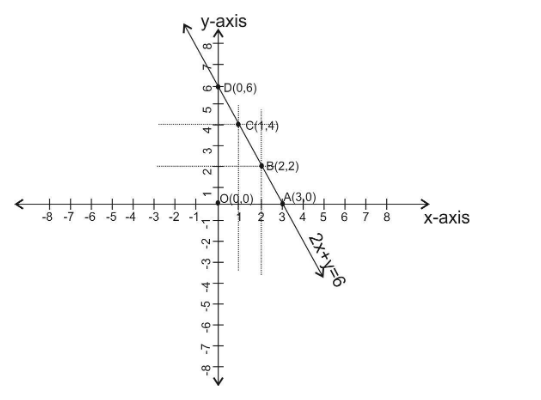
From the above graph we see that the graph of the linear equation meets the x-axis at $ (3,0) $ and y-axis at $ (0,6) $ .
Hence, coordinates of triangle OAB formed by graph of line and coordinate axis are given as:
$ O(0,0),\,\,A(3,0)\,\,and\,\,D(0,6) $ .
Therefore, area of triangle OAB = $ \dfrac{1}{2} \times OA \times OD $
$
\Rightarrow ar(\Delta OAD) = \dfrac{1}{2} \times 3 \times 6 \\
\Rightarrow ar(\Delta OAD) = 9 \;
$
Hence, the area of the triangle formed by a graph of a line and coordinate axis is $ 9\,\,square\,\,unit. $
Note: While plotting a graph of any equation. First calculate points very carefully. If all calculated points on plotting a graph do not come on a straight line then it is a hint of mistake. As for linear equations, graphs are always a straight line.
Complete step-by-step answer:
Given, linear equation is: $ 2x + y = 6 $
To plot a graph of a linear equation. We first assume some points of either of the variables and then calculate the value of another variable using the given linear equation.
Let $ x = 1, $ substituting it in a given linear equation. We have,
$
2(1) + y = 6 \\
\Rightarrow 2 + y = 6 \\
\Rightarrow y = 6 - 2 \\
\Rightarrow y = 4 \;
$
Therefore for $ x = 1, $ we have y = $ 4 $ .
Let $ x = 2, $ substituting it in a given linear equation. We have,
$
2(2) + y = 6 \\
\Rightarrow 4 + y = 6 \\
\Rightarrow y = 6 - 4 \\
\Rightarrow y = 2 \;
$
Therefore for $ x = 2, $ we have y = $ 2 $ .
Let $ x = 3, $ substituting it in a given linear equation. We have,
$
2(3) + y = 6 \\
\Rightarrow 6 + y = 6 \\
\Rightarrow y = 6 - 6 \\
\Rightarrow y = 0 \;
$
Therefore for $ x = 3, $ we have y = $ 0 $ .
Hence, from above we have a table:
| x | 1 | 2 | 3 |
| y | 4 | 2 | 0 |
Now, we will plot these points in the xy plane to find a graph of an equation $ 2x + y = 6 $ .
From the above graph we see that the graph of the linear equation meets the x-axis at $ (3,0) $ and y-axis at $ (0,6) $ .
Hence, coordinates of triangle OAB formed by graph of line and coordinate axis are given as:
$ O(0,0),\,\,A(3,0)\,\,and\,\,D(0,6) $ .
Therefore, area of triangle OAB = $ \dfrac{1}{2} \times OA \times OD $
$
\Rightarrow ar(\Delta OAD) = \dfrac{1}{2} \times 3 \times 6 \\
\Rightarrow ar(\Delta OAD) = 9 \;
$
Hence, the area of the triangle formed by a graph of a line and coordinate axis is $ 9\,\,square\,\,unit. $
Note: While plotting a graph of any equation. First calculate points very carefully. If all calculated points on plotting a graph do not come on a straight line then it is a hint of mistake. As for linear equations, graphs are always a straight line.
Recently Updated Pages
Master Class 11 Social Science: Engaging Questions & Answers for Success

Master Class 11 English: Engaging Questions & Answers for Success
Master Class 11 Maths: Engaging Questions & Answers for Success
Master Class 11 Chemistry: Engaging Questions & Answers for Success
Master Class 11 Biology: Engaging Questions & Answers for Success
Master Class 11 Physics: Engaging Questions & Answers for Success
Trending doubts
One Metric ton is equal to kg A 10000 B 1000 C 100 class 11 physics CBSE
Difference Between Prokaryotic Cells and Eukaryotic Cells
How many of the following diseases can be studied with class 11 biology CBSE
Two of the body parts which do not appear in MRI are class 11 biology CBSE
Which of the following enzymes is used for carboxylation class 11 biology CBSE
Explain zero factorial class 11 maths CBSE