




How do you draw the graph of equation $y=\dfrac{6}{5}x+5$ using the slope-intercept form? \[\]
Answer
 Verified
576k+ views
Hint: We recall the definition of slope and intercept of a line. We recall that the slope-intercept form of line is given by $y=mx+c$ where $m$ is the slope and $c$ is the intercept. We first plot $C\left( 0,c \right)$ and distance $\left| c \right|$ from the origin $O\left( 0,0 \right)$. We find the other point $A\left( a,0 \right)$ by putting $y=0$ in the given line and then finding the value of $x$. \[\]
Complete step-by-step solution:
We know that the intercept of a line is the $y-$coordinate of the point where it crosses the $y-$axis. We also know that the slope of the line is the degree of tilde of the line with a positive $x-$axis. It is given by the tangent of the angle the line makes with the positive $x-$axis. The general slope-intercept form of the line with slope $m$ and intercept $c$ is given by
\[y=mx+c\]
We are given in the question the equation of the line
\[y=\dfrac{6}{5}x+5\]
We compare the equation of above line with general slope-point form to have slope $m=\dfrac{6}{5}$ and intercept $c=5$. We need two points to draw a line. So we first plot the point $C\left( 0,5 \right)$ at distance 5 from the origin $O\left( 0,0 \right)$ where the given line cuts the $y-$axis. So we have
\[OC=5,m=\dfrac{6}{5}\]
Now let us put $y=0$ in the given equation to have;
\[\begin{align}
& 0=\dfrac{6}{5}x+5 \\
& \Rightarrow \dfrac{6}{5}x=-5 \\
& \Rightarrow x=\dfrac{-25}{6} \\
\end{align}\]
So the other point of the equation is $A\left( \dfrac{-25}{6},0 \right)$. We join the points $A\left( \dfrac{-25}{6},0 \right),C\left( 0, 5 \right)$ to get the required line. \[\]
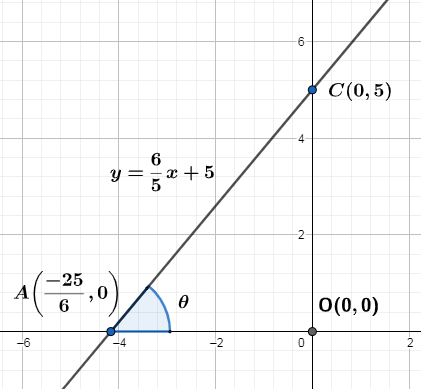
Note: We note that the tangent of the angle is the ratio of the opposite side to the adjacent side (excluding hypotenuse) in a right-angle triangle. So in right-angled triangle COA we have$\tan \theta =\tan \left( \angle CAO \right)=\dfrac{OC}{OA}=\dfrac{5}{\left| \dfrac{-25}{6} \right|}=\dfrac{6}{5}$. Hence the drawn line has the required slope. We also note that if the slope is negative the line will subtend the obtuse angle and if the slope is positive the line will subtend acute angle with positive $x-$axis.
Complete step-by-step solution:
We know that the intercept of a line is the $y-$coordinate of the point where it crosses the $y-$axis. We also know that the slope of the line is the degree of tilde of the line with a positive $x-$axis. It is given by the tangent of the angle the line makes with the positive $x-$axis. The general slope-intercept form of the line with slope $m$ and intercept $c$ is given by
\[y=mx+c\]
We are given in the question the equation of the line
\[y=\dfrac{6}{5}x+5\]
We compare the equation of above line with general slope-point form to have slope $m=\dfrac{6}{5}$ and intercept $c=5$. We need two points to draw a line. So we first plot the point $C\left( 0,5 \right)$ at distance 5 from the origin $O\left( 0,0 \right)$ where the given line cuts the $y-$axis. So we have
\[OC=5,m=\dfrac{6}{5}\]
Now let us put $y=0$ in the given equation to have;
\[\begin{align}
& 0=\dfrac{6}{5}x+5 \\
& \Rightarrow \dfrac{6}{5}x=-5 \\
& \Rightarrow x=\dfrac{-25}{6} \\
\end{align}\]
So the other point of the equation is $A\left( \dfrac{-25}{6},0 \right)$. We join the points $A\left( \dfrac{-25}{6},0 \right),C\left( 0, 5 \right)$ to get the required line. \[\]
Note: We note that the tangent of the angle is the ratio of the opposite side to the adjacent side (excluding hypotenuse) in a right-angle triangle. So in right-angled triangle COA we have$\tan \theta =\tan \left( \angle CAO \right)=\dfrac{OC}{OA}=\dfrac{5}{\left| \dfrac{-25}{6} \right|}=\dfrac{6}{5}$. Hence the drawn line has the required slope. We also note that if the slope is negative the line will subtend the obtuse angle and if the slope is positive the line will subtend acute angle with positive $x-$axis.
Recently Updated Pages
Basicity of sulphurous acid and sulphuric acid are

Master Class 11 Business Studies: Engaging Questions & Answers for Success
Master Class 11 Computer Science: Engaging Questions & Answers for Success
Master Class 11 Economics: Engaging Questions & Answers for Success
Master Class 11 Social Science: Engaging Questions & Answers for Success
Master Class 11 English: Engaging Questions & Answers for Success
Trending doubts
One Metric ton is equal to kg A 10000 B 1000 C 100 class 11 physics CBSE
The largest wind power cluster is located in the state class 11 social science CBSE
Explain zero factorial class 11 maths CBSE
State and prove Bernoullis theorem class 11 physics CBSE
Which among the following are examples of coming together class 11 social science CBSE
Can anyone list 10 advantages and disadvantages of friction