




Draw the graph of \[2x + y = 6\] and \[2x - y + 2 = 0.\] Shade the region bounded by these lines and\[x - y\]. Find the area of the shaded region.
Answer
 Verified
607.2k+ views
Hint:
Here, we have to find the area of the shaded region. First, we will draw the graph for the first two equations by plotting points using the equation. Then we will draw the graph for the third equation. Then we will find the region bounded by all these lines and calculate the area of the shaded region.
Formula used:
Area between two curves that intersect each other in the interval \[\left[ {a,b} \right]\] is given by \[\int\limits_a^c {[f(x) - g(x)]dx} + \int\limits_c^b {[f(x) - g(x)]dx} \], where \[c\] is the root of \[f\left( x \right) = g\left( x \right)\].
Complete step by step solution:
We are given with an equation \[2x + y = 6\] and \[2x - y + 2 = 0.\]
Now, We will consider the first equation of line \[2x + y = 6\].
Substituting \[x = 0\] in the equation \[2x + y = 6\], we will get
\[\begin{array}{l}2\left( 0 \right) + y = 6\\ \Rightarrow y = 6\end{array}\]
Substituting \[x = 1\]in the equation \[2x + y = 6\], we will get
\[\begin{array}{l}2\left( 1 \right) + y = 6\\ \Rightarrow y = 4\end{array}\]
Substituting \[x = 2\]in the equation \[2x + y = 6\], we will get
\[\begin{array}{l}4 + y = 6\\ \Rightarrow y = 2\end{array}\]
So, we will get the coordinates for the line \[2x + y = 6\] as \[\left( {0,6} \right)\], \[\left( {1,4} \right)\] and \[\left( {2,2} \right)\].
Now, We have to consider the second equation of line \[2x - y + 2 = 0\]
Substituting \[x = 0\] in the equation \[2x + y = 6\], we will get \[y = 2\].
Substituting \[y = 0\] in the equation \[2x + y = 6\], we will get \[x = - 1\].
Substituting \[x = 2\]in the equation \[2x + y = 6\], we will get
\[\begin{array}{l}4 + 2 = y\\ \Rightarrow y = 6\end{array}\]
So, we will get the coordinates for the line \[2x - y + 2 = 0\] as \[\left( {0,2} \right)\], \[\left( { - 1,0} \right)\]and \[\left( {2,6} \right)\].
Now, we have to draw a graph with these coordinates. We will get a straight line for these linear equations.
Now, we have to consider the equation \[x - y = 0\].
Substituting \[x = 0\], we will get \[y = 0\]
Substituting \[x = 1\], we will get \[y = 1\]
Substituting \[x = 2\], we will get \[y = 2\]
So, we will get the coordinates for the line \[x - y = 0\] as (0, 0), (1, 1), (2, 2).
Now, we have to plot the graph for that we have to find the area bounded by the lines.
Area between two curves that intersect each other in the interval \[\left[ {a,b} \right]\] is given by \[\int\limits_a^c {[f(x) - g(x)]dx} + \int\limits_c^b {[f(x) - g(x)]dx} \],
Area of bounded region \[ = \int\limits_{ - 2}^0 {2x + 2 - xdx} + \int\limits_0^4 {2x + 2 - xdx} \]
By integration and substituting the limit, we will get
\[ \Rightarrow \] Area of bounded region\[ = \dfrac{1}{2}\left[ {1( - 2 - 2) - 2(2 - 4) + 2(4 + 2)} \right]\]
Simplifying the terms, we get
\[ \Rightarrow \] Area of bounded region\[ = \dfrac{1}{2}\left[ { - 4 + 4 + 12} \right]\]
Adding and subtracting the terms, we get
\[ \Rightarrow \] Area of bounded region\[ = \dfrac{1}{2}\left[ {12} \right]\]
Dividing 12 by 2, we get
\[ \Rightarrow \] Area of bounded region \[ = 6\]
Now we will draw the graph of \[2x + y = 6\] and, Then we will shade the area bounded by the lines.
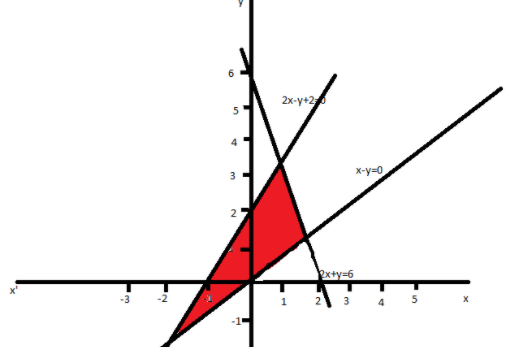
The region showed in red is the required area.
Note:
The line, which is at the highest, should be \[f\left( x \right)\] and the line which is at the lowest should be \[g\left( x \right)\]. We should know that in the differentiation we have product rule and quotient rule. But in the case of Integration, we don’t have such rules. Integration is a method of summing up the discrete data. While substituting the limit the lower limit value has to be subtracted from the upper limit value.
Here, we have to find the area of the shaded region. First, we will draw the graph for the first two equations by plotting points using the equation. Then we will draw the graph for the third equation. Then we will find the region bounded by all these lines and calculate the area of the shaded region.
Formula used:
Area between two curves that intersect each other in the interval \[\left[ {a,b} \right]\] is given by \[\int\limits_a^c {[f(x) - g(x)]dx} + \int\limits_c^b {[f(x) - g(x)]dx} \], where \[c\] is the root of \[f\left( x \right) = g\left( x \right)\].
Complete step by step solution:
We are given with an equation \[2x + y = 6\] and \[2x - y + 2 = 0.\]
Now, We will consider the first equation of line \[2x + y = 6\].
Substituting \[x = 0\] in the equation \[2x + y = 6\], we will get
\[\begin{array}{l}2\left( 0 \right) + y = 6\\ \Rightarrow y = 6\end{array}\]
Substituting \[x = 1\]in the equation \[2x + y = 6\], we will get
\[\begin{array}{l}2\left( 1 \right) + y = 6\\ \Rightarrow y = 4\end{array}\]
Substituting \[x = 2\]in the equation \[2x + y = 6\], we will get
\[\begin{array}{l}4 + y = 6\\ \Rightarrow y = 2\end{array}\]
So, we will get the coordinates for the line \[2x + y = 6\] as \[\left( {0,6} \right)\], \[\left( {1,4} \right)\] and \[\left( {2,2} \right)\].
Now, We have to consider the second equation of line \[2x - y + 2 = 0\]
Substituting \[x = 0\] in the equation \[2x + y = 6\], we will get \[y = 2\].
Substituting \[y = 0\] in the equation \[2x + y = 6\], we will get \[x = - 1\].
Substituting \[x = 2\]in the equation \[2x + y = 6\], we will get
\[\begin{array}{l}4 + 2 = y\\ \Rightarrow y = 6\end{array}\]
So, we will get the coordinates for the line \[2x - y + 2 = 0\] as \[\left( {0,2} \right)\], \[\left( { - 1,0} \right)\]and \[\left( {2,6} \right)\].
Now, we have to draw a graph with these coordinates. We will get a straight line for these linear equations.
Now, we have to consider the equation \[x - y = 0\].
Substituting \[x = 0\], we will get \[y = 0\]
Substituting \[x = 1\], we will get \[y = 1\]
Substituting \[x = 2\], we will get \[y = 2\]
So, we will get the coordinates for the line \[x - y = 0\] as (0, 0), (1, 1), (2, 2).
Now, we have to plot the graph for that we have to find the area bounded by the lines.
Area between two curves that intersect each other in the interval \[\left[ {a,b} \right]\] is given by \[\int\limits_a^c {[f(x) - g(x)]dx} + \int\limits_c^b {[f(x) - g(x)]dx} \],
Area of bounded region \[ = \int\limits_{ - 2}^0 {2x + 2 - xdx} + \int\limits_0^4 {2x + 2 - xdx} \]
By integration and substituting the limit, we will get
\[ \Rightarrow \] Area of bounded region\[ = \dfrac{1}{2}\left[ {1( - 2 - 2) - 2(2 - 4) + 2(4 + 2)} \right]\]
Simplifying the terms, we get
\[ \Rightarrow \] Area of bounded region\[ = \dfrac{1}{2}\left[ { - 4 + 4 + 12} \right]\]
Adding and subtracting the terms, we get
\[ \Rightarrow \] Area of bounded region\[ = \dfrac{1}{2}\left[ {12} \right]\]
Dividing 12 by 2, we get
\[ \Rightarrow \] Area of bounded region \[ = 6\]
Now we will draw the graph of \[2x + y = 6\] and, Then we will shade the area bounded by the lines.
The region showed in red is the required area.
Note:
The line, which is at the highest, should be \[f\left( x \right)\] and the line which is at the lowest should be \[g\left( x \right)\]. We should know that in the differentiation we have product rule and quotient rule. But in the case of Integration, we don’t have such rules. Integration is a method of summing up the discrete data. While substituting the limit the lower limit value has to be subtracted from the upper limit value.
Recently Updated Pages
Master Class 12 Business Studies: Engaging Questions & Answers for Success

Master Class 12 Chemistry: Engaging Questions & Answers for Success
Master Class 12 Biology: Engaging Questions & Answers for Success
Class 12 Question and Answer - Your Ultimate Solutions Guide
Master Class 11 English: Engaging Questions & Answers for Success
Master Class 11 Social Science: Engaging Questions & Answers for Success
Trending doubts
Differentiate between Pyramid of energy and pyramid class 12 biology CBSE
Draw the diagram of the pyramid of energy Explain In class 12 biology CBSE
When was the first election held in India a 194748 class 12 sst CBSE
The first microscope was invented by A Leeuwenhoek class 12 biology CBSE
Suicide bags of cells are aEndoplasmic reticulum bLysosome class 12 biology CBSE
The first general election of Lok Sabha was held in class 12 social science CBSE