




Draw the diagram of lingual frenulum.
Answer
 Verified
590.4k+ views
Hint: A fold of mucous membrane that is located under the center portion of your tongue is called a lingual frenulum. It tends to limit movement of our tongue.
Complete answer:
The thin strip of tissue which runs vertically from the floor of mouth to the undersurface of our tongue is known as the lingual frenulum. It also helps to stabilize the movements of the tongue. Because of this, it’s important for functions such as eating, speech and swallowing. It tends to limit the movement of our tongue, and it is so short in some people, and it interferes with speaking.
A "V" shaped hump of tissue is present at the base of the frenulum, in the floor of the mouth that houses a series of saliva gland ducts. In front of the attachment of the lingual frenulum, two largest ducts are in the center present and these are called Wharton's Ducts. They empty the sublingual salivary glands and submandibular or submaxillary into a small prominence on either side of the frenulum, the sublingual caruncle. These ducts are quite active in some persons, a considerable amount of saliva may interrupt them while yawning, cleaning the teeth, talking, or eating in a process known as gleeking.
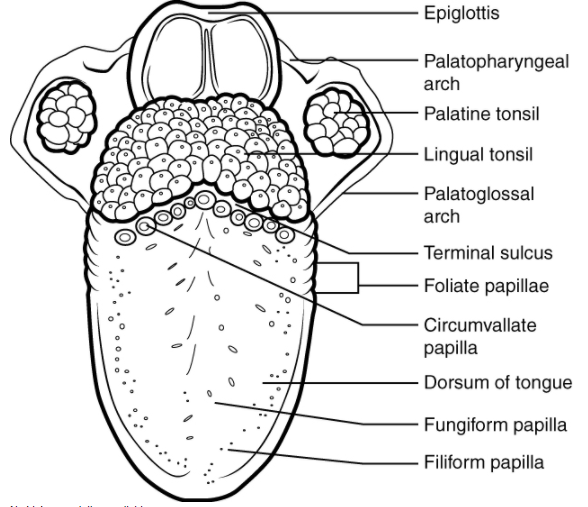
Note: A restrictive lingual frenulum of tongue tie is often seen in children. In approximately three percent of children, the attachment may limit their normal tongue mobility (ankyloglossia) that can lead to difficulties or discomfort while nursing and can also impact speech development.
Complete answer:
The thin strip of tissue which runs vertically from the floor of mouth to the undersurface of our tongue is known as the lingual frenulum. It also helps to stabilize the movements of the tongue. Because of this, it’s important for functions such as eating, speech and swallowing. It tends to limit the movement of our tongue, and it is so short in some people, and it interferes with speaking.
A "V" shaped hump of tissue is present at the base of the frenulum, in the floor of the mouth that houses a series of saliva gland ducts. In front of the attachment of the lingual frenulum, two largest ducts are in the center present and these are called Wharton's Ducts. They empty the sublingual salivary glands and submandibular or submaxillary into a small prominence on either side of the frenulum, the sublingual caruncle. These ducts are quite active in some persons, a considerable amount of saliva may interrupt them while yawning, cleaning the teeth, talking, or eating in a process known as gleeking.
Note: A restrictive lingual frenulum of tongue tie is often seen in children. In approximately three percent of children, the attachment may limit their normal tongue mobility (ankyloglossia) that can lead to difficulties or discomfort while nursing and can also impact speech development.
Recently Updated Pages
Master Class 12 Economics: Engaging Questions & Answers for Success

Master Class 12 English: Engaging Questions & Answers for Success
Master Class 12 Social Science: Engaging Questions & Answers for Success
Master Class 12 Maths: Engaging Questions & Answers for Success
Master Class 12 Physics: Engaging Questions & Answers for Success
Master Class 11 Social Science: Engaging Questions & Answers for Success
Trending doubts
One Metric ton is equal to kg A 10000 B 1000 C 100 class 11 physics CBSE
Difference Between Prokaryotic Cells and Eukaryotic Cells
Two of the body parts which do not appear in MRI are class 11 biology CBSE
1 ton equals to A 100 kg B 1000 kg C 10 kg D 10000 class 11 physics CBSE
Draw a diagram of nephron and explain its structur class 11 biology CBSE
10 examples of friction in our daily life