




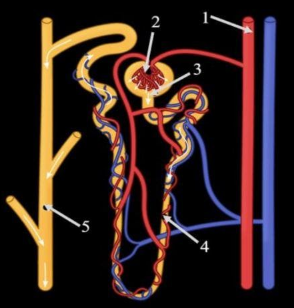
Draw the diagram and label any two parts mentioned below.
(a) Bowman’s capsule
(b) Glomerulus
(c) Loop of Henle
(d) Collecting duct
Answer
 Verified
613.2k+ views
Hint: In the urinary system, complex microscopic cells are present and known as nephrons. Their functions include urine production and removal of waste and excess of substance from the blood.
Complete answer:
A nephron is a structural and functional unit of the kidney. Its function is to convert blood into urine by filtration, reabsorption, secretion and excretion of useful and harmful substances which is present in the blood. In the mammalian kidney nephrons is a long tubular structure which consists of a bowman’s capsule, Glomerulus, Loop of Henle, distal convoluted tubule, proximal convoluted tubule, collecting tubule.
1. Bowman’s capsule- It is a cup-shaped structure form where the renal tubule extents. In the Bowman’s capsule, ultrafiltration occurs.
2. Glomerulus- Glomerulus is small tufts of capillaries through which blood flows in the high pressure. These capillaries receive blood from afferent arterioles.
3. Loop of Henle- It is a hairpin-like structure and has a thin and thick ascending limb. Through the loop of Henle fluid which is filtered through the glomerulus reaches the collecting duct. In the Loop of Henle reabsorption of useful substances takes place.
4. Distal convoluted tubule- These tubules contain cell linings having mitochondria which produce energy which is needed for active transport. They reabsorb calcium ions.
5. Proximal convoluted tubule- It is a part of nephrons where saltwater, organic solutes, glucose, and amino acids are filtered.
6. Collecting tubule- This tubule is the final segment before entering the collecting duct. In this tubule reabsorption of water occurs.
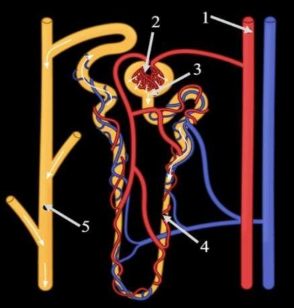
In the given diagram: (a) Bowman’s capsule by 3, (b) Glomerulus is represented by 2, (c)Loop of Henle by 4, and (d) Collecting duct by 5.
Note:
Nephrons is a structural and functional unit of the kidney and it regulates water and other soluble substances in the blood, also it helps in maintaining homeostasis of blood volume, and blood pressure by excreting out harmful substances and reabsorbing useful substances.
Complete answer:
A nephron is a structural and functional unit of the kidney. Its function is to convert blood into urine by filtration, reabsorption, secretion and excretion of useful and harmful substances which is present in the blood. In the mammalian kidney nephrons is a long tubular structure which consists of a bowman’s capsule, Glomerulus, Loop of Henle, distal convoluted tubule, proximal convoluted tubule, collecting tubule.
1. Bowman’s capsule- It is a cup-shaped structure form where the renal tubule extents. In the Bowman’s capsule, ultrafiltration occurs.
2. Glomerulus- Glomerulus is small tufts of capillaries through which blood flows in the high pressure. These capillaries receive blood from afferent arterioles.
3. Loop of Henle- It is a hairpin-like structure and has a thin and thick ascending limb. Through the loop of Henle fluid which is filtered through the glomerulus reaches the collecting duct. In the Loop of Henle reabsorption of useful substances takes place.
4. Distal convoluted tubule- These tubules contain cell linings having mitochondria which produce energy which is needed for active transport. They reabsorb calcium ions.
5. Proximal convoluted tubule- It is a part of nephrons where saltwater, organic solutes, glucose, and amino acids are filtered.
6. Collecting tubule- This tubule is the final segment before entering the collecting duct. In this tubule reabsorption of water occurs.
In the given diagram: (a) Bowman’s capsule by 3, (b) Glomerulus is represented by 2, (c)Loop of Henle by 4, and (d) Collecting duct by 5.
Note:
Nephrons is a structural and functional unit of the kidney and it regulates water and other soluble substances in the blood, also it helps in maintaining homeostasis of blood volume, and blood pressure by excreting out harmful substances and reabsorbing useful substances.
Recently Updated Pages
If x a + bt + ct2 where x is in meters and t is in class 11 physics CBSE

A car covers the first half distance between two places class 11 physics CBSE
The resultant of two vectors overrightarrow P and overrightarrow class 11 physics CBSE
Find the value of cos 135 class 11 maths CBSE
A mass M is held in place by an applied force F and class 11 physics CBSE
A solution of glucose in water is labelled as 10 dfracwv class 11 chemistry CBSE
Trending doubts
Find the value of the expression given below sin 30circ class 11 maths CBSE
What is the maximum height of a projectile class 11 physics CBSE
Derive an expression for maximum height and range of class 11 physics CBSE
Describe various types of epithelial tissues with the class 11 biology CBSE
Lysosomes are known as suicidal bags of cell why class 11 biology CBSE
State and derive law of conservation of momentum class 11 physics CBSE