




Draw the circuit symbols for p-n-p and n-p-n transistors.
Answer
 Verified
562k+ views
Hint: In n-p-n transistors 2 segments of n-type semiconductor are separated by a segment of p-type semiconductor. While in the p-n-p transistor 2 segments of p-type semiconductor are separated by a segment of n-type semiconductor.
Complete step by step solution:
The schematic representations of an n-p-n and p-n-p configuration are given as
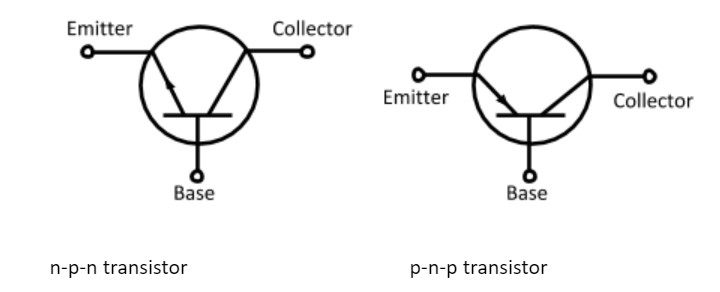
The sign of arrow in the circuit represents
1. Direction of current in circuit
2. Type of transistor
3. Emitter segment of transistor
Here 3 segments are present in transistor
(A) Emitter – It is of moderate size and heavily doped. It supplies a large number of majority carriers for the current flow through the transistor.
(B) Base – This is the central segment.
It is very thin and lightly doped.
(C) Collector – This segment collects a major portion of the majority carries supplies by the emitter. This collector side is moderately doped and larger in size as compared to the emitter.
Note: In order to draw the circuit diagram we must know about the direction of current and doping & thickness of emitter, collector and base.
Complete step by step solution:
The schematic representations of an n-p-n and p-n-p configuration are given as
The sign of arrow in the circuit represents
1. Direction of current in circuit
2. Type of transistor
3. Emitter segment of transistor
Here 3 segments are present in transistor
(A) Emitter – It is of moderate size and heavily doped. It supplies a large number of majority carriers for the current flow through the transistor.
(B) Base – This is the central segment.
It is very thin and lightly doped.
(C) Collector – This segment collects a major portion of the majority carries supplies by the emitter. This collector side is moderately doped and larger in size as compared to the emitter.
Note: In order to draw the circuit diagram we must know about the direction of current and doping & thickness of emitter, collector and base.
Recently Updated Pages
Master Class 11 English: Engaging Questions & Answers for Success

Master Class 11 Social Science: Engaging Questions & Answers for Success
Master Class 11 Maths: Engaging Questions & Answers for Success
Master Class 11 Biology: Engaging Questions & Answers for Success
Master Class 11 Physics: Engaging Questions & Answers for Success
Master Class 11 Chemistry: Engaging Questions & Answers for Success
Trending doubts
One Metric ton is equal to kg A 10000 B 1000 C 100 class 11 physics CBSE
Difference Between Prokaryotic Cells and Eukaryotic Cells
1 ton equals to A 100 kg B 1000 kg C 10 kg D 10000 class 11 physics CBSE
Find the value of the expression given below sin 30circ class 11 maths CBSE
Two of the body parts which do not appear in MRI are class 11 biology CBSE
What are hard magnetic materials class 11 physics CBSE