




Draw structure of 2 oxoacids of phosphorus in which oxidation number of phosphorus is $ + 3 $ .
Answer
 Verified
571.2k+ views
Hint: An oxoacid (sometimes called an oxyacid) is an oxygen-containing acid. An oxoacid is an acid that contains oxygen, to be more precise. At least one other element is contained. Has at least one oxygen bonded hydrogen atom.
Complete step by step answer
Basically, oxoacids are acids that contain oxygen as an ingredient. As such, a variety of oxoacids are known to form from Phosphorus, such as: $ {H_3}P{O_4} $ , $ {H_3}P{O_3} $ , etc. It is tetrahedrally surrounded by other atoms in phosphorous oxoacids. All these acids are commonly known to form at least one P = O bond and one P-OH bond.
In addition to P= O bonds and P-OH bonds in phosphorus oxoacids where the oxidation state of phosphorus is less than $ + 5 $ , P-P or P-H bonds are also observed. In general, these acids are seen as too disproportionate to either lower or higher states of oxidation. For instance, it provides phosphine and phosphoric acid when phosphorous acid is heated.
PHOSPHONIC ACID:
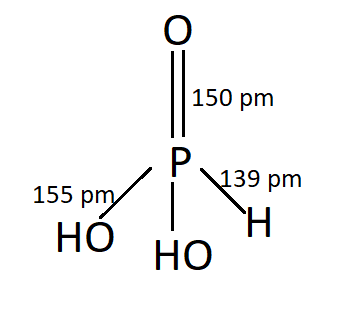
P has an oxidation number of $ + 3 $ . This is Dibasic.
$ {P_4}{O_6} + 6{H_2}O \to 4{H_3}P{O_3} $
$ PC{l_3} + 3{H_2}O \to {H_3}P{O_3} + 3HCl $
$ {H_4}{P_2}{O_5} $ :
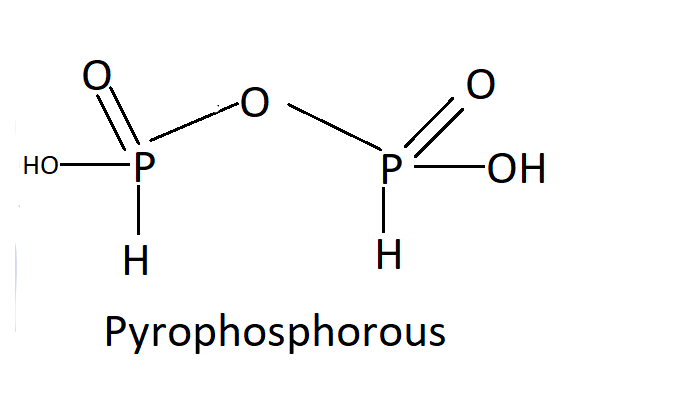
In oxoacids, the P-H bonds cannot go through ionization to provide $ {H^ + } $ ions, whereas the $ H $ atoms attached to oxygen in P-OH form are ionizable. Therefore, we can assume that only the oxygen-attached $ H $ atoms induce basicity. As a consequence of phosphorous acid, $ H_3PO_3 $ is dibasic due to the existence of two P-OH bonds, while $ H3PO4 $ is tribasic due to the presence of three P-OH bonds due to phosphoric acid. Phosphorus oxoacids that have P-H bonds have effective reducing properties.
Note
Metaphosphoric acid may not function as a monomer, yet occurs in the form of cyclic metaphosphoric acid as a cyclic trimer or in the form of poly metaphosphoric acid as a linear polymer. Acids with P-H bonds have effective reduction properties.
Complete step by step answer
Basically, oxoacids are acids that contain oxygen as an ingredient. As such, a variety of oxoacids are known to form from Phosphorus, such as: $ {H_3}P{O_4} $ , $ {H_3}P{O_3} $ , etc. It is tetrahedrally surrounded by other atoms in phosphorous oxoacids. All these acids are commonly known to form at least one P = O bond and one P-OH bond.
In addition to P= O bonds and P-OH bonds in phosphorus oxoacids where the oxidation state of phosphorus is less than $ + 5 $ , P-P or P-H bonds are also observed. In general, these acids are seen as too disproportionate to either lower or higher states of oxidation. For instance, it provides phosphine and phosphoric acid when phosphorous acid is heated.
PHOSPHONIC ACID:
P has an oxidation number of $ + 3 $ . This is Dibasic.
$ {P_4}{O_6} + 6{H_2}O \to 4{H_3}P{O_3} $
$ PC{l_3} + 3{H_2}O \to {H_3}P{O_3} + 3HCl $
$ {H_4}{P_2}{O_5} $ :
In oxoacids, the P-H bonds cannot go through ionization to provide $ {H^ + } $ ions, whereas the $ H $ atoms attached to oxygen in P-OH form are ionizable. Therefore, we can assume that only the oxygen-attached $ H $ atoms induce basicity. As a consequence of phosphorous acid, $ H_3PO_3 $ is dibasic due to the existence of two P-OH bonds, while $ H3PO4 $ is tribasic due to the presence of three P-OH bonds due to phosphoric acid. Phosphorus oxoacids that have P-H bonds have effective reducing properties.
Note
Metaphosphoric acid may not function as a monomer, yet occurs in the form of cyclic metaphosphoric acid as a cyclic trimer or in the form of poly metaphosphoric acid as a linear polymer. Acids with P-H bonds have effective reduction properties.
Recently Updated Pages
Three beakers labelled as A B and C each containing 25 mL of water were taken A small amount of NaOH anhydrous CuSO4 and NaCl were added to the beakers A B and C respectively It was observed that there was an increase in the temperature of the solutions contained in beakers A and B whereas in case of beaker C the temperature of the solution falls Which one of the following statements isarecorrect i In beakers A and B exothermic process has occurred ii In beakers A and B endothermic process has occurred iii In beaker C exothermic process has occurred iv In beaker C endothermic process has occurred

Master Class 11 Social Science: Engaging Questions & Answers for Success
Master Class 11 Physics: Engaging Questions & Answers for Success
Master Class 11 Maths: Engaging Questions & Answers for Success
Master Class 11 Economics: Engaging Questions & Answers for Success
Master Class 11 Computer Science: Engaging Questions & Answers for Success
Three beakers labelled as A B and C each containing 25 mL of water were taken A small amount of NaOH anhydrous CuSO4 and NaCl were added to the beakers A B and C respectively It was observed that there was an increase in the temperature of the solutions contained in beakers A and B whereas in case of beaker C the temperature of the solution falls Which one of the following statements isarecorrect i In beakers A and B exothermic process has occurred ii In beakers A and B endothermic process has occurred iii In beaker C exothermic process has occurred iv In beaker C endothermic process has occurred
Master Class 11 Social Science: Engaging Questions & Answers for Success
Master Class 11 Physics: Engaging Questions & Answers for Success
Trending doubts
One Metric ton is equal to kg A 10000 B 1000 C 100 class 11 physics CBSE
There are 720 permutations of the digits 1 2 3 4 5 class 11 maths CBSE
State and prove Bernoullis theorem class 11 physics CBSE
Draw a diagram of a plant cell and label at least eight class 11 biology CBSE
Difference Between Prokaryotic Cells and Eukaryotic Cells
Discuss the various forms of bacteria class 11 biology CBSE