




Draw labeled diagrams of the following:
(a) Female and male thallus of a liverwort.
(b) Gametophyte and sporophyte of Funaria.
(c) Alternation of generation in Angiosperm.
Answer
 Verified
419.4k+ views
Hint: Funariais a small genus of fungi. The genus has two different life forms, Gametophyte and sporophyte. Gametophytes are single-celled organisms that function to produce spores that will lead to the sporophyte. Gametophytes have many advantages over sporophytes, such as the ability to survive long periods without nutrients, which is why they are often used for ecosystem studies.
Complete step-by-step answer:
a. Female and male thallus of a liverwort:
Male and female gametophytes of Funa are the starting point of sexual reproduction, where sperm is released into the water and fertilizes an egg. Then, the thallus develops into a sporophyte that grows in size and begins to form sporangia that produce spores. Liverwort is a green algae found in moist or wet habitats such as soil, water or rock. Liverworts are usually divided into two stages: Sporodites are small, leafless plants (the Gametophyte), while the female thallus produces large leaves, called in their specific genus.
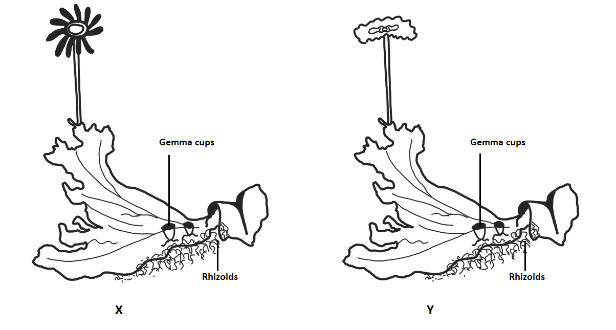
Image: X=Male thallus of a liverwort and Y= Female thallus of a liverwort.
b. Gametophyte and sporophyte of Funaria are the two most important phases of an organism's life cycle. Gametophytes are the phase that first grows from spores and produces flagella. Sporophytes produce spores to grow new gametophytes and develop into adults. The Gametophyte of Funaria is a motile parasite. The sporophyte of Funaria is an aquatic plant that lacks roots, stems, leaves or flowers but has a stem encased in a brownish sheath, which shelters its root system in water-filled cavities.
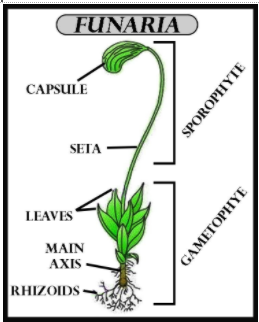
Image: Gametophyte and sporophyte of Funaria.
c. The process of reproduction in Angiosperm is governed by alternating two generations: the gametophyte generation and the sporophyte generation. The gametophyte generation starts when sperm cells fuse with egg cells. The sporophytes undergo several changes before producing spores released into the water. The sporophytes go through a dormant stage called the resting spore before waking up and starting to grow. They produce spores which are released into the water to start as new plants.
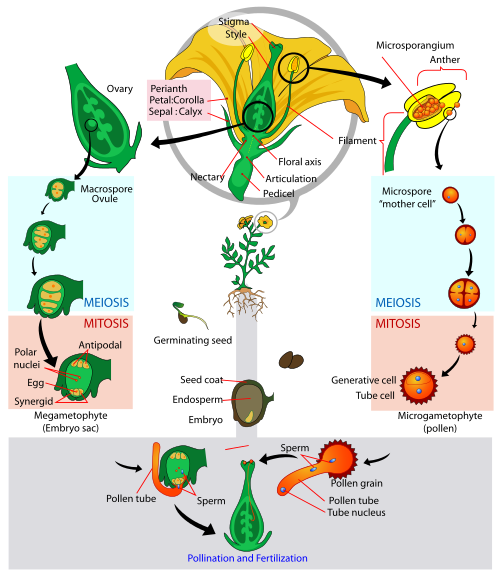
Image: Alternation of two generations in Angiosperm.
Note: Alternation of generation is the ability of an organism to produce gametes that are not genetically identical. Angiosperms, or flowering plants, have a complex alternation of generation. They have both sexual reproduction with simultaneous male and female parents and asexual reproduction with only one parent.
Complete step-by-step answer:
a. Female and male thallus of a liverwort:
Male and female gametophytes of Funa are the starting point of sexual reproduction, where sperm is released into the water and fertilizes an egg. Then, the thallus develops into a sporophyte that grows in size and begins to form sporangia that produce spores. Liverwort is a green algae found in moist or wet habitats such as soil, water or rock. Liverworts are usually divided into two stages: Sporodites are small, leafless plants (the Gametophyte), while the female thallus produces large leaves, called in their specific genus.
Image: X=Male thallus of a liverwort and Y= Female thallus of a liverwort.
b. Gametophyte and sporophyte of Funaria are the two most important phases of an organism's life cycle. Gametophytes are the phase that first grows from spores and produces flagella. Sporophytes produce spores to grow new gametophytes and develop into adults. The Gametophyte of Funaria is a motile parasite. The sporophyte of Funaria is an aquatic plant that lacks roots, stems, leaves or flowers but has a stem encased in a brownish sheath, which shelters its root system in water-filled cavities.
Image: Gametophyte and sporophyte of Funaria.
c. The process of reproduction in Angiosperm is governed by alternating two generations: the gametophyte generation and the sporophyte generation. The gametophyte generation starts when sperm cells fuse with egg cells. The sporophytes undergo several changes before producing spores released into the water. The sporophytes go through a dormant stage called the resting spore before waking up and starting to grow. They produce spores which are released into the water to start as new plants.
Image: Alternation of two generations in Angiosperm.
Note: Alternation of generation is the ability of an organism to produce gametes that are not genetically identical. Angiosperms, or flowering plants, have a complex alternation of generation. They have both sexual reproduction with simultaneous male and female parents and asexual reproduction with only one parent.
Recently Updated Pages
Master Class 12 Business Studies: Engaging Questions & Answers for Success

Master Class 12 Biology: Engaging Questions & Answers for Success
Master Class 12 Chemistry: Engaging Questions & Answers for Success
Class 12 Question and Answer - Your Ultimate Solutions Guide
Master Class 11 Social Science: Engaging Questions & Answers for Success
Master Class 11 English: Engaging Questions & Answers for Success
Trending doubts
Which are the Top 10 Largest Countries of the World?
One Metric ton is equal to kg A 10000 B 1000 C 100 class 11 physics CBSE
What is the Full Form of ICSE / ISC ?
Explain the Treaty of Vienna of 1815 class 10 social science CBSE
Draw a labelled sketch of the human eye class 12 physics CBSE
What is BLO What is the full form of BLO class 8 social science CBSE