




Draw five other situation of one-fourth half and three-fourth revolution on a clock.
Answer
 Verified
616.2k+ views
Hint: For this question we will start by proceeding with first defining what a clock is and what does a revolution means in a clock and then we will analyze the angles of a clock and find out the various situations where can draw the situations of one fourth of a revolution, half of a revolution and three fourth of a revolution.
Complete step by step answer:
Let’s start by understanding the meaning of clock and a revolution on the clock. So we know that a clock is basically a device which displays time. It has three hands or we can say revolving pointer rods, each hand being the hour hand, the minute hand and the seconds hand is the fastest of the three and the hour hand is the slowest of all. A cock face is numbered 1 through 12 indicating the hours in a 12-hour cycle, and a short hour hand makes two revolutions in a day. A long minute hand makes one revolution every hour and the seconds hand, which makes one revolution per minute.
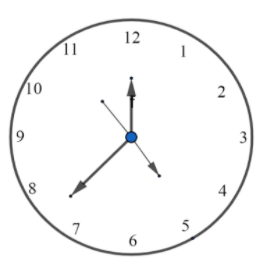
One full revolution means when the hands of the clock are completely full \[{{360}^{\circ }}\] angle on the clock face.
Now we have to show the situations of one fourth, half and three-fourth revolution on a clock:
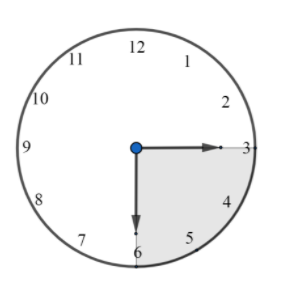
i) One fourth revolution: $\dfrac{{{360}^{\circ }}}{4}={{90}^{\circ }}$ , from $3\text{ to }6$
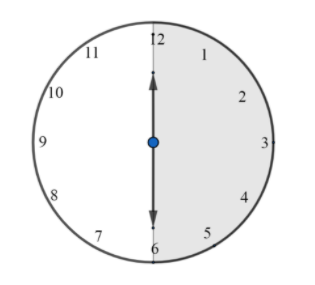
ii) Half revolution: $\dfrac{{{360}^{\circ }}}{2}={{180}^{\circ }}$ = $12\text{ to }6$
iii) Three-fourth revolution: $\dfrac{3\times {{360}^{\circ }}}{4}={{270}^{\circ }}$= $\text{9 to 6}$
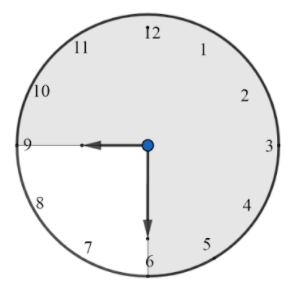
iv)Three-fourth revolution: $\dfrac{3\times {{360}^{\circ }}}{4}={{270}^{\circ }}$ = $\text{12 to 9}$
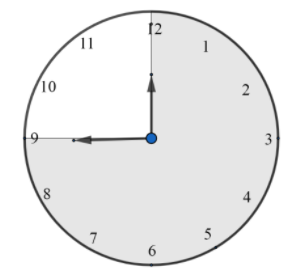
v) Half revolution: $\dfrac{{{360}^{\circ }}}{2}={{180}^{\circ }}$ = From $8\text{ to }2$
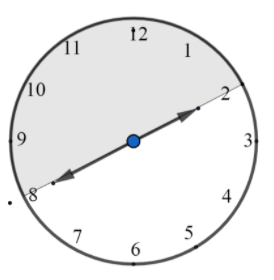
So, these were the five situations required in the questions.
Note: Students can take any example from their own mind, they can take any time period which fits into the condition asked in the question. For example for one-fourth, you can also show 12 to 3, 9 to 12 etc. Similarly for half of a revolution you could show 1 to 7, 3 to 9 etc. And same for three-fourth as well, 6 to 3 , 3 to 12 etc.
Complete step by step answer:
Let’s start by understanding the meaning of clock and a revolution on the clock. So we know that a clock is basically a device which displays time. It has three hands or we can say revolving pointer rods, each hand being the hour hand, the minute hand and the seconds hand is the fastest of the three and the hour hand is the slowest of all. A cock face is numbered 1 through 12 indicating the hours in a 12-hour cycle, and a short hour hand makes two revolutions in a day. A long minute hand makes one revolution every hour and the seconds hand, which makes one revolution per minute.
One full revolution means when the hands of the clock are completely full \[{{360}^{\circ }}\] angle on the clock face.
Now we have to show the situations of one fourth, half and three-fourth revolution on a clock:
i) One fourth revolution: $\dfrac{{{360}^{\circ }}}{4}={{90}^{\circ }}$ , from $3\text{ to }6$
ii) Half revolution: $\dfrac{{{360}^{\circ }}}{2}={{180}^{\circ }}$ = $12\text{ to }6$
iii) Three-fourth revolution: $\dfrac{3\times {{360}^{\circ }}}{4}={{270}^{\circ }}$= $\text{9 to 6}$
iv)Three-fourth revolution: $\dfrac{3\times {{360}^{\circ }}}{4}={{270}^{\circ }}$ = $\text{12 to 9}$
v) Half revolution: $\dfrac{{{360}^{\circ }}}{2}={{180}^{\circ }}$ = From $8\text{ to }2$
So, these were the five situations required in the questions.
Note: Students can take any example from their own mind, they can take any time period which fits into the condition asked in the question. For example for one-fourth, you can also show 12 to 3, 9 to 12 etc. Similarly for half of a revolution you could show 1 to 7, 3 to 9 etc. And same for three-fourth as well, 6 to 3 , 3 to 12 etc.
Recently Updated Pages
Master Class 12 Business Studies: Engaging Questions & Answers for Success

Master Class 12 Biology: Engaging Questions & Answers for Success
Master Class 12 Chemistry: Engaging Questions & Answers for Success
Class 12 Question and Answer - Your Ultimate Solutions Guide
Master Class 11 Social Science: Engaging Questions & Answers for Success
Master Class 11 English: Engaging Questions & Answers for Success
Trending doubts
What is the full form of NDA a National Democratic class 10 social science CBSE
Explain the Treaty of Vienna of 1815 class 10 social science CBSE
Who Won 36 Oscar Awards? Record Holder Revealed
Bharatiya Janata Party was founded in the year A 1979 class 10 social science CBSE
What is the median of the first 10 natural numbers class 10 maths CBSE
Why is it 530 pm in india when it is 1200 afternoon class 10 social science CBSE