




How can I draw dots-and-crosses diagrams (showing outer electrons only) for ammonia, $ N{{H}_{3}} $ ?
Answer
 Verified
557.7k+ views
Hint: Lewis structures, also known as Lewis dot formulas, Lewis dot structures, electron dot structures, or Lewis electron dot structures (LEDS), are diagrams that depict the bonding between atoms in a molecule, as well as any lone pairs of electrons that may be present. Any covalently bound molecule, as well as coordination compounds, can be represented by a Lewis structure.
Complete Step By Step Answer:
Ammonia is a nitrogen-hydrogen chemical with the formula $ N{{H}_{3}} $ . Ammonia is a colourless gas with a strong pungent odour. It is a stable binary hydride and the simplest pictogen hydride. It's a frequent nitrogenous waste, especially among aquatic creatures, and it helps terrestrial organisms meet their nutritional demands by acting as a precursor to food and fertilisers. Ammonia is also utilised in many commercial cleaning products and is a building block for the production of many medicinal drugs, either directly or indirectly. It is mostly gathered by air and water displacement downward.
With the dots and crosses at the intersections, you draw crossing circles.
Nitrogen (N) belongs to Group 15, which means it contains five outer electrons. To complete its octet, it needs three additional electrons.
Hydrogen (H) belongs to Group 1, which means it only contains one electron. To complete its valence shell, it requires one additional electron.
Three H atoms sharing electrons and forming covalent connections with a N atom can provide each atom a full shell.
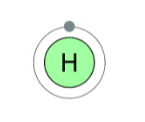
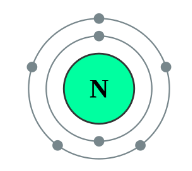

Hence this is the structure of Ammonia.
Note:
Because a particular mechanism exists to prevent ammonia build-up in the circulation, the toxicity of ammonia solutions seldom causes issues in humans and other mammals. The enzyme carbamoyl phosphate synthetase converts ammonia to carbamoyl phosphate, which subsequently enters the urea cycle to be incorporated into amino acids or eliminated in the urine. This process is absent in fish and amphibians, who can generally remove ammonia from their bodies by direct excretion. Ammonia is very poisonous to aquatic creatures, even at low quantities, and is thus categorised as hazardous to the environment.
Complete Step By Step Answer:
Ammonia is a nitrogen-hydrogen chemical with the formula $ N{{H}_{3}} $ . Ammonia is a colourless gas with a strong pungent odour. It is a stable binary hydride and the simplest pictogen hydride. It's a frequent nitrogenous waste, especially among aquatic creatures, and it helps terrestrial organisms meet their nutritional demands by acting as a precursor to food and fertilisers. Ammonia is also utilised in many commercial cleaning products and is a building block for the production of many medicinal drugs, either directly or indirectly. It is mostly gathered by air and water displacement downward.
With the dots and crosses at the intersections, you draw crossing circles.
Nitrogen (N) belongs to Group 15, which means it contains five outer electrons. To complete its octet, it needs three additional electrons.
Hydrogen (H) belongs to Group 1, which means it only contains one electron. To complete its valence shell, it requires one additional electron.
Three H atoms sharing electrons and forming covalent connections with a N atom can provide each atom a full shell.
Hence this is the structure of Ammonia.
Note:
Because a particular mechanism exists to prevent ammonia build-up in the circulation, the toxicity of ammonia solutions seldom causes issues in humans and other mammals. The enzyme carbamoyl phosphate synthetase converts ammonia to carbamoyl phosphate, which subsequently enters the urea cycle to be incorporated into amino acids or eliminated in the urine. This process is absent in fish and amphibians, who can generally remove ammonia from their bodies by direct excretion. Ammonia is very poisonous to aquatic creatures, even at low quantities, and is thus categorised as hazardous to the environment.
Recently Updated Pages
If x a + bt + ct2 where x is in meters and t is in class 11 physics CBSE

A car covers the first half distance between two places class 11 physics CBSE
The resultant of two vectors overrightarrow P and overrightarrow class 11 physics CBSE
Find the value of cos 135 class 11 maths CBSE
A mass M is held in place by an applied force F and class 11 physics CBSE
A solution of glucose in water is labelled as 10 dfracwv class 11 chemistry CBSE
Trending doubts
One Metric ton is equal to kg A 10000 B 1000 C 100 class 11 physics CBSE
Find the value of the expression given below sin 30circ class 11 maths CBSE
What do you mean by retardation What is its SI uni class 11 physics CBSE
Draw a diagram of nephron and explain its structur class 11 biology CBSE
10 examples of friction in our daily life
Difference between physical and chemical change class 11 chemistry CBSE