




Draw and label the parts of L. S of the flower.
Answer
 Verified
626.7k+ views
Hint: Each flower has four whorls – calyx, corolla, androecium, and gynoecium.
Complete answer:
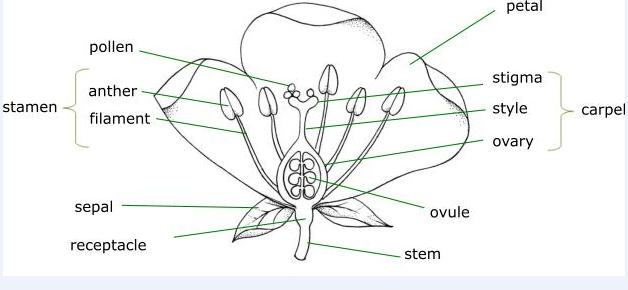
Fig. L. S of flower
A flower with all the four whorls is called a complete flower.
Calyx
- It is the outermost whorl of a flower composed of a number of lobes called sepals.
- When the sepals are free, the calyx is called polysepalous and when the sepals are fused, the calyx is called gamosepalous
- It is usually green or colored.
Corolla
- It is the second whorl of a flower composed of petals.
- When the petals are free the corolla is called polypetalous and when petals are fused, it is called gamopetalous.
- They are usually larger, brightly colored, and strongly scented which attracts insects for pollination.
Androecium
- It is the third whorl of a flower composed of stamens.
- The stamen represents the male reproductive organ consists of two parts – a thin slender stalk called filament and at the tip of which there is a bilobed box- like structure called the anther.
- The two anther lobes are connected with a tissue called connective.
Inside the anther, there are two pollen sacs enclosing pollen grains.
Gynoecium
- It is the innermost female reproductive whorl of the flower composed of carpels. Each carpel has three parts – ovary, style, and stigma.
- The ovary is the basal swollen portion of carpels.
- The style connects the ovary with the stigma and usually arises from the top of the ovary.
The stigma is usually placed on the style.
Note: Sometimes calyx and corolla are not distinguishable from one another and the whorl is this called perianth. The separate parts of the perianth are called tepal.
Complete answer:
Fig. L. S of flower
A flower with all the four whorls is called a complete flower.
Calyx
- It is the outermost whorl of a flower composed of a number of lobes called sepals.
- When the sepals are free, the calyx is called polysepalous and when the sepals are fused, the calyx is called gamosepalous
- It is usually green or colored.
Corolla
- It is the second whorl of a flower composed of petals.
- When the petals are free the corolla is called polypetalous and when petals are fused, it is called gamopetalous.
- They are usually larger, brightly colored, and strongly scented which attracts insects for pollination.
Androecium
- It is the third whorl of a flower composed of stamens.
- The stamen represents the male reproductive organ consists of two parts – a thin slender stalk called filament and at the tip of which there is a bilobed box- like structure called the anther.
- The two anther lobes are connected with a tissue called connective.
Inside the anther, there are two pollen sacs enclosing pollen grains.
Gynoecium
- It is the innermost female reproductive whorl of the flower composed of carpels. Each carpel has three parts – ovary, style, and stigma.
- The ovary is the basal swollen portion of carpels.
- The style connects the ovary with the stigma and usually arises from the top of the ovary.
The stigma is usually placed on the style.
Note: Sometimes calyx and corolla are not distinguishable from one another and the whorl is this called perianth. The separate parts of the perianth are called tepal.
Recently Updated Pages
Master Class 11 English: Engaging Questions & Answers for Success

Master Class 11 Social Science: Engaging Questions & Answers for Success
Master Class 11 Maths: Engaging Questions & Answers for Success
Master Class 11 Biology: Engaging Questions & Answers for Success
Master Class 11 Physics: Engaging Questions & Answers for Success
Master Class 11 Chemistry: Engaging Questions & Answers for Success
Trending doubts
One Metric ton is equal to kg A 10000 B 1000 C 100 class 11 physics CBSE
Difference Between Prokaryotic Cells and Eukaryotic Cells
Find the value of the expression given below sin 30circ class 11 maths CBSE
Two of the body parts which do not appear in MRI are class 11 biology CBSE
Draw a diagram of a plant cell and label at least eight class 11 biology CBSE
10 examples of friction in our daily life