




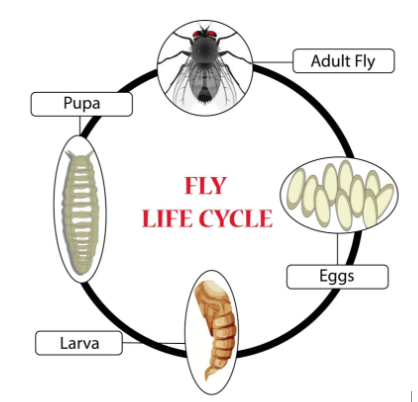
Draw and label the life cycle of a fly.
Answer
 Verified
584k+ views
Hint: The zoological name of a housefly is Musca domestica. A fly during its lifetime goes through roughly three to four stages. It comes within the suborder Cyclorrapha under phylum arthropods and exhibits a similar pattern of life forms as other organisms in this category.
Complete answer:
The female housefly generally mates once in a lifetime. Consequently, it stores all the sperms for future use. Every female house flies lay 500 eggs in her entire lifetime. This occurs in multiple batches of about 75 to 150. The life cycle of a fly passes through various stages starting from an egg hatching into a larva, which gets transformed into a pupa and then metamorphoses into a fly.
Egg:
- The female fly lays eggs on dead and decayed organic matter.
- The colour of their eggs is white.
- The length of each egg is about 1.2 mm.
- Within one day, the eggs start hatching and larvae come out of them.
Larva:
- These larvae then live and feed in the same place.
- Their colour is pale-whitish.
- The larva’s length varies from 3-9 mm.
- Their body is thinner at the mouth end and the larvae are legless.
- Under normal conditions, larval development takes two weeks, while in cooler conditions it may take 30 days or more.
- At the end of the third instar, a larva crawls to a cool and dry place and subsequently transforms into a pupa.
Pupa:
- The pupa is enclosed in a cylindrical case which has rounded ends.
- The length of each pupa is about 1.2 mm.
- Initially, a pupa is yellowish in colour. It later darkens through red and brown to nearly black colour with age.
- Pupae may take 2 to 20 days or more to complete their development based on the temperature.
- After the completion of metamorphosis, an adult housefly emerges out from the pupa.
Note:
- Housefly’s larvae are also called maggots.
- An ‘instar’ Is a developmental stage in the life cycle of arthropods such as insects until they reach sexual maturity.
- ‘Metamorphosis’: a biological process by which an animal develops after hatching from the eggs. It involves a number of conspicuous changes within the body structure of the organism.
Complete answer:
The female housefly generally mates once in a lifetime. Consequently, it stores all the sperms for future use. Every female house flies lay 500 eggs in her entire lifetime. This occurs in multiple batches of about 75 to 150. The life cycle of a fly passes through various stages starting from an egg hatching into a larva, which gets transformed into a pupa and then metamorphoses into a fly.
Egg:
- The female fly lays eggs on dead and decayed organic matter.
- The colour of their eggs is white.
- The length of each egg is about 1.2 mm.
- Within one day, the eggs start hatching and larvae come out of them.
Larva:
- These larvae then live and feed in the same place.
- Their colour is pale-whitish.
- The larva’s length varies from 3-9 mm.
- Their body is thinner at the mouth end and the larvae are legless.
- Under normal conditions, larval development takes two weeks, while in cooler conditions it may take 30 days or more.
- At the end of the third instar, a larva crawls to a cool and dry place and subsequently transforms into a pupa.
Pupa:
- The pupa is enclosed in a cylindrical case which has rounded ends.
- The length of each pupa is about 1.2 mm.
- Initially, a pupa is yellowish in colour. It later darkens through red and brown to nearly black colour with age.
- Pupae may take 2 to 20 days or more to complete their development based on the temperature.
- After the completion of metamorphosis, an adult housefly emerges out from the pupa.
Note:
- Housefly’s larvae are also called maggots.
- An ‘instar’ Is a developmental stage in the life cycle of arthropods such as insects until they reach sexual maturity.
- ‘Metamorphosis’: a biological process by which an animal develops after hatching from the eggs. It involves a number of conspicuous changes within the body structure of the organism.
Recently Updated Pages
Master Class 11 Maths: Engaging Questions & Answers for Success

Master Class 11 Economics: Engaging Questions & Answers for Success
Master Class 11 Biology: Engaging Questions & Answers for Success
Class 11 Question and Answer - Your Ultimate Solutions Guide
Master Class 11 English: Engaging Questions & Answers for Success
Master Class 11 Social Science: Engaging Questions & Answers for Success
Trending doubts
Find the value of the expression given below sin 30circ class 11 maths CBSE
Draw a diagram of nephron and explain its structur class 11 biology CBSE
Proton was discovered by A Thomson B Rutherford C Chadwick class 11 chemistry CBSE
What is the sex ratio of Kerala class 11 social science CBSE
State the laws of reflection of light
Derive the equation of motion by the calculus method class 11 physics CBSE