




Draw and label the diagram showing various regions of Electro-magnetic spectrum and their wavelength ranges.
Answer
 Verified
565.5k+ views
Hint: The waves which are created or produced by the oscillating time-varying magnetic and electric fields, vibrating in mutually perpendicular directions are known as electromagnetic waves. Electromagnetic waves proceed forward in vacuum (free space) with the speed same as the speed of light (in vacuum, \[3 \times {10^8}m{s^{ - 1}}\] ).
Complete answer:
Electromagnetic waves are classified based on the range of their wavelengths into seven types. The arrangement of the wide range of wavelengths of electromagnetic waves is known as the electromagnetic spectrum. The spectrum shows the distribution of the wavelengths according to the corresponding waves. Electromagnetic spectrum:
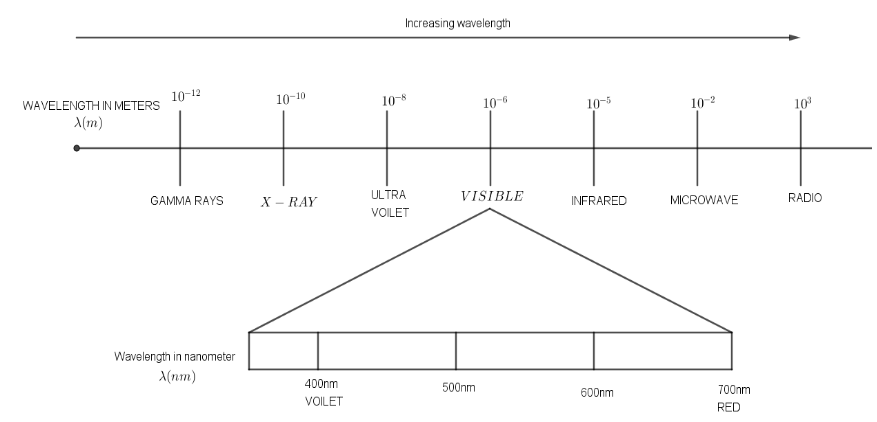
Gamma rays have the shortest wavelengths in the spectrum whereas radio waves have the longest wavelength. The wave regions are arranged in increasing order of wavelengths as Gamma rays, X-rays, Ultraviolet rays, Visible rays, Infrared, microwaves, radio waves.
The electromagnetic waves in the visible region are the waves visible to human eyes. The range of colors in the visible region varies between $400\,nm-700\,nm$. The shorter wavelengths are violet and longer wavelengths correspond to red color. Before and after the visible region, the wave region is not visible because the human eye cannot detect these waves.
Note: The waves with different wavelengths show different characteristics, and are also produced by different sources. The waves with a larger wavelength have less energy. Because the energy of a wave is inversely proportional to the wavelength of the wave. \[E = \dfrac{{hc}}{\lambda }\] and \[E \propto \dfrac{1}{\lambda }\] where \[h\] is Planck’s constant, \[c\] is speed of light in vacuum and \[\lambda \] is the wavelength of wave.
Complete answer:
Electromagnetic waves are classified based on the range of their wavelengths into seven types. The arrangement of the wide range of wavelengths of electromagnetic waves is known as the electromagnetic spectrum. The spectrum shows the distribution of the wavelengths according to the corresponding waves. Electromagnetic spectrum:
Gamma rays have the shortest wavelengths in the spectrum whereas radio waves have the longest wavelength. The wave regions are arranged in increasing order of wavelengths as Gamma rays, X-rays, Ultraviolet rays, Visible rays, Infrared, microwaves, radio waves.
The electromagnetic waves in the visible region are the waves visible to human eyes. The range of colors in the visible region varies between $400\,nm-700\,nm$. The shorter wavelengths are violet and longer wavelengths correspond to red color. Before and after the visible region, the wave region is not visible because the human eye cannot detect these waves.
Note: The waves with different wavelengths show different characteristics, and are also produced by different sources. The waves with a larger wavelength have less energy. Because the energy of a wave is inversely proportional to the wavelength of the wave. \[E = \dfrac{{hc}}{\lambda }\] and \[E \propto \dfrac{1}{\lambda }\] where \[h\] is Planck’s constant, \[c\] is speed of light in vacuum and \[\lambda \] is the wavelength of wave.
Recently Updated Pages
Basicity of sulphurous acid and sulphuric acid are

Master Class 12 Economics: Engaging Questions & Answers for Success
Master Class 12 Biology: Engaging Questions & Answers for Success
Master Class 11 English: Engaging Questions & Answers for Success
Master Class 11 Physics: Engaging Questions & Answers for Success
Master Class 11 Computer Science: Engaging Questions & Answers for Success
Trending doubts
Draw a labelled sketch of the human eye class 12 physics CBSE
The chemical formula of tear gas is A CO Cl 2 B C 10 class 12 chemistry CBSE
Draw ray diagrams each showing i myopic eye and ii class 12 physics CBSE
Which are the Top 10 Largest Countries of the World?
Differentiate between homogeneous and heterogeneous class 12 chemistry CBSE
Which is the correct genotypic ratio of mendel dihybrid class 12 biology CBSE