




How can I draw all possible stereoisomers for 2-chloro-3-hexanol?
Answer
 Verified
608.1k+ views
Hint: Organic chemistry is the branch of chemistry in which carbon and its compounds are mainly studied. In Organic chemistry various compounds of carbon are found and formed as well. Carbon compounds are present in linear chain, branched chain and even in closed chain also. Carbon compounds have a unique property that they can arrange their atoms in different manner in three dimensional structure and due to which we obtain different structures of the same compounds.
Complete step by step answer:
Optical isomerism occurs mainly in substances that have the same molecular and structural formula, but they cannot be superimposed on each other. Typically optical isomerism is shown by stereoisomers which rotate the plane of polarized light.
Chiral carbons are those which have no plane of symmetry and all the attached groups are different.
Achiral carbons are those where a plane of symmetry and all the groups attached to the central carbon atom are not different.
Molecules having chiral centre will shown optical isomerism first we will draw the bond-line structure of $2-$ chlorohexan$-3-01.$
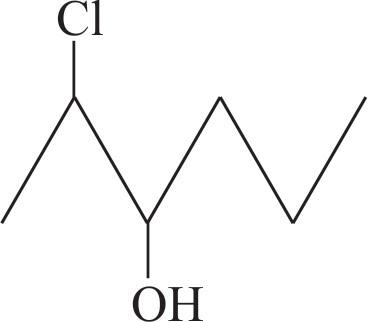
We can see that this compound contain two chiral centres : $\text{C}-2$ and $\text{C}-3$ $\to n=2$
So acc to $[{{2}^{n}}]$
$[{{2}^{n}}]=4$ stereoisomers
Here are the $4$ stereoisomer of $2$ chloro $-3-$ hexanol,
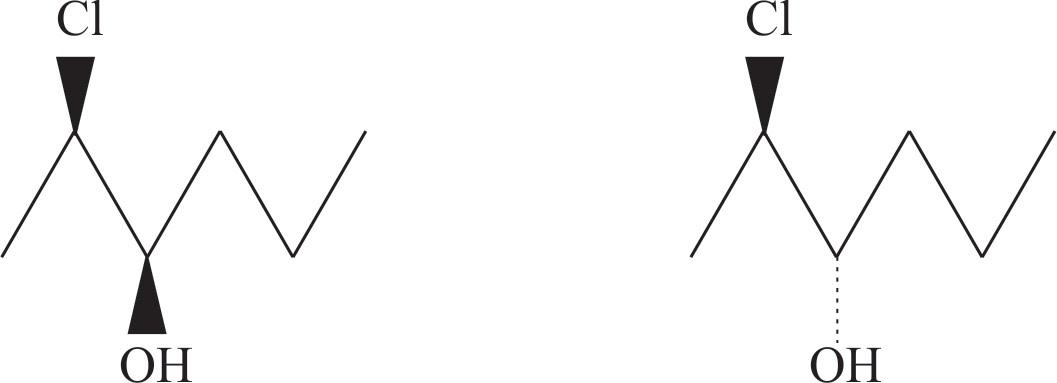
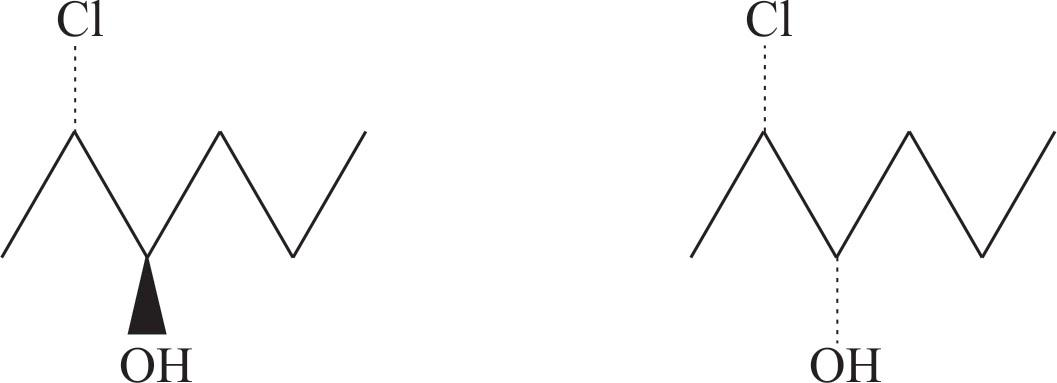
These are wedge-dash structures
Final Answer: The compound $2$ chloro$-3-$ hexanol has four possible stereoisomers.
Note: Isomerism is the phenomenon in which molecular formulas are the same but physical and chemical properties are different. Isomerism is further classified into two parts – Structural and Stereo-Isomerism.
In structural isomerism, species have similar molecular formula but the structure is different while in stereo isomerism, species have similar molecular formula but the arrangement of an atom in space is different. Due to their different arrangement they give rise to different molecules which have different either physical properties or chemical properties.
Complete step by step answer:
Optical isomerism occurs mainly in substances that have the same molecular and structural formula, but they cannot be superimposed on each other. Typically optical isomerism is shown by stereoisomers which rotate the plane of polarized light.
Chiral carbons are those which have no plane of symmetry and all the attached groups are different.
Achiral carbons are those where a plane of symmetry and all the groups attached to the central carbon atom are not different.
Molecules having chiral centre will shown optical isomerism first we will draw the bond-line structure of $2-$ chlorohexan$-3-01.$
We can see that this compound contain two chiral centres : $\text{C}-2$ and $\text{C}-3$ $\to n=2$
So acc to $[{{2}^{n}}]$
$[{{2}^{n}}]=4$ stereoisomers
Here are the $4$ stereoisomer of $2$ chloro $-3-$ hexanol,
These are wedge-dash structures
Final Answer: The compound $2$ chloro$-3-$ hexanol has four possible stereoisomers.
Note: Isomerism is the phenomenon in which molecular formulas are the same but physical and chemical properties are different. Isomerism is further classified into two parts – Structural and Stereo-Isomerism.
In structural isomerism, species have similar molecular formula but the structure is different while in stereo isomerism, species have similar molecular formula but the arrangement of an atom in space is different. Due to their different arrangement they give rise to different molecules which have different either physical properties or chemical properties.
Recently Updated Pages
Which will be the least stable resonating structure class 11 chemistry CBSE

How many 5 digit telephone numbers can be construc-class-11-maths-CBSE
How do you find the angle of the resultant vector class 11 physics CBSE
Draw labelled diagram of the following i Gram seed class 11 biology CBSE
What is the need and importance of classification class 11 biology CBSE
The way in which the sparrows expressed their sorrow class 11 english CBSE
Trending doubts
One Metric ton is equal to kg A 10000 B 1000 C 100 class 11 physics CBSE
Find the value of the expression given below sin 30circ class 11 maths CBSE
1 Quintal is equal to a 110 kg b 10 kg c 100kg d 1000 class 11 physics CBSE
Draw a diagram of nephron and explain its structur class 11 biology CBSE
10 examples of friction in our daily life
Proton was discovered by A Thomson B Rutherford C Chadwick class 11 chemistry CBSE