




Draw a well labelled diagram of an eukaryotic nucleus. How is it different from nucleoid?
Answer
 Verified
625.5k+ views
Hint:- In eukaryotes, the cells are not primitive, having distinct membranes around the organelles. The eukaryotic nucleus is prominent. It is enclosed in a nuclear membrane. The nucleus of the eukaryotic cells contains nucleoli.
Complete answer:-
In eukaryotic cells, the nucleus is a double membrane-bound. It is well developed. It contains the genome of the organism which is DNA. It is the main integrity of a cell. It controls all the main processes of the cell. It is the largest organelle of a cell and also supports transcription and replication processes. The nucleus contains and protects the genetic material. This genetic material is in the form of DNA along with histone and non-histone proteins making up the chromatin network.
The nucleus is attached to a network of the endoplasmic reticulum. The endoplasmic reticulum has several ribosomes around it thus making it a rough endoplasmic reticulum. Nucleoid is basically an area that is irregular in shape. It is present in a prokaryotic (primitive) cell. Nucleoid is the genetic material of a prokaryotic cell. It is not surrounded by an envelope. It lies just scattered in the cytoplasm. The area contains the chromosome. The functions of the nucleoid are the same as the nucleus of a eukaryotic cell.
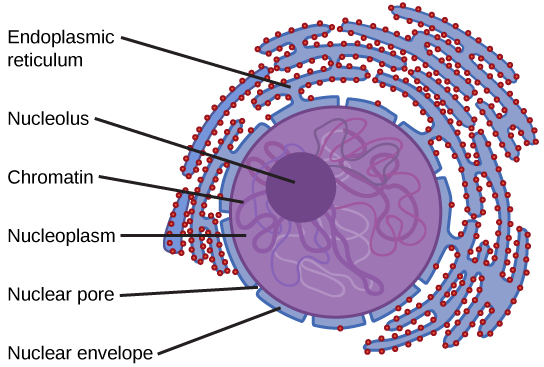
Note: Organisms of all the other kingdoms except monera are eukaryotic. Protista, Animalia, Plantae, and Fungi are all eukaryotic. The chromatin material present in the nucleus condenses in the form of chromosomes at the time of cell division. The protoplasm present inside the nucleus is known as the nucleoplasm.
Complete answer:-
In eukaryotic cells, the nucleus is a double membrane-bound. It is well developed. It contains the genome of the organism which is DNA. It is the main integrity of a cell. It controls all the main processes of the cell. It is the largest organelle of a cell and also supports transcription and replication processes. The nucleus contains and protects the genetic material. This genetic material is in the form of DNA along with histone and non-histone proteins making up the chromatin network.
The nucleus is attached to a network of the endoplasmic reticulum. The endoplasmic reticulum has several ribosomes around it thus making it a rough endoplasmic reticulum. Nucleoid is basically an area that is irregular in shape. It is present in a prokaryotic (primitive) cell. Nucleoid is the genetic material of a prokaryotic cell. It is not surrounded by an envelope. It lies just scattered in the cytoplasm. The area contains the chromosome. The functions of the nucleoid are the same as the nucleus of a eukaryotic cell.
Note: Organisms of all the other kingdoms except monera are eukaryotic. Protista, Animalia, Plantae, and Fungi are all eukaryotic. The chromatin material present in the nucleus condenses in the form of chromosomes at the time of cell division. The protoplasm present inside the nucleus is known as the nucleoplasm.
Recently Updated Pages
Master Class 12 Economics: Engaging Questions & Answers for Success

Master Class 12 Social Science: Engaging Questions & Answers for Success
Master Class 12 English: Engaging Questions & Answers for Success
Master Class 12 Maths: Engaging Questions & Answers for Success
Master Class 12 Physics: Engaging Questions & Answers for Success
Master Class 12 Biology: Engaging Questions & Answers for Success
Trending doubts
Draw a labelled sketch of the human eye class 12 physics CBSE
Which are the Top 10 Largest Countries of the World?
Draw ray diagrams each showing i myopic eye and ii class 12 physics CBSE
Which is the correct genotypic ratio of mendel dihybrid class 12 biology CBSE
Differentiate between homogeneous and heterogeneous class 12 chemistry CBSE
Give 10 examples of unisexual and bisexual flowers