




Draw a $\vartriangle $ABC, right-angled at B, such that AB = 3cm, BC = 4cm. Now construct a $\vartriangle $PQB similar to$\vartriangle $ABC, each of those sides is $\dfrac{7}{5}$ times the corresponding side of $\vartriangle $ABC.
Answer
 Verified
585.6k+ views
Hint: As the question says we have to draw the diagram each of those side is $\dfrac{7}{5}$ times the corresponding side of $\vartriangle $ABC. First we have to find the length of second triangle and construct the triangle ABC with the side that AB = 3cm, BC = 4cm and right angle at B.
Complete step-by-step answer:
We have AB = 3cm
BC = 4cm
And the question mentions that the sides of triangle PQB is $\dfrac{7}{5}$times of the corresponding side of triangle ABC.
So, the side of triangle PQB is
BQ = $\dfrac{7}{5}$BC
Put the value of BC
BQ = $\dfrac{7}{5}.4cm$
Multiply 4 by $\dfrac{7}{5}$
BQ =$\dfrac{{28}}{5}cm$
Divide the numerator by denominator
BQ =$5.6cm$
As same we can find the value of PB
PB = $\dfrac{7}{5}$AB
PB =$\dfrac{7}{5}.3cm$
Multiply 3 by $\dfrac{7}{5}$
PB =$\dfrac{{21}}{5}cm$
Divide the numerator by denominator
PB =$4.2cm$
Now we have the length of BQ and PB of the triangle PQB
We can construct the triangle by using the above measures of side
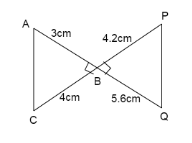
First construct the triangle ABC which is right angle at point B
Both the triangle at right angle at point B
Extend the AB by 5.6 cm and make the point Q
Extend the CB by 4.2cm and make the point P
Now simply join the P and Q
Here the triangle PQB is formed .
Note: Always read the question carefully as the question says the side of the second triangle is $\dfrac{7}{5}$ times of the corresponding triangle ABC. So just multiply the side of triangle ABC by $\dfrac{7}{5}$. Do the calculation neat and carefully. Draw the diagram step by step.
Complete step-by-step answer:
We have AB = 3cm
BC = 4cm
And the question mentions that the sides of triangle PQB is $\dfrac{7}{5}$times of the corresponding side of triangle ABC.
So, the side of triangle PQB is
BQ = $\dfrac{7}{5}$BC
Put the value of BC
BQ = $\dfrac{7}{5}.4cm$
Multiply 4 by $\dfrac{7}{5}$
BQ =$\dfrac{{28}}{5}cm$
Divide the numerator by denominator
BQ =$5.6cm$
As same we can find the value of PB
PB = $\dfrac{7}{5}$AB
PB =$\dfrac{7}{5}.3cm$
Multiply 3 by $\dfrac{7}{5}$
PB =$\dfrac{{21}}{5}cm$
Divide the numerator by denominator
PB =$4.2cm$
Now we have the length of BQ and PB of the triangle PQB
We can construct the triangle by using the above measures of side
First construct the triangle ABC which is right angle at point B
Both the triangle at right angle at point B
Extend the AB by 5.6 cm and make the point Q
Extend the CB by 4.2cm and make the point P
Now simply join the P and Q
Here the triangle PQB is formed .
Note: Always read the question carefully as the question says the side of the second triangle is $\dfrac{7}{5}$ times of the corresponding triangle ABC. So just multiply the side of triangle ABC by $\dfrac{7}{5}$. Do the calculation neat and carefully. Draw the diagram step by step.
Recently Updated Pages
Master Class 11 Computer Science: Engaging Questions & Answers for Success

Master Class 11 Business Studies: Engaging Questions & Answers for Success
Master Class 11 Economics: Engaging Questions & Answers for Success
Master Class 11 English: Engaging Questions & Answers for Success
Master Class 11 Maths: Engaging Questions & Answers for Success
Master Class 11 Biology: Engaging Questions & Answers for Success
Trending doubts
Difference Between Plant Cell and Animal Cell
Fill the blanks with the suitable prepositions 1 The class 9 english CBSE
Which places in India experience sunrise first and class 9 social science CBSE
Who is eligible for RTE class 9 social science CBSE
What is pollution? How many types of pollution? Define it
Name 10 Living and Non living things class 9 biology CBSE