




Draw a triangle ABC with side BC = 7 cm, $ \angle B=45{}^\circ ,\angle A=105{}^\circ $ . Then, construct a triangle whose sides are $ \dfrac{3}{4} $ times the corresponding sides of triangle ABC.
Answer
 Verified
621.3k+ views
Hint: Construct the triangle ABC using the basic methods. To draw the triangle EBD, draw a ray BX at an acute angle to line BC on the opposite side of A and mark 4 equidistant points B1, B2, B3, B4 on ray BX. Join B3 and C. Draw B4D parallel to B3C and ED parallel to AC. Hence, the triangle EBD is the required triangle.
Complete step-by-step answer:
In this question, we need to construct a triangle ABC with side BC = 7 cm, $ \angle B=45{}^\circ ,\angle A=105{}^\circ $ . Then, we need to construct a triangle whose sides are $ \dfrac{4}{3} $ times the corresponding sides of triangle ABC.
First, we will find the measure of $ \angle C $ using the angle sum property of a triangle on triangle ABC.
$ \angle A+\angle B+\angle C=180{}^\circ $
$ 105{}^\circ +45{}^\circ +\angle C=180{}^\circ $
$ \angle C=180{}^\circ -150{}^\circ $
$ \angle C=30{}^\circ $
Now, we will start with the construction.
The steps for the construction are given below.
Constructing triangle ABC:
Step 1: Draw base BC of length 7 cm.
Step 2: Draw a ray at an angle of $ 45{}^\circ $ with line BC from point B.
Step 3: Draw a ray at an angle $ 30{}^\circ $ from line CB from point C and mark the intersection point of the rays from B and C as A.
Step 4: Join AB and AC.
Triangle ABC is the required triangle.
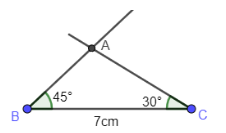
Triangle ABC is the required triangle.
For constructing triangle EBD whose sides are times the corresponding sides of triangle ABC.
Step 1: Draw a ray BX at an acute angle to line BC on the opposite side of A.
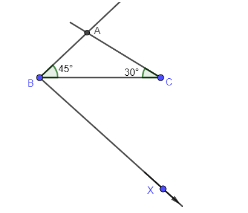
Step 2: Mark 4 equidistant points B1, B2, B3, B4 on ray BX.
Step 3: Join B3 and C.
Step 4: Draw B4D parallel to B3C and label the intersection on the extension of BC as D.
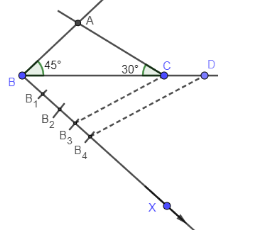
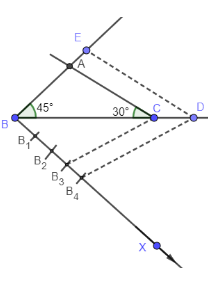
Step 5: Draw DE parallel to CA and label the intersection with the extension of BA as E
Triangle EBD is the required triangle.
The following figure shows the final construction:
Note: In this question, it is very important to know about the angle sum property of a triangle.The angle sum property of a triangle states that the angles of a triangle always add up to $ 180{}^\circ $ . Every triangle has three angles and whether it is an acute, obtuse, or right triangle, the angles sum to $ 180{}^\circ $ . For example, in triangle ABC, angle A + angle B + angle C = $ 180{}^\circ $ .
Complete step-by-step answer:
In this question, we need to construct a triangle ABC with side BC = 7 cm, $ \angle B=45{}^\circ ,\angle A=105{}^\circ $ . Then, we need to construct a triangle whose sides are $ \dfrac{4}{3} $ times the corresponding sides of triangle ABC.
First, we will find the measure of $ \angle C $ using the angle sum property of a triangle on triangle ABC.
$ \angle A+\angle B+\angle C=180{}^\circ $
$ 105{}^\circ +45{}^\circ +\angle C=180{}^\circ $
$ \angle C=180{}^\circ -150{}^\circ $
$ \angle C=30{}^\circ $
Now, we will start with the construction.
The steps for the construction are given below.
Constructing triangle ABC:
Step 1: Draw base BC of length 7 cm.
Step 2: Draw a ray at an angle of $ 45{}^\circ $ with line BC from point B.
Step 3: Draw a ray at an angle $ 30{}^\circ $ from line CB from point C and mark the intersection point of the rays from B and C as A.
Step 4: Join AB and AC.
Triangle ABC is the required triangle.
Triangle ABC is the required triangle.
For constructing triangle EBD whose sides are times the corresponding sides of triangle ABC.
Step 1: Draw a ray BX at an acute angle to line BC on the opposite side of A.
Step 2: Mark 4 equidistant points B1, B2, B3, B4 on ray BX.
Step 3: Join B3 and C.
Step 4: Draw B4D parallel to B3C and label the intersection on the extension of BC as D.
Step 5: Draw DE parallel to CA and label the intersection with the extension of BA as E
Triangle EBD is the required triangle.
The following figure shows the final construction:
Note: In this question, it is very important to know about the angle sum property of a triangle.The angle sum property of a triangle states that the angles of a triangle always add up to $ 180{}^\circ $ . Every triangle has three angles and whether it is an acute, obtuse, or right triangle, the angles sum to $ 180{}^\circ $ . For example, in triangle ABC, angle A + angle B + angle C = $ 180{}^\circ $ .

Recently Updated Pages
Master Class 12 Business Studies: Engaging Questions & Answers for Success

Master Class 12 Biology: Engaging Questions & Answers for Success
Master Class 12 Chemistry: Engaging Questions & Answers for Success
Class 12 Question and Answer - Your Ultimate Solutions Guide
Master Class 11 Social Science: Engaging Questions & Answers for Success
Master Class 11 English: Engaging Questions & Answers for Success
Trending doubts
What is BLO What is the full form of BLO class 8 social science CBSE
Citizens of India can vote at the age of A 18 years class 8 social science CBSE
Right to vote is a AFundamental Right BFundamental class 8 social science CBSE
10 slogans on organ donation class 8 english CBSE
Name the states through which the Tropic of Cancer class 8 social science CBSE
What are the methods of reducing friction. Explain