




Draw a triangle $ABC$ with $BC = 6cm,AB = 5cm$ and $\angle ABC = {60^ \circ }$. Then construct a triangle whose sides are $\dfrac{3}{4}$ of the corresponding sides of the $\vartriangle ABC$.
Answer
 Verified
615k+ views
Hint : In this we will use the concept of construction of triangles .We will construct the required triangle by using the given details in the question. First we construct the triangle ABC and then by using some basic steps of constructions of a triangle similar to a given triangle ,we will construct the required triangle.
Complete step-by-step answer:
Here, first we have to construct $\vartriangle ABC$.
To construct $\vartriangle ABC$ we have given , $BC = 6cm,AB = 5cm$ and $\angle ABC = {60^ \circ }$.
$ \to $ constructing $\vartriangle ABC$
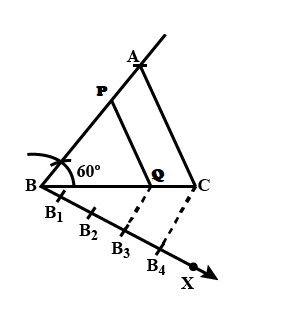
Step 1: Draw a baseline $BC$ of length 6cm ,using a ruler.
Step 2: Now draw a ray form base point B at an angle of ${60^ \circ }$.
Step 3: Mark an arc of radius 5cm on the ray that is drawn from point B in step 2 and label that intersection point as A .
Step 4: Now join A to C .
Here, the constructed triangle is the required $\vartriangle ABC$
Now, we have to construct another triangle whose sides are $\dfrac{3}{4}$ of the corresponding sides of $\vartriangle ABC$.
We are naming this triangle as $\vartriangle PBQ$
$ \to $ constructing $\vartriangle PBQ$,
Step 1: Draw a ray $BX$,on the opposite side of point A .
Step 2: Now, mark 4 equidistant points ${B_1},{B_2},{B_3}{\text{ and }}{B_4}$ on the ray $BX$ that is drawn in step 1.
Step 3: Now join the point ${B_4}C$ to point C .
Step 4: Draw a line ${B_3}Q$ that is parallel to ${B_4}C$ and mark that point of intersection with line $BC$ as $Q$.
Step 5: Draw a line $QP$ that is parallel to line $CA$ and mark that point of intersection with $AB$ as $P$.
Here, the constructed triangle $\vartriangle PBQ$ is the required triangle .
Note : In this type of questions the main thing to remember is the steps of constructions. First we have to make a base line whose length has been already given in the question and then by making an arc with given radius we will draw another required line and then by joining the points of those lines we will construct the required triangle.
Complete step-by-step answer:
Here, first we have to construct $\vartriangle ABC$.
To construct $\vartriangle ABC$ we have given , $BC = 6cm,AB = 5cm$ and $\angle ABC = {60^ \circ }$.
$ \to $ constructing $\vartriangle ABC$
Step 1: Draw a baseline $BC$ of length 6cm ,using a ruler.
Step 2: Now draw a ray form base point B at an angle of ${60^ \circ }$.
Step 3: Mark an arc of radius 5cm on the ray that is drawn from point B in step 2 and label that intersection point as A .
Step 4: Now join A to C .
Here, the constructed triangle is the required $\vartriangle ABC$
Now, we have to construct another triangle whose sides are $\dfrac{3}{4}$ of the corresponding sides of $\vartriangle ABC$.
We are naming this triangle as $\vartriangle PBQ$
$ \to $ constructing $\vartriangle PBQ$,
Step 1: Draw a ray $BX$,on the opposite side of point A .
Step 2: Now, mark 4 equidistant points ${B_1},{B_2},{B_3}{\text{ and }}{B_4}$ on the ray $BX$ that is drawn in step 1.
Step 3: Now join the point ${B_4}C$ to point C .
Step 4: Draw a line ${B_3}Q$ that is parallel to ${B_4}C$ and mark that point of intersection with line $BC$ as $Q$.
Step 5: Draw a line $QP$ that is parallel to line $CA$ and mark that point of intersection with $AB$ as $P$.
Here, the constructed triangle $\vartriangle PBQ$ is the required triangle .
Note : In this type of questions the main thing to remember is the steps of constructions. First we have to make a base line whose length has been already given in the question and then by making an arc with given radius we will draw another required line and then by joining the points of those lines we will construct the required triangle.

Recently Updated Pages
Master Class 7 English: Engaging Questions & Answers for Success

Master Class 7 Maths: Engaging Questions & Answers for Success
Master Class 7 Science: Engaging Questions & Answers for Success
Class 7 Question and Answer - Your Ultimate Solutions Guide
Master Class 9 General Knowledge: Engaging Questions & Answers for Success
Master Class 9 Social Science: Engaging Questions & Answers for Success
Trending doubts
The value of 6 more than 7 is A 1 B 1 C 13 D 13 class 7 maths CBSE
Convert 200 Million dollars in rupees class 7 maths CBSE
List of coprime numbers from 1 to 100 class 7 maths CBSE
AIM To prepare stained temporary mount of onion peel class 7 biology CBSE
The plural of Chief is Chieves A True B False class 7 english CBSE
Write a letter to the editor of the national daily class 7 english CBSE