



Draw a right triangle \[PQR\], right angled at Q such that \[PQ = 3cm\], \[QR = 4cm\]. Now construct \[\vartriangle AQB\] similar to $\vartriangle PQR$ each of whose sides is $\dfrac{7}{5}$ times the corresponding sides of $\vartriangle PQR$
Answer
 Verified
559.2k+ views
Hint: Using scale factor for the given triangle draw the next triangle.Then we're given a triangle, so via a means of scale issue homes we can draw the subsequent required triangle via a means of extending the ray, then dividing the ray on the unit period after which draws parallel traces at the size values after which entire the triangle.
Complete step by step solution:
Given a $\vartriangle PQR$ in which $\angle Q = {90^o}$, $PQ = 4cm$ and $QR = 3cm$
STEPS OF CONSTRUCTION
Draw a line segment $PQ = 4cm$
At Q make $\angle PQY = {90^o}$
Take Q as the centre and radius 3cm draw an Arc cutting QY at R.
Join PR to obtain the$\vartriangle PQR$
Through Q as centre and radius 3cm draw an Arc cutting QY at R.
Join PR to obtain the $\vartriangle PQR$
Through Q, construct an acute angle $\angle PQR( < {90^o})$opposite to the vertex.
Mark 5 points ${Q_1},{Q_2},{Q_3},{Q_4},{Q_5}$ in $QX$ such that$Q{Q_1} = {Q_1}{Q_2} = {Q_2}{Q_3} = {Q_3}{Q_4} = {Q_4}{Q_5}$
Join${Q_5}P$
Through ${Q_3}$ through \[{Q_3}{P_1}||{Q_5}P\] intersecting QP at ${P_1}$.
Now through PQ, draw ${P_1}{R_1}||PR$intersecting QR at ${R_1}$
On following the above steps of construction, we get the diagram which is required.
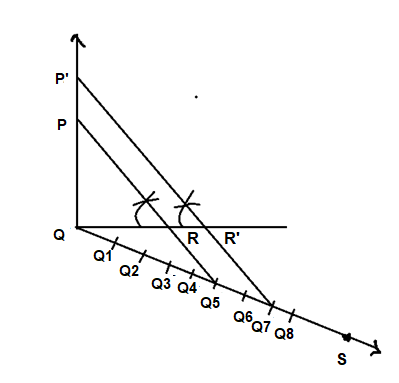
Therefore, the $\vartriangle {P_1}Q{R_1}$ is the required triangle whose sides is $\dfrac{7}{5}$ times the corresponding sides of $\vartriangle PQR$
Note: When we draw the extended ray, we have to make sure the ray is marked according to the highest of the difference factor and the divisions are in equal measurements to each other and the lower value of the difference factor should join the base side of the triangle given in the question.
Complete step by step solution:
Given a $\vartriangle PQR$ in which $\angle Q = {90^o}$, $PQ = 4cm$ and $QR = 3cm$
STEPS OF CONSTRUCTION
Draw a line segment $PQ = 4cm$
At Q make $\angle PQY = {90^o}$
Take Q as the centre and radius 3cm draw an Arc cutting QY at R.
Join PR to obtain the$\vartriangle PQR$
Through Q as centre and radius 3cm draw an Arc cutting QY at R.
Join PR to obtain the $\vartriangle PQR$
Through Q, construct an acute angle $\angle PQR( < {90^o})$opposite to the vertex.
Mark 5 points ${Q_1},{Q_2},{Q_3},{Q_4},{Q_5}$ in $QX$ such that$Q{Q_1} = {Q_1}{Q_2} = {Q_2}{Q_3} = {Q_3}{Q_4} = {Q_4}{Q_5}$
Join${Q_5}P$
Through ${Q_3}$ through \[{Q_3}{P_1}||{Q_5}P\] intersecting QP at ${P_1}$.
Now through PQ, draw ${P_1}{R_1}||PR$intersecting QR at ${R_1}$
On following the above steps of construction, we get the diagram which is required.
Therefore, the $\vartriangle {P_1}Q{R_1}$ is the required triangle whose sides is $\dfrac{7}{5}$ times the corresponding sides of $\vartriangle PQR$
Note: When we draw the extended ray, we have to make sure the ray is marked according to the highest of the difference factor and the divisions are in equal measurements to each other and the lower value of the difference factor should join the base side of the triangle given in the question.

Recently Updated Pages
Three beakers labelled as A B and C each containing 25 mL of water were taken A small amount of NaOH anhydrous CuSO4 and NaCl were added to the beakers A B and C respectively It was observed that there was an increase in the temperature of the solutions contained in beakers A and B whereas in case of beaker C the temperature of the solution falls Which one of the following statements isarecorrect i In beakers A and B exothermic process has occurred ii In beakers A and B endothermic process has occurred iii In beaker C exothermic process has occurred iv In beaker C endothermic process has occurred

Master Class 9 Social Science: Engaging Questions & Answers for Success
Master Class 9 Science: Engaging Questions & Answers for Success
Master Class 9 Maths: Engaging Questions & Answers for Success
Master Class 9 General Knowledge: Engaging Questions & Answers for Success
Class 9 Question and Answer - Your Ultimate Solutions Guide
Three beakers labelled as A B and C each containing 25 mL of water were taken A small amount of NaOH anhydrous CuSO4 and NaCl were added to the beakers A B and C respectively It was observed that there was an increase in the temperature of the solutions contained in beakers A and B whereas in case of beaker C the temperature of the solution falls Which one of the following statements isarecorrect i In beakers A and B exothermic process has occurred ii In beakers A and B endothermic process has occurred iii In beaker C exothermic process has occurred iv In beaker C endothermic process has occurred
Master Class 9 Social Science: Engaging Questions & Answers for Success
Master Class 9 Science: Engaging Questions & Answers for Success
Trending doubts
Find the sum of series 1 + 2 + 3 + 4 + 5 + + 100 class 9 maths CBSE
Fill the blanks with the suitable prepositions 1 The class 9 english CBSE
Difference Between Plant Cell and Animal Cell
What is pollution? How many types of pollution? Define it
Name 10 Living and Non living things class 9 biology CBSE
Which are the Top 10 Largest States of India?