




Draw a ray of diagram to show the angle of deviation when a ray of light passes through a glass prism.
Answer
 Verified
612.6k+ views
Hint: When a ray of light passes through a glass prism it gets refracted or deviated two times. One when it enters the glass prism (from rarer medium to denser medium), second when it leaves the prism (denser medium to rarer medium).
Complete step-by-step answer:
Below is the ray diagram showing angle of deviation when a ray of light passes through a glass prism.
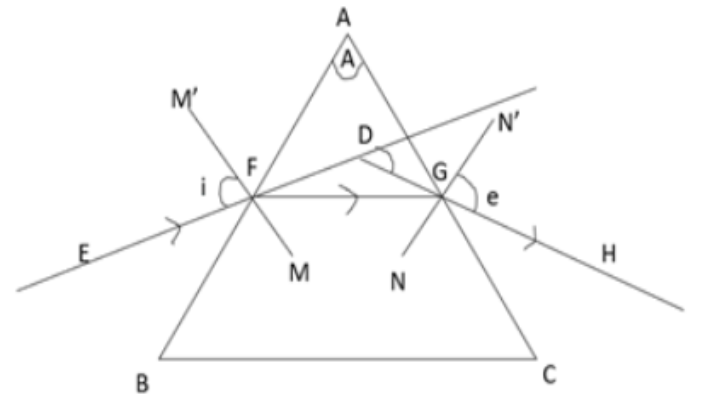
In the diagram,
EF $\to$ Incident beam
i $\to$ angle of incidence
GH $\to$ Emergent beam
e $\to$ angle of emergence
D $\to$ angle of deviation
A $\to$ angle of prism
The ray of light is EF which touches the prism or the incident beam and GH is the emergent beam. So that means the ray hits the prism at F and emerges from G. D is the angle of deviation as shown in the figure.
Additional Information:
Glass prism is a transparent object made of glass. It has two triangular ends and three rectangular faces.
Opposite faces of rectangular prisms are not parallel. They are inclined at some angle.
We have two laws of refraction,
The incident light, normal and refracted ray lies on the same plane.
Snell’ law which states that ratio of sine of incident angle to the sine of angle of refraction is a constant. That constant is called the refractive index. $\dfrac{{\sin i}}{{\sin r}} = \mu $
Amount of change in speed of light in a medium depends on the property of the medium called refractive index. Refractive index is a measure of how much the speed of light changes when it enters a denser medium from air.
Absolute refractive index is defined as the ratio of speed of light in vacuum/air to the speed of light in the medium.
Note: In the branch of optics the Snell’s law has a wide range of applications. The principle behind the manufacture of the optical apparatus is the Snell’s law.
Different colors of light have different wavelengths; hence they have different angles of refraction as a result different angles of deviation.
Complete step-by-step answer:
Below is the ray diagram showing angle of deviation when a ray of light passes through a glass prism.
In the diagram,
EF $\to$ Incident beam
i $\to$ angle of incidence
GH $\to$ Emergent beam
e $\to$ angle of emergence
D $\to$ angle of deviation
A $\to$ angle of prism
The ray of light is EF which touches the prism or the incident beam and GH is the emergent beam. So that means the ray hits the prism at F and emerges from G. D is the angle of deviation as shown in the figure.
Additional Information:
Glass prism is a transparent object made of glass. It has two triangular ends and three rectangular faces.
Opposite faces of rectangular prisms are not parallel. They are inclined at some angle.
We have two laws of refraction,
The incident light, normal and refracted ray lies on the same plane.
Snell’ law which states that ratio of sine of incident angle to the sine of angle of refraction is a constant. That constant is called the refractive index. $\dfrac{{\sin i}}{{\sin r}} = \mu $
Amount of change in speed of light in a medium depends on the property of the medium called refractive index. Refractive index is a measure of how much the speed of light changes when it enters a denser medium from air.
Absolute refractive index is defined as the ratio of speed of light in vacuum/air to the speed of light in the medium.
Note: In the branch of optics the Snell’s law has a wide range of applications. The principle behind the manufacture of the optical apparatus is the Snell’s law.
Different colors of light have different wavelengths; hence they have different angles of refraction as a result different angles of deviation.
Recently Updated Pages
Master Class 12 Economics: Engaging Questions & Answers for Success

Master Class 12 English: Engaging Questions & Answers for Success
Master Class 12 Social Science: Engaging Questions & Answers for Success
Master Class 12 Maths: Engaging Questions & Answers for Success
Master Class 12 Physics: Engaging Questions & Answers for Success
Master Class 9 General Knowledge: Engaging Questions & Answers for Success
Trending doubts
Explain the Treaty of Vienna of 1815 class 10 social science CBSE
Why is it 530 pm in india when it is 1200 afternoon class 10 social science CBSE
What is the full form of POSCO class 10 social science CBSE
Define Potential, Developed, Stock and Reserved resources
Which Country Has the Largest Border with India?
Complete the sentence with the most appropriate word class 10 english CBSE