




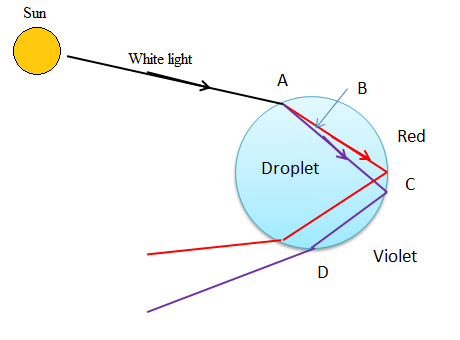
Draw a ray diagram to show the formation of a rainbow and mark the points where dispersion and internal reflection occurs.
Answer
 Verified
617.7k+ views
Hint: Examine the factors for the formation of rainbow. Recall the concept of refraction of light, total internal reflection of light and dispersion. All of these characteristics of light cause the formation of a rainbow.
Complete step by step answer:
We know that when sunlight passes through a glass prism or water droplet, it gets refracted and then disperses in seven different colors. We call it rainbow. We know that light of different wavelengths has different velocities. The bending of light at the boundary of another medium varies with wavelength of light. Since each color has different wavelengths, when the sunlight enters the water medium it splits into seven different colors. This is known as dispersion of light.
We see when the sunlight enters the boundary between air and water droplet, it gets refracted due to change in medium. We have shown it in the following figure by point A. Since the light deviates differently for each different wavelengths present in the white light, the dispersion occurs which splits the white light into seven different colors. We have shown it in the following figure by point B. We know that red light has maximum wavelength. Therefore, the red light undergoes minimum deviation while violet light undergoes maximum deviation. Now we can observe the split colors now reflected at the inner boundary between water and air cause it to suffer total internal reflection (point C). These colors now refract at the boundary between water and air before coming out of the droplet (point D).
We observe in the rainbow that violet color is at the top and violet color at the bottom. This is primarily due to different wavelengths of red and violet color. All other colors of rainbow lie between the band of red and violet color.
Note:
There is also the second type of rainbow formation that is secondary rainbow. Secondary rainbow forms when the sunlight enters the droplet from the lower surface of the droplet. Primary rainbows that we discussed in the above solution occur at lower altitudes than the secondary rainbows.
Complete step by step answer:
We know that when sunlight passes through a glass prism or water droplet, it gets refracted and then disperses in seven different colors. We call it rainbow. We know that light of different wavelengths has different velocities. The bending of light at the boundary of another medium varies with wavelength of light. Since each color has different wavelengths, when the sunlight enters the water medium it splits into seven different colors. This is known as dispersion of light.
We see when the sunlight enters the boundary between air and water droplet, it gets refracted due to change in medium. We have shown it in the following figure by point A. Since the light deviates differently for each different wavelengths present in the white light, the dispersion occurs which splits the white light into seven different colors. We have shown it in the following figure by point B. We know that red light has maximum wavelength. Therefore, the red light undergoes minimum deviation while violet light undergoes maximum deviation. Now we can observe the split colors now reflected at the inner boundary between water and air cause it to suffer total internal reflection (point C). These colors now refract at the boundary between water and air before coming out of the droplet (point D).
We observe in the rainbow that violet color is at the top and violet color at the bottom. This is primarily due to different wavelengths of red and violet color. All other colors of rainbow lie between the band of red and violet color.
Note:
There is also the second type of rainbow formation that is secondary rainbow. Secondary rainbow forms when the sunlight enters the droplet from the lower surface of the droplet. Primary rainbows that we discussed in the above solution occur at lower altitudes than the secondary rainbows.
Recently Updated Pages
Master Class 12 Business Studies: Engaging Questions & Answers for Success

Master Class 12 Chemistry: Engaging Questions & Answers for Success
Master Class 12 Biology: Engaging Questions & Answers for Success
Class 12 Question and Answer - Your Ultimate Solutions Guide
Master Class 11 English: Engaging Questions & Answers for Success
Master Class 11 Social Science: Engaging Questions & Answers for Success
Trending doubts
Which are the Top 10 Largest Countries of the World?
Draw a labelled sketch of the human eye class 12 physics CBSE
The end of compass needle which points towards north class 12 physics CBSE
Differentiate between homogeneous and heterogeneous class 12 chemistry CBSE
Why is the cell called the structural and functional class 12 biology CBSE
When was the first election held in India a 194748 class 12 sst CBSE