




Draw a plot showing the variation of photoelectric current with collector plate potential for two different frequencies, \[{\nu _1} > {\nu _2}\] , of incident radiation having the same intensity. In which case will the stopping potential be higher ? Justify your answer.
Answer
 Verified
560.4k+ views
Hint: Photocurrent is defined as the electric current that flows through a photosensitive device when it is exposed to sunlight or other radiation sources. Collector plate potential is said to be the potential difference between emitter and collector. Using Einstein’s photoelectric effect equation, draw a suitable graph.
Complete answer:
Photoelectric effect occurs due to the emission of electrons when a radiant source hits a material. It was first observed by Heinrich hertz in the year 1887, whose concept failed to explain the wave theory. Einstein resolved this by using Planck’s concept to treat light as a particle and light propagation as a wave.
Now, the energy of the proton that hits the metal surface can be calculated as the sum of energy that is required to eject an electron and the kinetic energy at which the electron starts to move. According to plank, the energy required to eject an electron can be given as \[E = h\nu \],where h is the Planck’s constant.
Now , stopping potential is given as
\[ \Rightarrow eV = h\nu - h{\nu _0}\]
Where \[{\nu _0}\] is threshold frequency. Hence the collector potential will be high for higher frequency value, but however will have same saturation current value, which purely depends on the material used. Now we can use the above equation to draw the graph.
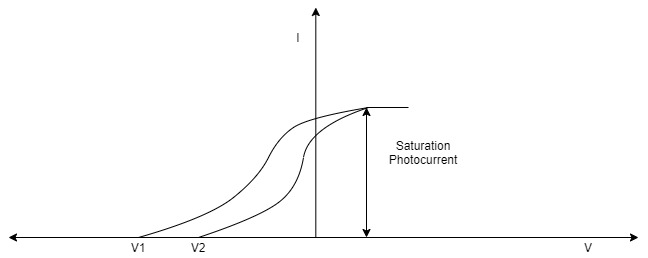
Thus, the required graph is drawn for variation of photoelectric current and collector potential for a photoelectric device. From the graph , we can see that the stopping potential of the highest frequency is higher than the lesser frequency one. Thus \[{\nu _1}\]has greater stopping potential.
Note:
Einstein explained the light as a particle, using the quantum theory of particles. This helped him to generate the required equation to find the kinetic energy of the light wave. He theorized that the energy used to split the electron will be the same as the energy of the photon.
Complete answer:
Photoelectric effect occurs due to the emission of electrons when a radiant source hits a material. It was first observed by Heinrich hertz in the year 1887, whose concept failed to explain the wave theory. Einstein resolved this by using Planck’s concept to treat light as a particle and light propagation as a wave.
Now, the energy of the proton that hits the metal surface can be calculated as the sum of energy that is required to eject an electron and the kinetic energy at which the electron starts to move. According to plank, the energy required to eject an electron can be given as \[E = h\nu \],where h is the Planck’s constant.
Now , stopping potential is given as
\[ \Rightarrow eV = h\nu - h{\nu _0}\]
Where \[{\nu _0}\] is threshold frequency. Hence the collector potential will be high for higher frequency value, but however will have same saturation current value, which purely depends on the material used. Now we can use the above equation to draw the graph.
Thus, the required graph is drawn for variation of photoelectric current and collector potential for a photoelectric device. From the graph , we can see that the stopping potential of the highest frequency is higher than the lesser frequency one. Thus \[{\nu _1}\]has greater stopping potential.
Note:
Einstein explained the light as a particle, using the quantum theory of particles. This helped him to generate the required equation to find the kinetic energy of the light wave. He theorized that the energy used to split the electron will be the same as the energy of the photon.
Recently Updated Pages
Master Class 12 Social Science: Engaging Questions & Answers for Success

Master Class 12 Physics: Engaging Questions & Answers for Success
Master Class 12 Maths: Engaging Questions & Answers for Success
Master Class 12 Economics: Engaging Questions & Answers for Success
Master Class 12 Chemistry: Engaging Questions & Answers for Success
Master Class 12 Business Studies: Engaging Questions & Answers for Success
Trending doubts
Which are the Top 10 Largest Countries of the World?
Draw a labelled sketch of the human eye class 12 physics CBSE
Explain the structure of megasporangium class 12 biology CBSE
What are the major means of transport Explain each class 12 social science CBSE
How many chromosomes are found in human ovum a 46 b class 12 biology CBSE
The diagram of the section of a maize grain is given class 12 biology CBSE