




Draw a neat labelled diagram of the sectional view of the human female reproductive system.
Answer
 Verified
570.6k+ views
Hint: Reproduction is the mechanism by which more organisms like themselves are produced by organisms. But, unlike other body systems, while the reproductive system is important for keeping a species alive, it is not essential for keeping an individual alive. For reproduction, both the male reproductive system and the female reproductive system are required.
Complete answer:
The exterior section of the female reproductive organs, which means covering, is called the vulva. The vulva, situated between the thighs, covers the opening of the vagina and other sexual organs within the body.
The vagina, uterus, fallopian tubes, and ovaries are the internal reproductive organs of a female.A muscular hollow tube that runs from the genital opening to the uterus is the vagina.
The vagina will expand and contract because it has muscular walls.
Three functions serve the vagina:
1)It's where the penis during sexual intercourse is inserted.
2)It is the direction (the canal of birth) by which a child leaves the body of a mother during childbirth.
3)It is the path by which, during cycles, menstrual blood leaves the body.
The vagina connects with the cervix (meaning neck) to the uterus, or womb. The uterus is shaped like an upside-down pear, with a dense lining and muscular walls. The uterus also includes some of the female body's strongest muscles. To accommodate a growing fetus, these muscles may expand and contract and then help push the baby out during labor.
The uterus is just about 3 inches (7.5 centimeters) long and 2 inches (5 centimeters) wide when a woman isn't pregnant.
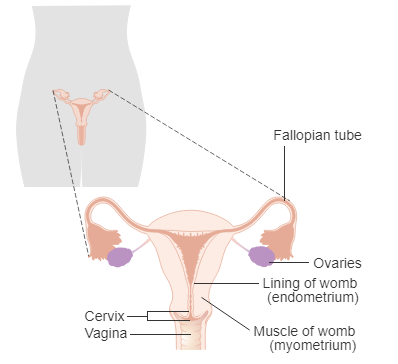
FEMALE REPRODUCTIVE SYSTEM
The Fallopian tubes connect the uterus to the upper uterine corners of the ovaries.. Two oval-shaped organs are the ovaries, which sit on the upper right and left of the uterus. In a process called ovulation, they produce, store and release eggs into the fallopian tubes.
The reproductive system of the female allows a woman to:
1)Develop eggs (ova)
2)Having sexual intercourse
3)A fertilized egg is preserved and nurtured until it is fully grown.
4)Giving birth
Girls begin to release eggs near the end of puberty as part of a monthly phase called the menstrual cycle. Around once a month, an ovary sends a tiny egg into one of the fallopian tubes during ovulation.
The egg leaves the body about 2 weeks later via the uterus, which is menstruation, unless the egg is fertilized by a sperm while in the fallopian tube. In most females, blood and tissue from the inner lining of the uterus combine to form a menstrual flow that lasts between 3 and 5 days.The first cycle of a girl is named menarche.
Note: It can take up to 2 years for the body of a girl to develop a normal menstrual cycle from menarche. Her body is responding to the hormones puberty brings during that period. On average, an adult woman's monthly period is 28 days, but the range is 23 to 35 days.
Complete answer:
The exterior section of the female reproductive organs, which means covering, is called the vulva. The vulva, situated between the thighs, covers the opening of the vagina and other sexual organs within the body.
The vagina, uterus, fallopian tubes, and ovaries are the internal reproductive organs of a female.A muscular hollow tube that runs from the genital opening to the uterus is the vagina.
The vagina will expand and contract because it has muscular walls.
Three functions serve the vagina:
1)It's where the penis during sexual intercourse is inserted.
2)It is the direction (the canal of birth) by which a child leaves the body of a mother during childbirth.
3)It is the path by which, during cycles, menstrual blood leaves the body.
The vagina connects with the cervix (meaning neck) to the uterus, or womb. The uterus is shaped like an upside-down pear, with a dense lining and muscular walls. The uterus also includes some of the female body's strongest muscles. To accommodate a growing fetus, these muscles may expand and contract and then help push the baby out during labor.
The uterus is just about 3 inches (7.5 centimeters) long and 2 inches (5 centimeters) wide when a woman isn't pregnant.
FEMALE REPRODUCTIVE SYSTEM
The Fallopian tubes connect the uterus to the upper uterine corners of the ovaries.. Two oval-shaped organs are the ovaries, which sit on the upper right and left of the uterus. In a process called ovulation, they produce, store and release eggs into the fallopian tubes.
The reproductive system of the female allows a woman to:
1)Develop eggs (ova)
2)Having sexual intercourse
3)A fertilized egg is preserved and nurtured until it is fully grown.
4)Giving birth
Girls begin to release eggs near the end of puberty as part of a monthly phase called the menstrual cycle. Around once a month, an ovary sends a tiny egg into one of the fallopian tubes during ovulation.
The egg leaves the body about 2 weeks later via the uterus, which is menstruation, unless the egg is fertilized by a sperm while in the fallopian tube. In most females, blood and tissue from the inner lining of the uterus combine to form a menstrual flow that lasts between 3 and 5 days.The first cycle of a girl is named menarche.
Note: It can take up to 2 years for the body of a girl to develop a normal menstrual cycle from menarche. Her body is responding to the hormones puberty brings during that period. On average, an adult woman's monthly period is 28 days, but the range is 23 to 35 days.
Recently Updated Pages
Master Class 12 Business Studies: Engaging Questions & Answers for Success

Master Class 12 Biology: Engaging Questions & Answers for Success
Master Class 12 Chemistry: Engaging Questions & Answers for Success
Class 12 Question and Answer - Your Ultimate Solutions Guide
Master Class 11 Social Science: Engaging Questions & Answers for Success
Master Class 11 English: Engaging Questions & Answers for Success
Trending doubts
Which is more stable and why class 12 chemistry CBSE
Which are the Top 10 Largest Countries of the World?
Draw a labelled sketch of the human eye class 12 physics CBSE
Differentiate between homogeneous and heterogeneous class 12 chemistry CBSE
What are the major means of transport Explain each class 12 social science CBSE
Sulphuric acid is known as the king of acids State class 12 chemistry CBSE