




Draw a neat labelled diagram of L.S. of tooth.
Answer
 Verified
630.9k+ views
Hint: A tooth is a calcified, hard and tough structure that is present in the mouth or jaws of many vertebrate animals. It is primarily used for eating and breaking down food into smaller compositions by chewing, crushing, tearing or grinding.
Complete answer:
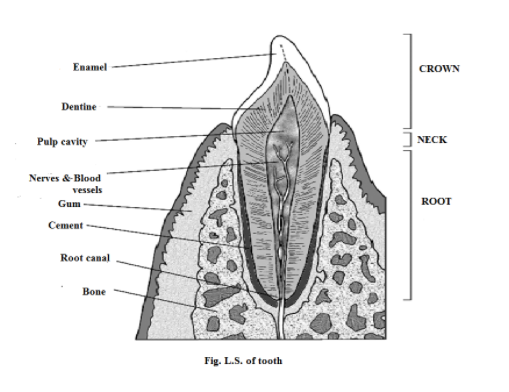
Additional information: A tooth consists of a hard, upper portion and is known as the enamel. The portion of the tooth that is exposed in the oral cavity is the crown, while the portion that remains embedded inside is known as the root. The structure of the teeth can be divided into different parts such as enamel, dentine, pulp cavity and the cement.
The dentine tissues are situated inside the enamel and are softer than the enamel. It extends from the root to the enamel of the tooth. The pulp cavity is the centre portion of the teeth and it receives the blood vessels and nerves. It supplies nutrients to the dentine. Near the root, there is a canal from which the blood vessels and nerves enter the tooth and it is known as the root canal. The tooth is planted onto the bone which is also known as the alveolar bones. The alveolar bone is covered by a soft tissue that is known as the gum. The tooth is supported by the tissue or gum, alveolar bone and ligaments.
Note: The L.S. of the tooth shows three important parts that are crown, neck and root. The crown contains a hard structure, called enamel. Below the enamel, lies the dentine and the pulp cavity is the innermost part of the tooth. The pulp cavity is soft and it has the blood vessels and nerves.
Complete answer:
Additional information: A tooth consists of a hard, upper portion and is known as the enamel. The portion of the tooth that is exposed in the oral cavity is the crown, while the portion that remains embedded inside is known as the root. The structure of the teeth can be divided into different parts such as enamel, dentine, pulp cavity and the cement.
The dentine tissues are situated inside the enamel and are softer than the enamel. It extends from the root to the enamel of the tooth. The pulp cavity is the centre portion of the teeth and it receives the blood vessels and nerves. It supplies nutrients to the dentine. Near the root, there is a canal from which the blood vessels and nerves enter the tooth and it is known as the root canal. The tooth is planted onto the bone which is also known as the alveolar bones. The alveolar bone is covered by a soft tissue that is known as the gum. The tooth is supported by the tissue or gum, alveolar bone and ligaments.
Note: The L.S. of the tooth shows three important parts that are crown, neck and root. The crown contains a hard structure, called enamel. Below the enamel, lies the dentine and the pulp cavity is the innermost part of the tooth. The pulp cavity is soft and it has the blood vessels and nerves.
Recently Updated Pages
Master Class 11 English: Engaging Questions & Answers for Success

Master Class 11 Social Science: Engaging Questions & Answers for Success
Master Class 11 Maths: Engaging Questions & Answers for Success
Master Class 11 Chemistry: Engaging Questions & Answers for Success
Master Class 11 Biology: Engaging Questions & Answers for Success
Master Class 11 Physics: Engaging Questions & Answers for Success
Trending doubts
One Metric ton is equal to kg A 10000 B 1000 C 100 class 11 physics CBSE
Difference Between Prokaryotic Cells and Eukaryotic Cells
Find the value of the expression given below sin 30circ class 11 maths CBSE
1 ton equals to A 100 kg B 1000 kg C 10 kg D 10000 class 11 physics CBSE
Two of the body parts which do not appear in MRI are class 11 biology CBSE
Draw a diagram of nephron and explain its structur class 11 biology CBSE