




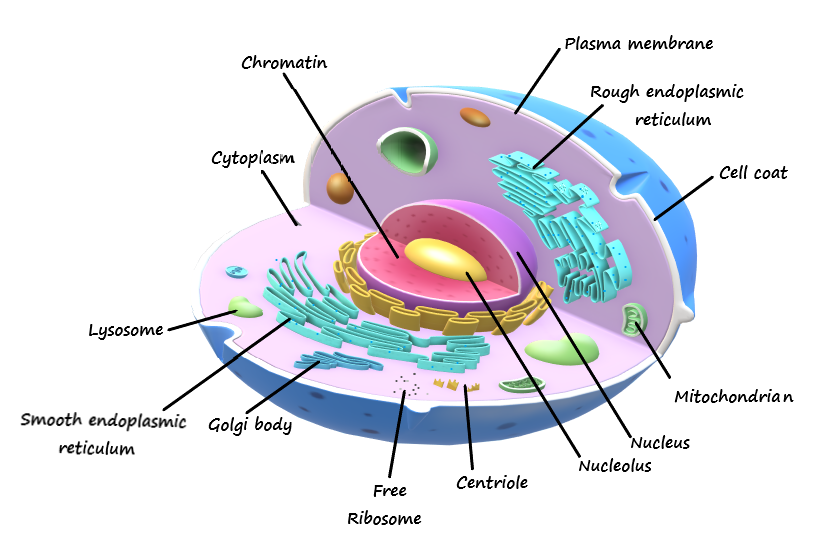
Draw a neat labeled diagram of an animal cell.
Answer
 Verified
633.6k+ views
Hint: Animal cells are eukaryotic cells that are protected by a cell membrane and include a membrane-bound nucleus and organelles. But unlike eukaryotic cells of plants and fungus, the cells of animals don't even have a cell wall. Such a characteristic was already lost in ancient history by single-celled entities which have greatly contributed to the Kingdom Animalia.
Complete answer: The animal kingdom is remarkable amongst eukaryotic species since most animal tissues are fused together in a plasma membrane by a triple protein helix recognized as collagen. Plant and fungal cells are attached together by other substances, such as pectin, in tissue or clusters. The reality no other species employ collagen in this way is one confirmation that almost all animals originated from a single unicellular descendant. Bones, shells, spicules, and other rugged frameworks are shaped whenever the outer layer incorporating collagen between animal cells is calcified. Almost all animal cells are diploid that means that the chromosomes remain in homologous pairs. The distribution of animal cells emerges in a number of ways. Mostly in the case of sexual reproduction, the cell phase of meiotic division is first employed to produce haploid daughter cells or gametes. Two haploid cells merge to produce a diploid zygote, which turns into a new offspring as its cells are dividing and multiplying.
Additional Information:
Animal cells do possess structures such as centrioles, lysosomes, cilia, and flagella which were not usually found in plant cells. The centromeres are microtubule-organizing cores situated near the nucleus of animal cells. In accordance with their function as just a gastrointestinal component and organ-recycling Centre for animal tissue, lysosomes are regarded to be part of the endomembrane system.
Note: Animal cells exist in all forms and sizes, with dimensions varying from a few mm to m. Animals are smaller and simpler than plant cells and therefore are usually irregular in shape, taking various forms due to its lack of a cell wall. Acting together all cells allows the animal its flexibility to shift, replicate, adapt to stimuli, consume, and absorb food. Generally, the concerted effort of all animal cells might be what promotes the daily functioning of the body.
Complete answer: The animal kingdom is remarkable amongst eukaryotic species since most animal tissues are fused together in a plasma membrane by a triple protein helix recognized as collagen. Plant and fungal cells are attached together by other substances, such as pectin, in tissue or clusters. The reality no other species employ collagen in this way is one confirmation that almost all animals originated from a single unicellular descendant. Bones, shells, spicules, and other rugged frameworks are shaped whenever the outer layer incorporating collagen between animal cells is calcified. Almost all animal cells are diploid that means that the chromosomes remain in homologous pairs. The distribution of animal cells emerges in a number of ways. Mostly in the case of sexual reproduction, the cell phase of meiotic division is first employed to produce haploid daughter cells or gametes. Two haploid cells merge to produce a diploid zygote, which turns into a new offspring as its cells are dividing and multiplying.
Additional Information:
Animal cells do possess structures such as centrioles, lysosomes, cilia, and flagella which were not usually found in plant cells. The centromeres are microtubule-organizing cores situated near the nucleus of animal cells. In accordance with their function as just a gastrointestinal component and organ-recycling Centre for animal tissue, lysosomes are regarded to be part of the endomembrane system.
Note: Animal cells exist in all forms and sizes, with dimensions varying from a few mm to m. Animals are smaller and simpler than plant cells and therefore are usually irregular in shape, taking various forms due to its lack of a cell wall. Acting together all cells allows the animal its flexibility to shift, replicate, adapt to stimuli, consume, and absorb food. Generally, the concerted effort of all animal cells might be what promotes the daily functioning of the body.
Recently Updated Pages
Which will be the least stable resonating structure class 11 chemistry CBSE

How many 5 digit telephone numbers can be construc-class-11-maths-CBSE
How do you find the angle of the resultant vector class 11 physics CBSE
Draw labelled diagram of the following i Gram seed class 11 biology CBSE
What is the need and importance of classification class 11 biology CBSE
The way in which the sparrows expressed their sorrow class 11 english CBSE
Trending doubts
One Metric ton is equal to kg A 10000 B 1000 C 100 class 11 physics CBSE
Find the value of the expression given below sin 30circ class 11 maths CBSE
1 Quintal is equal to a 110 kg b 10 kg c 100kg d 1000 class 11 physics CBSE
Draw a diagram of nephron and explain its structur class 11 biology CBSE
10 examples of friction in our daily life
Proton was discovered by A Thomson B Rutherford C Chadwick class 11 chemistry CBSE