




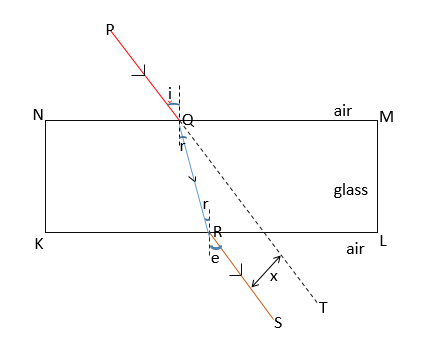
Draw a labelled diagram to show the refraction of light when light travels from air into glass and then comes out to reach air?
Answer
 Verified
626.4k+ views
Hint: Light bends towards the normal when it travels from a rarer medium to a denser medium and away from the normal when it travels from denser to rarer medium.
Complete step by step answer:
Consider an incident ray PQ be incident from air obliquely on a glass surface MN of a glass black KLMN. The angle at which the ray PR is incident on the surface MN is called the angle of incidence as is denoted by ‘i’. As the speed of light changes when the medium changes, the refracted light QR bends toward the normal inside the glass, because the density of glass is more than the density of air. The angle that the refracted ray makes with the normal is the refracted ray is called the angle of refraction and is denoted by ‘r’. The refracted ray QR is incident on the glass surface KL. However, this time the light ray passes from glass to air so it bends away from the normal on refraction. The angle of emergence is the angle the emergent ray makes with the normal at the surface KL, and is denoted by ‘e’. The angle of emergence is equal to the angle of incidence. The emergent ray RS is parallel to the direction of the incident ray. The distance between the emergent ray RS and the direction of incident ray (QT) is called the lateral displacement.
Note:
The light ray on passing from a rarer (air) to denser (glass) medium bends towards the normal, as the speed of light reduces in the denser medium. On passing from denser (glass0 to rarer (air) medium, the light ray bends away from the normal, as the speed of light increases in the rarer medium.
Complete step by step answer:
Consider an incident ray PQ be incident from air obliquely on a glass surface MN of a glass black KLMN. The angle at which the ray PR is incident on the surface MN is called the angle of incidence as is denoted by ‘i’. As the speed of light changes when the medium changes, the refracted light QR bends toward the normal inside the glass, because the density of glass is more than the density of air. The angle that the refracted ray makes with the normal is the refracted ray is called the angle of refraction and is denoted by ‘r’. The refracted ray QR is incident on the glass surface KL. However, this time the light ray passes from glass to air so it bends away from the normal on refraction. The angle of emergence is the angle the emergent ray makes with the normal at the surface KL, and is denoted by ‘e’. The angle of emergence is equal to the angle of incidence. The emergent ray RS is parallel to the direction of the incident ray. The distance between the emergent ray RS and the direction of incident ray (QT) is called the lateral displacement.
Note:
The light ray on passing from a rarer (air) to denser (glass) medium bends towards the normal, as the speed of light reduces in the denser medium. On passing from denser (glass0 to rarer (air) medium, the light ray bends away from the normal, as the speed of light increases in the rarer medium.
Recently Updated Pages
Master Class 12 Business Studies: Engaging Questions & Answers for Success

Master Class 12 Chemistry: Engaging Questions & Answers for Success
Master Class 12 Biology: Engaging Questions & Answers for Success
Class 12 Question and Answer - Your Ultimate Solutions Guide
Master Class 11 English: Engaging Questions & Answers for Success
Master Class 11 Social Science: Engaging Questions & Answers for Success
Trending doubts
Which are the Top 10 Largest Countries of the World?
Draw a labelled sketch of the human eye class 12 physics CBSE
Differentiate between homogeneous and heterogeneous class 12 chemistry CBSE
Differentiate between Pyramid of energy and pyramid class 12 biology CBSE
Why is the cell called the structural and functional class 12 biology CBSE
Draw the diagram of the pyramid of energy Explain In class 12 biology CBSE