




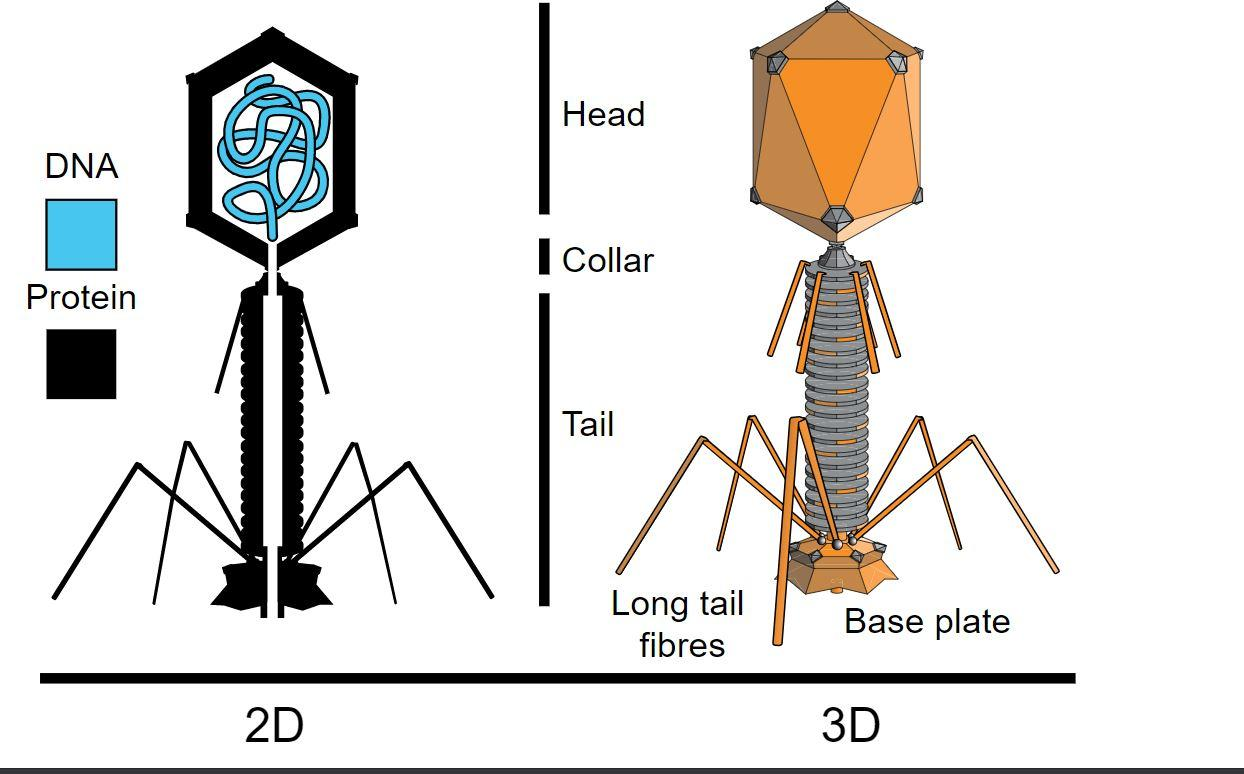
Draw a labeled diagram of bacteriophage.
Answer
 Verified
612k+ views
Hint: Viruses are microscopic parasites and contagious agents with living and nonliving characteristics. These viruses can infect plants, animals, and other microorganisms.
Complete answer:
Viruses are non-cellular, microscopic, and infectious agents that live by depending upon the host cell. They contain genetic material as RNA or DNA and proteins; they invade and reproduce by using organisms, plants, and animal cellular organelles as they lack the required cellular material.
Certain viruses that infect bacteria are known as Bacteriophage or phage i.e. bacteria eater. Bacteriophages are the viruses that parasitize them and reproduce inside them. Some of their characteristics are:
a) These Bacteriophages like other viruses also consist of a core of genetic material that is surrounded by a capsid.
b) Genetic material of bacteriophage can either be DNA or RNA according to their general composition.
c) After infecting bacterial host cells they hijack the cellular control of the host cell and stop them from producing bacterial components and force them to produce viral components.
d) They generally bring about the lysis of bacterial host cells.
Structural composition of Bacteriophage:
Typical bacteriophage composed of a polyhedral head, a short collar, and a helical tail.
The Head is hexagonal and consists of 2000 capsomeres with genetic material double-stranded DNA or single-stranded RNA present in the head.
Collar and whiskers of phage help to attach the six long tail fibers to the phage particle during virus assembly.
The tail is cylindrical and is composed of a central hollow tube which is surrounded by a contractile sheath (protein) with annular rings and the distal end of the tail consists of a basal plate that has tail fibers.
Diagram showing the structure of bacteriophage:
Note:
Bacteriophage replicates inside the bacterial cell with the help of a cycle either a lytic or lysogenic cycle. These Bacteriophages are highly specific for their target bacteria, and also effective against multi-resistant pathogens.
Complete answer:
Viruses are non-cellular, microscopic, and infectious agents that live by depending upon the host cell. They contain genetic material as RNA or DNA and proteins; they invade and reproduce by using organisms, plants, and animal cellular organelles as they lack the required cellular material.
Certain viruses that infect bacteria are known as Bacteriophage or phage i.e. bacteria eater. Bacteriophages are the viruses that parasitize them and reproduce inside them. Some of their characteristics are:
a) These Bacteriophages like other viruses also consist of a core of genetic material that is surrounded by a capsid.
b) Genetic material of bacteriophage can either be DNA or RNA according to their general composition.
c) After infecting bacterial host cells they hijack the cellular control of the host cell and stop them from producing bacterial components and force them to produce viral components.
d) They generally bring about the lysis of bacterial host cells.
Structural composition of Bacteriophage:
Typical bacteriophage composed of a polyhedral head, a short collar, and a helical tail.
The Head is hexagonal and consists of 2000 capsomeres with genetic material double-stranded DNA or single-stranded RNA present in the head.
Collar and whiskers of phage help to attach the six long tail fibers to the phage particle during virus assembly.
The tail is cylindrical and is composed of a central hollow tube which is surrounded by a contractile sheath (protein) with annular rings and the distal end of the tail consists of a basal plate that has tail fibers.
Diagram showing the structure of bacteriophage:
Note:
Bacteriophage replicates inside the bacterial cell with the help of a cycle either a lytic or lysogenic cycle. These Bacteriophages are highly specific for their target bacteria, and also effective against multi-resistant pathogens.
Recently Updated Pages
Match columnI with columnII and choose the correct class 12 biology NEET_UG

Match columnI with columnII and choose the correct class 12 biology NEET_UG
Match columnI with columnII and choose the correct class 12 biology NEET_UG
Which plant will lose its economic value if its fruits class 12 biology NEET_UG
Human insulin is being commercially produced from a class 12 biology NEET_UG
Match columnI with columnII and choose the correct class 12 biology NEET_UG
Trending doubts
Which are the Top 10 Largest Countries of the World?
Draw a labelled sketch of the human eye class 12 physics CBSE
Differentiate between homogeneous and heterogeneous class 12 chemistry CBSE
Draw a well labelled diagram of LS of the human ki class 12 biology CBSE
Modern Homo sapiens arose during the ice age between class 12 biology CBSE
Why is the cell called the structural and functional class 12 biology CBSE